Concussions, TBI, and HRV: How Brain Injuries Disrupt Heart Rate Variability
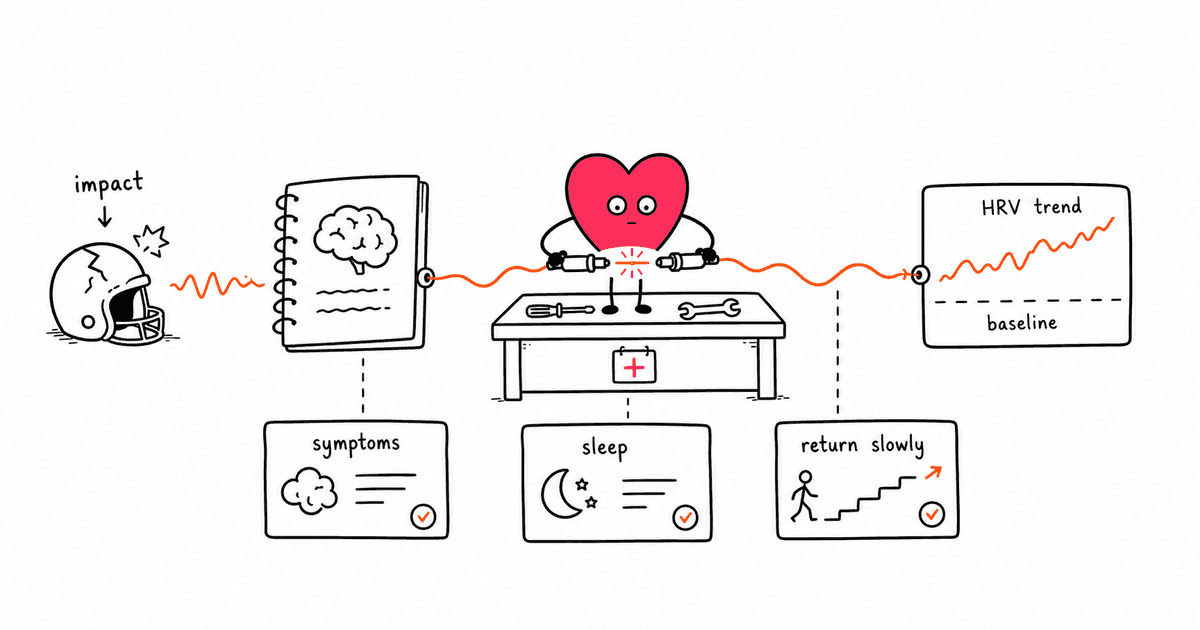
Trying to decode today's HRV number? Use the free interpreter first, then build a practical recovery plan. Interpret your HRV
Every year, an estimated 69 million people worldwide sustain a traumatic brain injury (TBI). In the United States alone, emergency departments treat roughly 2.5 million TBI-related visits annually. While most concussions resolve within weeks, the autonomic disruption they cause can linger far longer than headaches or dizziness suggest. Heart rate variability is emerging as one of the most promising objective tools for tracking that hidden disruption and guiding a safer recovery.
How Do Concussions Affect Heart Rate Variability?
Concussions and traumatic brain injuries significantly reduce HRV by disrupting the autonomic nervous system's ability to regulate cardiovascular function. The impact damages neural pathways connecting the brain to the vagus nerve and sympathetic centers, shifting the body toward sympathetic dominance and reducing the parasympathetic flexibility that drives higher HRV.
A 2024 scoping review published in Brain Injury examined HRV changes across the full spectrum of TBI severity. The findings were consistent: TBI is associated with decreased HRV regardless of whether the injury is classified as mild, moderate, or severe. Both time-domain metrics like RMSSD and SDNN and frequency-domain measures showed significant reductions compared to healthy controls.
The Autonomic Cascade After a Brain Injury
Understanding why concussions lower HRV requires looking at how the brain controls the autonomic nervous system.
The Brain-Heart Connection
Your brainstem, hypothalamus, and prefrontal cortex work together to regulate autonomic balance. The medulla oblongata in the brainstem houses the nucleus tractus solitarius and the dorsal motor nucleus, which directly control vagal output to the heart. When a concussion disrupts these structures or the neural pathways connecting them, the result is a measurable shift in autonomic regulation. Seizure-related HRV changes follow the same broad brain-heart logic, though epilepsy and HRV requires a different kind of clinical caution.
What Happens Immediately After Injury
In the acute phase following a concussion, several cascading events affect autonomic function:
- Neuroinflammation triggers an immune response that activates the sympathetic nervous system, similar to what happens during systemic inflammation
- Disrupted cerebral blood flow autoregulation forces the cardiovascular system to compensate through altered autonomic signaling
- Metabolic crisis in affected brain cells increases energy demands, driving sympathetic activation
- Neurotransmitter imbalance affects the signaling pathways that maintain parasympathetic tone
The net effect is a body stuck in a heightened stress response, even when resting. Your HRV drops because the parasympathetic brake that normally keeps heart rate variable is weakened.
What the Research Shows
Concussions Lower HRV Even in "Mild" Cases
The term "mild TBI" (mTBI) can be misleading. While most concussions are classified as mild, the autonomic effects are anything but minor.
A 2023 meta-analysis published in Frontiers in Neurology found that individuals with a history of concussion showed lowered HRV at rest even after symptom recovery. The study examined 15 studies involving over 900 participants and found significant reductions in high-frequency HRV (a marker of vagal tone) that persisted beyond the point where athletes reported feeling "back to normal."
This finding is critical: feeling better and being physiologically recovered are not the same thing.
HRV Predicts Recovery Timeline
A study published in Scientific Reports (2026) examined nocturnal autonomic activity in athletes after sport-related concussion. Athletes were classified by their return-to-sport timeline: regular recovery (under 28 days) versus prolonged recovery (28 days or more). Using multimodal wearable devices to track nocturnal HRV, researchers found distinct autonomic profiles between the groups, suggesting that nighttime HRV patterns could help predict which athletes will take longer to recover.
Persistent Post-Concussive Symptoms and Autonomic Dysfunction
Approximately 10 to 30 percent of concussion patients develop persistent post-concussive symptoms (PPCS), experiencing problems like headaches, brain fog, fatigue, and exercise intolerance for months or even years. A 2025 study in Experimental Physiology found that adults with PPCS and exercise intolerance showed altered autonomic cardiovascular function compared to matched controls, with reduced parasympathetic indices even at rest.
This pattern mirrors what researchers observe in dysautonomia, and some clinicians now consider post-concussive autonomic dysfunction a form of acquired dysautonomia.
HRV as a Return-to-Play Biomarker
One of the most promising applications of HRV in concussion management is as an objective return-to-play (RTP) tool. Current concussion protocols rely heavily on subjective symptom reporting, which creates two problems: athletes may underreport symptoms to return faster, and some athletes genuinely feel better while their autonomic nervous system remains compromised.
Why Subjective Reporting Falls Short
A case study published in PMC tracked a collegiate soccer player's HRV before and after a diagnosed concussion. The data showed a one-week delay between when the athlete reported being symptom-free and when HRV metrics returned to baseline levels. This gap represents a window of vulnerability where returning to contact sports could increase the risk of re-injury.
How HRV-Guided Protocols Work
HRV-guided return-to-play protocols add an objective physiological layer to standard concussion management:
- Establish a pre-injury baseline by tracking morning HRV consistently during the season
- Monitor HRV daily post-injury to track the trajectory of autonomic recovery
- Compare recovery trends against the individual's baseline rather than population norms
- Correlate HRV recovery with symptom resolution before clearing for progressive return
- Flag incomplete recovery when symptoms resolve but HRV remains suppressed
This approach is similar to how athletes use HRV to prevent overtraining, but with higher stakes since the risk is neurological rather than musculoskeletal.
Wearable Technology for Concussion Monitoring
Consumer wearables have made continuous HRV monitoring accessible for concussion recovery in ways that were previously limited to clinical settings.
What to Track
The most relevant HRV metrics for concussion monitoring include:
| Metric | What It Measures | Why It Matters for TBI |
|---|---|---|
| RMSSD | Beat-to-beat variability (parasympathetic) | Most sensitive to concussion-related vagal suppression |
| SDNN | Overall autonomic variability | Captures both branches of autonomic disruption |
| HF Power | High-frequency vagal activity | Directly reflects parasympathetic recovery |
| LF/HF Ratio | Sympathovagal balance | Elevated ratio indicates sympathetic dominance post-injury |
| Resting Heart Rate | Baseline cardiac demand | Often elevated after concussion, slow to normalize |
Recommended Wearables for Tracking
For concussion recovery monitoring, overnight and continuous HRV tracking devices offer the most useful data:
- Oura Ring 4: Tracks nighttime HRV, resting heart rate, and body temperature. The overnight RMSSD trend is particularly useful for concussion recovery tracking.
- Whoop 5: Provides continuous HRV monitoring with recovery scores. The journal feature lets you tag concussion-related variables to identify recovery patterns.
- Garmin Forerunner 265: Offers HRV Status tracking that compares current values against a rolling baseline, making it easy to spot when values deviate from your norm.
- Apple Watch Series 11: Records overnight HRV and provides trend analysis through the Health app. The Apple Watch HRV guide covers setup and interpretation.
Measurement Tips for Concussion Recovery
- Measure at the same time daily, ideally first thing in the morning before getting out of bed
- Use overnight readings when available, as they reduce the noise from daily activities
- Track trends over weeks, not individual readings. Day-to-day fluctuations are normal even during recovery
- Log symptoms alongside HRV to identify correlations between autonomic data and how you feel
- Do not use a single HRV reading to make return-to-activity decisions. The trend matters more than any snapshot
HRV Biofeedback for TBI Rehabilitation
Beyond monitoring, HRV biofeedback training is showing promise as an active rehabilitation tool for brain injury patients.
The Evidence
A randomized controlled study published in Applied Psychophysiology and Biofeedback (2023) tested HRV biofeedback in patients with mild TBI. Participants who received HRV biofeedback training showed greater improvements in executive function, information processing speed, verbal memory, and psychological symptoms compared to a psychoeducation control group. The biofeedback group also showed improved HRV indices and reduced post-concussion symptom scores.
The mechanism likely involves strengthening the connection between the prefrontal cortex and the brainstem autonomic centers, essentially retraining the top-down regulation of heart rate that concussion disrupts. This aligns with the neurovisceral integration model that links HRV to cognitive performance.
The HERO Study
The Concussion Alliance highlighted the HERO study in 2025, which investigates HRV biofeedback therapy specifically for veterans and service members with TBI. Military populations experience high rates of blast-related concussions, and the study examines whether breathing exercises combined with real-time HRV feedback can improve outcomes in this group.
Vagus Nerve Stimulation After Brain Injury
Non-invasive vagus nerve stimulation (nVNS) is another emerging intervention for post-concussive autonomic dysfunction.
A 2025 observational study from Cherry Creek Neurology evaluated nVNS as an adjunctive treatment for patients with persistent post-concussive symptoms. The study, which collected data from clinical care between 2021 and 2024, found that nVNS was associated with reductions in post-concussive symptoms. By directly stimulating the vagus nerve, nVNS may help restore the parasympathetic activity that concussions suppress.
This approach activates the cholinergic anti-inflammatory pathway, potentially addressing both the autonomic dysfunction and the neuroinflammation that sustain post-concussive symptoms. Research published in Frontiers in Neuroscience (2024) confirmed that non-invasive VNS represents a promising approach for managing inflammatory conditions, including those triggered by brain injury.
Special Populations
Youth and Adolescent Concussions
Children and adolescents are particularly vulnerable to concussion-related autonomic disruption. A 2025 systematic review examined the impact of concussion on the cardiac autonomic nervous system specifically in adolescents, finding evidence of compromised autonomic regulation post-injury.
Young athletes present unique challenges: their autonomic nervous systems are still developing, they may be less reliable at reporting symptoms, and the pressure to return to sport can be intense. HRV monitoring provides an objective safeguard that does not depend on self-reporting accuracy.
Repeated Concussions
Each successive concussion appears to compound the autonomic damage. Research suggests that individuals with a history of multiple concussions show progressively lower baseline HRV values and slower recovery trajectories. This is especially relevant for athletes in contact sports who may accumulate several concussions over a career.
Long-Term Effects
The relationship between TBI and long-term autonomic health is still being studied. Some evidence suggests that severe or repeated brain injuries may permanently alter autonomic function, contributing to increased cardiovascular risk. This echoes research linking chronic autonomic disruption to conditions like heart disease and reduced longevity.
Practical Recovery Strategies
While professional medical guidance is essential after any concussion, several evidence-based strategies can support autonomic recovery.
Sleep Optimization
Quality sleep is when most autonomic recovery occurs. After a concussion, prioritize:
- Consistent bed and wake times to support circadian rhythm recovery
- A dark, quiet sleep environment to minimize sympathetic activation
- Avoiding screens before bed, which can worsen both concussion symptoms and sleep quality
- Monitoring overnight HRV to track recovery progress during sleep
Graduated Exercise
Current evidence supports early, symptom-limited aerobic exercise after concussion rather than strict rest. Monitor your HRV before and after light activity. If your HRV drops significantly below baseline or symptoms worsen, reduce intensity.
Stress Management
Concussions lower your stress tolerance by reducing autonomic flexibility. Stress management techniques that support parasympathetic recovery include:
- Gentle breathing exercises at resonance frequency (approximately 6 breaths per minute)
- Meditation with a focus on body awareness rather than intense concentration
- Nature exposure and low-stimulation environments
- Limiting cognitive demands during the acute recovery phase
Nutrition and Anti-Inflammatory Support
Supporting the brain's healing process through nutrition may help restore autonomic function faster:
- Omega-3 fatty acids have shown neuroprotective properties in TBI research
- Anti-inflammatory foods can help address the neuroinflammation driving autonomic disruption
- Adequate hydration supports cerebral blood flow and autonomic regulation
- Magnesium, which is often depleted after brain injury, supports nervous system recovery
When to Seek Medical Attention
HRV monitoring is a complement to professional concussion management, not a replacement. Seek medical evaluation if:
- HRV remains significantly below your baseline more than four weeks after injury
- Symptoms worsen despite rest and conservative management
- You experience new symptoms like heart palpitations, fainting, or exercise intolerance
- Your resting heart rate remains elevated without another explanation
- You have sustained multiple concussions within a short timeframe
Frequently Asked Questions
How quickly does HRV drop after a concussion?
HRV typically decreases within hours of a concussion. Most studies show measurable reductions in RMSSD and high-frequency HRV within the first 24 to 48 hours. The magnitude of the drop varies by injury severity, with some individuals showing only mild suppression and others experiencing substantial reductions.
How long does it take for HRV to recover after a concussion?
For most mild concussions, HRV begins trending back toward baseline within one to four weeks, though full recovery may lag behind symptom resolution by one to two weeks. For severe TBI or persistent post-concussive symptoms, autonomic recovery can take months. Individual variation is significant, which is why tracking your personal trend matters more than comparing to population norms.
Can HRV predict whether a concussion will lead to prolonged symptoms?
Emerging research suggests yes. Studies show that athletes with lower HRV in the acute phase after concussion and those whose HRV recovers more slowly are more likely to experience prolonged symptoms. A 2026 study found distinct nocturnal autonomic profiles between athletes with regular versus prolonged recovery, supporting HRV as an early prognostic indicator.
Should I stop exercising if my HRV is low after a concussion?
Not necessarily. Current guidelines recommend symptom-limited aerobic exercise as part of concussion recovery rather than strict rest. However, if exercise causes your HRV to drop significantly below your post-injury baseline or triggers symptom worsening, reduce the intensity. Work with a healthcare provider familiar with concussion management to develop an appropriate graduated exercise plan.
Is HRV monitoring useful for mild concussions?
Yes, and arguably more so than for severe cases. Mild concussions are where the gap between subjective symptom resolution and physiological recovery is most dangerous. Feeling "fine" while your autonomic system is still compromised creates risk for premature return to contact sports or high-demand activities.
Need a quick read on your HRV number first?
Enter your HRV value, age range, device, and recovery context for a plain-English interpretation before you decide what to do next.
Interpret Your HRV NumberBuild the 30-day plan