Long COVID and HRV: How Heart Rate Variability Tracks Autonomic Recovery
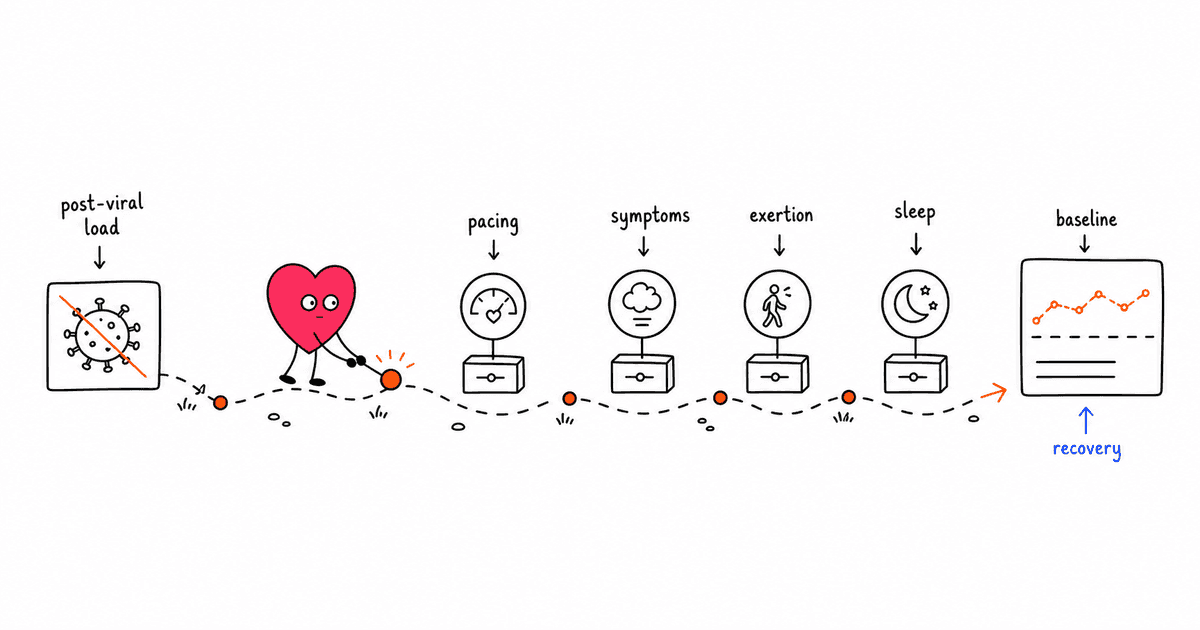
Trying to decode today's HRV number? Use the free interpreter first, then build a practical recovery plan. Interpret your HRV
What Is Long COVID?
Long COVID, also called post-acute sequelae of SARS-CoV-2 (PASC), refers to persistent symptoms lasting four or more weeks after an initial COVID-19 infection. It affects an estimated 10 to 35 percent of infected individuals globally, with symptoms ranging from fatigue and brain fog to cardiovascular dysregulation and exercise intolerance.
One of the most consistent findings in long COVID research is disrupted autonomic nervous system function, and HRV has emerged as a practical, non-invasive way to measure this disruption. Understanding how long COVID affects HRV can help you track recovery, avoid setbacks, and make informed decisions about returning to normal activity.
How Long COVID Disrupts the Autonomic Nervous System
The autonomic nervous system (ANS) controls involuntary functions like heart rate, digestion, and breathing. It operates through two branches: the sympathetic ("fight or flight") and parasympathetic ("rest and digest") systems. Healthy autonomic function requires a dynamic balance between these branches.
Long COVID appears to disrupt this balance through several mechanisms:
- Neurotropism: SARS-CoV-2 can directly damage nerve tissue, including the vagus nerve, which drives parasympathetic activity
- Persistent inflammation: Elevated cytokines and inflammatory markers continue to stress the nervous system long after the acute infection resolves
- Autoimmune dysfunction: Some patients develop autoantibodies that target autonomic receptors, creating ongoing interference with normal regulation
- Microclotting: Microscopic blood clots may impair circulation to nerve tissue, reducing autonomic signaling efficiency
The result is a condition broadly called dysautonomia, where the body struggles to regulate basic functions that healthy people never think about.
What the Research Shows About Long COVID and HRV
Multiple studies have confirmed that long COVID patients show measurable changes in HRV compared to healthy controls.
Lower Resting HRV
A 2025 study published in Scientific Reports found that long COVID reduced HRV both at rest and during deep breathing maneuvers. The researchers concluded that persistent symptoms following COVID-19 implied impairment of cardiac autonomic control. Specifically, time-domain measures like RMSSD and SDNN were both significantly lower in long COVID patients.
Wearable-Detected Changes
Research published in Scientific Reports (2025) analyzing wearable device data found that RMSSD dropped from approximately 65 milliseconds at baseline to around 45 milliseconds during and after COVID infection in affected individuals. These changes persisted for weeks to months, providing an objective biomarker for ongoing autonomic disruption.
Sympathetic Dominance
A comprehensive review in Frontiers in Cardiovascular Medicine documented that long COVID patients show a consistent pattern of sympathovagal imbalance, with suppressed parasympathetic activity and elevated sympathetic tone. This manifests as higher resting heart rates, reduced HRV, and impaired vagal activity.
Post-Exertional HRV Collapse
A 2025 study using wearable HRV monitoring found that long COVID patients experienced pronounced HRV suppression after physical exertion, with delayed recovery compared to controls. This finding is especially important because it provides a measurable threshold for post-exertional malaise (PEM), one of the most debilitating aspects of long COVID. The pattern resembles what athletes experience with overtraining syndrome, though the underlying mechanisms differ.
Common Symptoms Linked to Autonomic Dysfunction
When long COVID disrupts autonomic regulation, the effects ripple across multiple body systems. Many seemingly unrelated symptoms share a common root in autonomic dysfunction:
| Symptom | Autonomic Connection |
|---|---|
| Fatigue | Sympathetic overdrive increases energy expenditure at rest |
| Brain fog | Reduced cerebral blood flow from impaired autonomic regulation |
| Palpitations | Exaggerated sympathetic cardiac responses |
| Exercise intolerance | Blunted heart rate and blood pressure responses during activity |
| Dizziness on standing | Orthostatic intolerance from impaired baroreflexes |
| Sleep disruption | Sympathetic dominance interfering with sleep-stage transitions |
| Digestive issues | Vagal impairment affecting gut motility |
POTS and Long COVID
Postural orthostatic tachycardia syndrome (POTS) has become one of the most recognized autonomic complications of long COVID. POTS involves an excessive heart rate increase (typically 30+ beats per minute) when moving from lying down to standing, often accompanied by dizziness, lightheadedness, and fatigue.
Studies estimate that POTS affects roughly 30 percent of long COVID patients with dysautonomia symptoms. HRV analysis in POTS patients typically shows markedly reduced parasympathetic markers and elevated low-frequency-to-high-frequency (LF/HF) ratios, indicating sympathetic dominance.
If you notice your wearable consistently recording elevated resting heart rates alongside suppressed HRV, especially with positional symptoms, discussing POTS screening with a healthcare provider is worthwhile.
Using HRV to Track Long COVID Recovery
One of the most practical applications of HRV monitoring in long COVID is tracking recovery over time. Unlike subjective symptom questionnaires, HRV provides an objective, daily measurement of autonomic function.
What Recovery Looks Like in the Data
Autonomic recovery from long COVID typically follows a gradual, non-linear pattern:
- Weeks 1 to 4 post-infection: HRV often drops significantly, with RMSSD declining 20 to 40 percent below baseline
- Months 1 to 3: Slow upward trend in HRV if recovery is progressing, though day-to-day variability remains high
- Months 3 to 6: Most people who recover see HRV approach pre-infection levels, though some take longer
- Beyond 6 months: Persistent HRV suppression at this stage may indicate ongoing autonomic dysfunction requiring medical evaluation. Factors like age and pre-existing conditions influence individual recovery timelines
This post-infectious tracking problem is not unique to COVID. Tick-borne infections can also complicate autonomic recovery, which is why HRV during Lyme disease recovery deserves the same trend-based, medically grounded interpretation.
Key Metrics to Watch
When tracking long COVID recovery through HRV, focus on these indicators:
- RMSSD trend: The most sensitive parasympathetic marker. Look for a gradual upward trend over weeks, not daily fluctuations
- Resting heart rate: Should trend downward as autonomic function improves. Persistently elevated RHR (5+ beats above your pre-COVID baseline) suggests ongoing sympathetic overdrive
- HRV during sleep: Nighttime HRV is less influenced by daily stressors and often provides the clearest picture of autonomic recovery. Sleep deprivation can complicate this picture, so maintaining consistent sleep habits is important
- Recovery after exertion: Healthy HRV rebounds within 24 to 48 hours after moderate exercise. Prolonged suppression signals you may be pushing too hard
HRV-Guided Pacing: Avoiding Post-Exertional Malaise
Post-exertional malaise, where symptoms flare dramatically after physical or mental exertion, is one of the most challenging aspects of long COVID. HRV monitoring can help you find your activity threshold and stay within it.
How Pacing Works
The concept is straightforward: use your daily HRV reading to guide activity levels.
- HRV at or above your rolling baseline: You have more autonomic capacity. Light to moderate activity is likely safe
- HRV below your baseline by 10 percent or more: Your nervous system is under strain. Prioritize rest and recovery activities
- HRV significantly suppressed (20+ percent below baseline): A strong signal to minimize all non-essential exertion and focus on parasympathetic-supporting practices
Practical Pacing Protocol
- Establish your baseline: Track morning HRV for at least one week before using it to guide activity
- Check HRV every morning: Take a reading immediately after waking, before getting out of bed
- Match activity to your reading: On good HRV days, gentle walking or light stretching is reasonable. On low days, rest
- Track patterns: Note which activities cause the largest HRV dips the following day
- Expand gradually: As your baseline improves over weeks, slowly increase activity duration and intensity
This approach aligns with recent research showing that wearable HRV monitoring can identify safe activity thresholds in long COVID patients, potentially preventing PEM episodes.
Breathing and Vagal Stimulation for Recovery
Since long COVID predominantly suppresses parasympathetic (vagal) activity, targeted vagal stimulation can support recovery. Breathing exercises are among the most accessible and research-backed approaches.
Resonance Frequency Breathing
Breathing at approximately 6 breaths per minute (5 seconds in, 5 seconds out) maximizes the natural coupling between breathing and heart rate, stimulating the vagus nerve. Research on HRV biofeedback shows this technique can improve parasympathetic tone even in populations with autonomic dysfunction.
For long COVID recovery, start with 5-minute sessions twice daily and gradually extend to 10 to 15 minutes as tolerated.
Additional Vagal Supports
- Cold water face immersion: Triggering the dive reflex by splashing cold water on the face activates the vagus nerve. Start with cool water and progress gradually
- Gargling: Vigorous gargling stimulates vagal branches in the throat
- Gentle humming: Extended exhalation with humming promotes vagal tone and activates parasympathetic pathways. Meditation practices that incorporate humming or chanting may be especially beneficial
- Slow, supported movement: Gentle yoga or tai chi can support autonomic rebalancing without triggering PEM
The Role of Inflammation in HRV Suppression
Inflammation and HRV are tightly connected through what researchers call the cholinergic anti-inflammatory pathway. The vagus nerve normally helps regulate inflammation by signaling immune cells to reduce cytokine production. When the vagus nerve is compromised, as in long COVID, this anti-inflammatory brake weakens.
Research shows that long COVID patients often maintain elevated levels of inflammatory markers like C-reactive protein (CRP), interleukin-6 (IL-6), and tumor necrosis factor-alpha (TNF-alpha) for months. These same markers correlate inversely with HRV: higher inflammation, lower HRV. Anti-inflammatory nutrition, including omega-3 fatty acids, may help support recovery through this pathway.
This creates a potential feedback loop: immune dysfunction drives inflammation, which further suppresses vagal activity, which reduces the body's ability to control inflammation. Breaking this cycle through anti-inflammatory nutrition, stress management, and vagal stimulation may support both HRV recovery and symptom improvement.
Wearable Monitoring: What to Look For
Tracking HRV during long COVID recovery does not require clinical-grade equipment. Consumer wearables can capture meaningful trends when used consistently.
Recommended Monitoring Approach
- Measure at the same time daily: Morning readings before rising are most reliable
- Use the same device: Different wearables calculate HRV differently, so switching devices mid-recovery makes trend analysis unreliable
- Track RMSSD specifically: If your device reports multiple HRV metrics, RMSSD is the most relevant for parasympathetic function
- Look at 7-day and 30-day trends: Individual daily readings are noisy. Rolling averages reveal the true trajectory
Devices like the Oura Ring, Whoop, Apple Watch, and Garmin watches all provide HRV tracking suitable for long COVID recovery monitoring. Ring-based and wrist-based sensors each have advantages: rings tend to have less motion artifact during sleep measurements, while watches offer continuous daytime tracking.
When to Seek Medical Attention
While HRV monitoring is a valuable self-tracking tool, certain patterns warrant professional evaluation:
- No improvement in HRV trends after 3 months: Persistently suppressed HRV may indicate ongoing autonomic damage requiring specialist assessment
- RMSSD consistently below 10 milliseconds: Very low HRV in the context of long COVID may signal significant autonomic compromise
- Heart rate spikes above 120 bpm with minimal activity: Could indicate POTS or other cardiovascular complications
- New or worsening symptoms alongside declining HRV: Progressive deterioration rather than recovery requires medical investigation
A cardiologist or autonomic specialist can perform formal testing, including tilt-table tests and comprehensive HRV analysis, to characterize the specific pattern of autonomic dysfunction and guide targeted treatment.
Long COVID HRV Recovery: What the Timeline Looks Like
Recovery timelines vary significantly depending on severity of initial infection, pre-existing health, and individual factors. However, research and clinical observation suggest some general patterns:
- Mild acute COVID with lingering symptoms: HRV often begins recovering within 4 to 8 weeks. Most people in this group see meaningful improvement by 3 months
- Moderate acute COVID with persistent fatigue: Recovery may take 3 to 6 months, with a more gradual and uneven trajectory. Good days and bad days are normal
- Severe acute COVID or POTS diagnosis: HRV recovery can extend beyond 6 to 12 months. These cases often benefit from structured rehabilitation programs and specialist care
Throughout recovery, patience matters. Pushing to return to pre-COVID activity levels before HRV data supports it frequently leads to setbacks. Trust the trend, not individual readings.
Key Takeaways
- Long COVID disrupts autonomic nervous system balance, consistently lowering HRV through mechanisms including nerve damage, persistent inflammation, and autoimmune dysfunction
- Research confirms that RMSSD and other HRV metrics can serve as objective biomarkers for tracking autonomic recovery after COVID-19
- HRV-guided pacing, where daily activity is matched to morning HRV readings, may help prevent post-exertional malaise episodes
- Parasympathetic-supporting practices like resonance breathing, cold exposure, and gentle movement can aid autonomic recovery. See our complete guide on how to improve HRV for additional strategies
- Consumer wearables provide sufficient accuracy for tracking recovery trends when used consistently over weeks and months. See our best HRV monitors guide for recommendations
- Persistent HRV suppression beyond 3 months warrants evaluation by a healthcare provider specializing in autonomic disorders. For a deeper understanding of autonomic conditions, see our guide on dysautonomia and HRV
Need a quick read on your HRV number first?
Enter your HRV value, age range, device, and recovery context for a plain-English interpretation before you decide what to do next.
Interpret Your HRV NumberBuild the 30-day plan