Martial Arts and HRV: How Combat Training Shapes Your Autonomic Nervous System
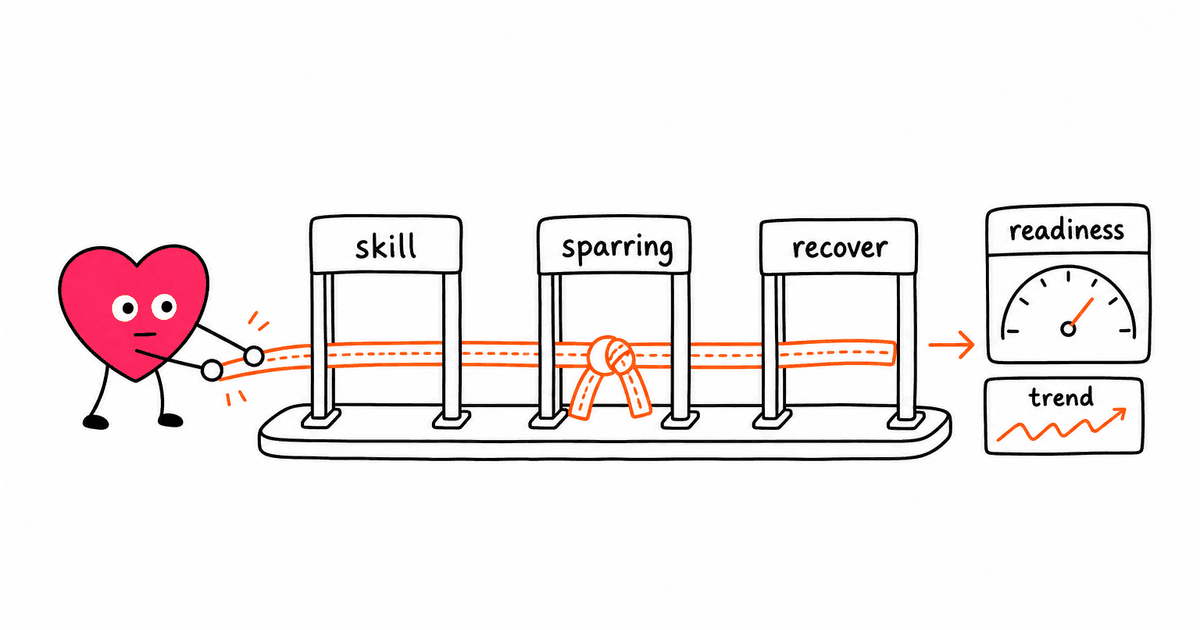
Trying to decode today's HRV number? Use the free interpreter first, then build a practical recovery plan. Interpret your HRV
Few forms of exercise challenge the autonomic nervous system quite like martial arts. A single training session can swing between explosive bursts of power, sustained grappling under physical pressure, precise technical drills, and meditative breathwork, sometimes within the same hour. This constant shifting between sympathetic activation and parasympathetic recovery creates a unique training stimulus that directly influences heart rate variability.
Whether you train Brazilian jiu-jitsu, karate, boxing, Muay Thai, judo, or mixed martial arts, your HRV data reveals how your body is processing the distinctive stressors of combat training. Understanding this relationship helps fighters avoid overtraining, time their peak performance for competition, and recover more effectively between sessions.
What Makes Martial Arts Different From Other Exercise
Martial arts create a distinctive autonomic profile because they simultaneously engage physical, cognitive, and emotional stress systems in ways that most conventional exercise does not. A long run stresses the aerobic system. A heavy squat session stresses the muscular system. A sparring round stresses everything at once.
Research published in Sports (2020) examined HRV patterns in professional mixed martial arts athletes and found that training load, recovery status, and autonomic modulation were tightly linked. Hard training days produced significant HRV suppression the following morning, while rest days allowed measurable parasympathetic rebound. This is consistent with other endurance and power sports, but the magnitude and variability of the swings were notable due to the unpredictable nature of combat training.
Several factors make martial arts uniquely demanding on the autonomic nervous system:
- Unpredictable intensity: Unlike a structured interval workout, sparring requires constant reactive adjustments. Heart rate can spike from resting to near-maximal within seconds when a training partner attacks.
- Cognitive load: Reading an opponent, planning sequences, and reacting to threats activates the prefrontal cortex and triggers stress hormones that affect HRV independently of physical effort.
- Emotional activation: Combat simulation triggers the fight-or-flight response at a deeper level than non-contact exercise. Even experienced fighters experience sympathetic spikes during sparring that go beyond what their physical effort alone would produce.
- Contact stress: Absorbing strikes, resisting submissions, and physical grappling create mechanical stress and pain signals that further activate the sympathetic nervous system.
How Different Martial Arts Affect HRV
Not all combat disciplines create the same autonomic demands. The balance between aerobic endurance, anaerobic power, technical precision, and physical contact varies significantly across styles.
Striking Arts: Boxing, Muay Thai, and Karate
Striking disciplines combine sustained aerobic work (footwork, movement, rhythm) with explosive anaerobic bursts (combinations, kicks, defensive reactions). A study on Muay Thai fighters published in Frontiers in Physiology found that eight weeks of structured training combined with strength work and nutritional guidance produced measurable improvements in cardiac autonomic modulation, with greater parasympathetic activation observed post-intervention.
Bag work and pad sessions tend to follow a more predictable intensity pattern, creating HRV responses similar to HIIT training. Sparring, however, introduces the cognitive and emotional stressors that amplify autonomic disruption beyond what the physical effort alone would predict.
Karate practitioners who focus on kata (pre-arranged forms) experience a different autonomic profile. A 2023 study published in Frontiers in Pediatrics found that karate training in children produced favorable shifts in HRV, with increased parasympathetic markers compared to sedentary controls. The researchers attributed this partly to the rhythmic breathing patterns integrated into traditional kata practice, which stimulate the vagus nerve in ways similar to dedicated breathing exercises.
Grappling Arts: BJJ, Judo, and Wrestling
Grappling creates sustained isometric tension that significantly elevates blood pressure and heart rate while restricting normal breathing patterns. A study on Brazilian jiu-jitsu practitioners examined vagal reactivation after exercise and found that experienced grapplers demonstrated efficient parasympathetic recovery, suggesting that regular grappling training develops autonomic resilience over time.
The unique HRV challenge in grappling is the breathing restriction. Being pinned under an opponent's weight or defending a choke compresses the thorax and disrupts the normal respiratory patterns that support vagal tone. This creates acute sympathetic spikes that can persist even during rest periods between rounds. Experienced grapplers learn to maintain controlled breathing under pressure, which is essentially a form of HRV biofeedback training applied in real time.
Judo adds explosive throwing movements to the grappling equation, creating a hybrid stress profile that combines the anaerobic demands of striking with the sustained tension of groundwork. Competition judo matches, with their five-minute duration and constant grip fighting, produce some of the highest sustained heart rates in combat sports. For another grip-dominant example outside combat, rock climbing and HRV shows how sustained tension, problem-solving, and recovery interact.
Mixed Martial Arts
MMA combines all of the above into a single discipline, making it arguably the most autonomically demanding sport in existence. Research in Sports (2020) tracking 14 professional MMA athletes found that HRV measures, particularly the natural logarithm of RMSSD (lnRMSSD), were sensitive to daily training load changes. Morning HRV readings after hard training days showed significant suppression compared to readings after easy or rest days.
The training structure of MMA fighters, which typically includes separate sessions for striking, grappling, wrestling, and strength and conditioning, creates a cumulative autonomic load that requires careful management. This is where HRV tracking becomes especially valuable, because the variety of training modalities makes it difficult to estimate total stress from session logs alone.
Traditional and Internal Martial Arts
Tai chi and qigong represent the opposite end of the martial arts spectrum in terms of autonomic impact. These practices emphasize slow, controlled movements paired with deep breathing and mental focus. Research has consistently shown that tai chi improves parasympathetic tone and raises baseline HRV, particularly in older adults. While they are covered in detail in our dedicated articles, it is worth noting that many competitive fighters incorporate traditional martial arts elements into their recovery routines specifically to promote parasympathetic rebound.
Using HRV to Guide Martial Arts Training
Combat athletes face a scheduling challenge that most other athletes do not: the need to develop multiple physical qualities (endurance, power, strength, flexibility, technical skill) simultaneously while managing the additional stress of contact training. HRV data provides an objective framework for navigating this complexity.
Morning HRV Monitoring Protocol
The measurement process is the same as for any sport. Take a one-to-two-minute reading each morning, lying down, before getting out of bed, consuming caffeine, or checking your phone. Consistency in timing and position is critical for reliable data. For a complete guide to getting started, see our HRV beginner's guide.
After two weeks of baseline data collection, you can begin using your readings to inform daily training decisions:
- HRV at or above baseline: Green light for high-intensity sparring, hard strength sessions, or fight simulations. Your autonomic system is recovered.
- HRV slightly below baseline: Choose technical drilling, pad work at moderate intensity, or zone 2 conditioning. Your body can handle work but not maximal stress.
- HRV well below baseline: Prioritize recovery activities: light movement, stretching, mobility work, or film study. Pushing through a hard session in this state increases injury risk and delays adaptation.
Managing Sparring Load
Sparring is the most autonomically costly training activity for martial artists, and it is also the hardest to dose precisely. Unlike a set of intervals where you control the intensity, sparring intensity depends on your partner, your competitive instincts, and the round's dynamics.
HRV data can help you make smarter decisions about when to spar hard and when to limit contact. If your morning HRV is suppressed after a week of heavy sparring, reducing intensity or swapping live rounds for positional drilling allows your nervous system to recover without losing skill development time.
Some fight camps now use HRV-guided sparring protocols, where athletes only engage in hard sparring when their morning readings indicate full recovery. Early evidence suggests this approach reduces accumulated damage and overtraining risk while maintaining competitive sharpness.
Fight Camp Periodization
The weeks leading up to a competition follow a predictable pattern: increasing intensity and specificity, followed by a taper. HRV tracking provides objective confirmation that this process is working.
During the intensification phase (typically six to eight weeks out), expect increasing day-to-day HRV variability with a slightly suppressed weekly average. This is normal and reflects the accumulated training load. However, if your weekly average drops consistently for more than two consecutive weeks, the camp intensity may be unsustainable.
During the taper (one to two weeks before competition), HRV should trend upward as training volume decreases. Research on combat athletes has shown that fight-ready athletes typically show their highest and most stable HRV readings in the final days before competition. If your HRV is not rising during the taper, investigate sleep quality, hydration, weight cutting stress, or anxiety about the upcoming event.
Weight Cutting and HRV
Weight cutting is one of the most significant HRV disruptors in combat sports. A 2026 study published in Scientific Reports examined combat athletes (MMA, BJJ, and Muay Thai) undergoing rapid weight loss before competition. The researchers found significant effects on HRV parameters following acute high-intensity exercise in weight-cut athletes, highlighting the compounded autonomic stress of combining dehydration with physical exertion.
HRV monitoring during a weight cut can serve as an early warning system. A dramatic drop in resting RMSSD during the cut, beyond what dehydration alone would explain, may indicate that the body is under dangerous levels of stress. Athletes and coaches who track HRV through the cutting process can make more informed decisions about how aggressively to pursue a weight class.
The Mind-Body Connection in Combat Sports
One of the most fascinating aspects of martial arts training is its impact on the autonomic nervous system beyond physical fitness. The mental discipline, focused attention, and stress inoculation that come with years of combat training appear to produce lasting changes in baseline autonomic regulation.
Stress Inoculation and Vagal Tone
Regularly placing yourself in controlled high-stress situations, like sparring or competition, trains your nervous system to recover more quickly from sympathetic activation. Over time, experienced martial artists develop what researchers call "autonomic flexibility": the ability to rapidly shift between high sympathetic activation (during a fight) and parasympathetic recovery (between rounds or after training).
This is reflected in HRV data as higher resting RMSSD combined with rapid post-exercise HRV recovery. It is a similar adaptation seen in military and first responder populations who undergo stress inoculation training, and it has practical benefits beyond the gym, including better stress management in daily life.
Breathwork Integration
Many traditional martial arts incorporate specific breathing techniques that directly stimulate the vagus nerve. Diaphragmatic breathing during kata, the controlled exhalation during strikes (known as kiai in karate or the sharp exhale in boxing), and the breath control required during grappling all function as forms of vagal stimulation.
A 2026 study in Sports found that a one-week HRV biofeedback program improved autonomic function and kata performance in Eastern martial arts athletes. The participants who practiced resonance frequency breathing alongside their regular training showed enhanced parasympathetic markers compared to those who used passive relaxation. This suggests that the breathwork already embedded in many martial arts traditions has measurable autonomic benefits, and that deliberately enhancing this component through HRV biofeedback can amplify the effect.
Meditation and Mindfulness Components
Arts like karate, aikido, and traditional kung fu include meditation as a core practice. Even combat-focused disciplines like boxing and MMA increasingly incorporate meditation and visualization as part of mental preparation. These practices have well-documented effects on HRV, promoting parasympathetic activity and reducing resting sympathetic tone. For martial artists, this means that the "soft" aspects of training, the breathing, meditation, and mental focus, are not separate from physical preparation. They are complementary pathways to the same autonomic adaptations that improve performance and accelerate recovery.
Best HRV Trackers for Martial Artists
Combat athletes need HRV devices that can withstand physical contact and provide reliable data. Not every consumer wearable is suited to a training environment where you get punched, thrown, or pinned. For a comprehensive comparison, see our guide to HRV monitors.
For Morning Monitoring (Best Overall Approach)
The most accurate and practical approach for martial artists is to use a dedicated wearable for overnight and morning HRV tracking, then remove it before training to avoid damage.
- Oura Ring 4: The ring form factor makes it ideal for martial artists. It tracks HRV overnight, provides a morning readiness score, and can be removed before training without disrupting your data. The slim profile also means it can be worn during technical drilling if desired, though it should be removed for sparring. See our full Oura Ring 4 review.
- Whoop 5: Whoop's strain tracking is particularly useful for martial artists because it captures the total autonomic cost of training, including the cognitive and emotional components that a simple heart rate monitor might underestimate. The band is durable enough for bag work and drilling but should be removed or covered during sparring. Read our Whoop 5 review.
For Training and Competition Data
- Garmin HRM-600: A chest strap provides the most accurate real-time heart rate data during training. Wear it under your rashguard during grappling or under your hand wraps during striking sessions to capture precise heart rate data that can be analyzed alongside your morning HRV readings.
- Polar Vantage V3: Polar's overnight ANS recovery tracking combined with detailed training analytics makes it a strong choice for serious combat athletes. The nightly recharge feature provides a clear readiness assessment each morning.
- Garmin Forerunner 265: A versatile option that tracks morning HRV and can double as a conditioning timer for strength and cardio sessions outside of martial arts training.
Martial Arts HRV Compared to Other Sports
Combat athletes tend to show distinct HRV patterns compared to pure endurance or pure strength athletes. Understanding these differences provides useful context for interpreting your own data.
Endurance athletes like runners and cyclists typically develop high resting HRV through sustained aerobic training that builds parasympathetic tone. Their HRV responses to training are relatively predictable: long slow sessions cause mild suppression, intervals cause moderate suppression, and rest days allow recovery.
Martial artists often show more volatile day-to-day HRV patterns because their training sessions vary dramatically in both intensity and type. A Monday BJJ session might be 90 minutes of moderate-intensity rolling, while Tuesday's boxing class involves 12 rounds of sparring. This variability makes trend analysis more important than single-day readings for combat athletes.
Interestingly, research suggests that the mental and emotional components of martial arts training produce autonomic adaptations that athletes in non-contact sports rarely develop. The ability to maintain composure under physical threat, recover quickly between rounds, and downregulate the sympathetic nervous system after intense confrontation are trainable skills that manifest as improved HRV metrics over time.
How to Start Tracking HRV as a Martial Artist
Step 1: Choose Your Device
Select a wearable that fits your training lifestyle. For most martial artists, a device worn only during sleep and morning measurement (like the Oura Ring) avoids the risk of damage during training.
Step 2: Build Your Baseline
Measure your HRV every morning for at least 14 days before making any training adjustments. Note the type and intensity of the previous day's training alongside each reading. This creates your personal reference framework.
Step 3: Identify Your Recovery Patterns
Pay attention to how quickly your HRV returns to baseline after different types of training:
- After heavy sparring
- After technical drilling only
- After strength and conditioning
- After rest days
Most martial artists find that sparring produces the longest recovery window, often 48 to 72 hours for a full return to baseline. Technical drilling and conditioning sessions typically require 24 to 48 hours. Knowing your individual recovery timelines helps you schedule the training week more effectively.
Step 4: Apply and Adjust
Use the green/amber/red framework to modify your daily training. Start conservatively. If your HRV is below baseline the morning after sparring, choose drilling over more sparring. Track how this approach affects your performance, injury rate, and overall well-being over several months.
Common Mistakes Martial Artists Make With HRV
Training Through Low Readings Out of Toughness
Combat sports culture values mental toughness, which can lead athletes to ignore HRV data that signals a need for rest. A suppressed HRV reading is not a reflection of mental weakness. It is an objective measurement of autonomic stress. Training hard on a day when your nervous system is depleted does not build character; it delays adaptation and increases injury risk.
Only Tracking After Hard Days
Many martial artists only check their HRV after they already feel fatigued. The real value of HRV monitoring comes from consistent daily tracking that reveals trends before subjective fatigue sets in. Some of the most important data points come on days when you feel fine but your HRV tells a different story.
Ignoring the Impact of Weight Cuts
Rapid weight loss suppresses HRV independently of training load. If you are monitoring HRV during a fight camp, account for the additional autonomic cost of caloric restriction and dehydration. A drop in RMSSD during a cut does not necessarily mean you need to reduce training. It means your total stress load, from all sources combined, is elevated.
Comparing Numbers Across Disciplines
A competitive boxer and a recreational BJJ practitioner will likely have very different baseline HRV values. Even within the same discipline, individual variation is enormous. Your HRV data is meaningful only in comparison to your own baseline, not to training partners, competitors, or generic benchmarks. For more context on personal ranges, see our guide to understanding HRV numbers.
The Bottom Line
Martial arts training creates a uniquely complex stress profile that combines physical exertion, cognitive demand, emotional activation, and contact stress. This complexity makes HRV an especially valuable tool for combat athletes, because subjective feelings of readiness can be unreliable in a sport where toughness culture often encourages training through fatigue.
By tracking morning HRV consistently and using the data to guide decisions about when to spar hard, when to drill, and when to rest, martial artists can optimize the training stimulus while reducing the risk of overtraining and injury. The same autonomic flexibility that HRV monitoring helps develop, the ability to ramp up under pressure and recover quickly afterward, is precisely what separates elite fighters from the rest.
Whether you practice karate, BJJ, boxing, MMA, or any other combat discipline, your HRV data provides an objective window into how your nervous system is handling the unique demands of your training. Used consistently, it becomes one of the most powerful tools in a fighter's preparation arsenal.
Need a quick read on your HRV number first?
Enter your HRV value, age range, device, and recovery context for a plain-English interpretation before you decide what to do next.
Interpret Your HRV NumberBuild the 30-day plan