Isometric Exercise and HRV: How Wall Sits, Planks, and Handgrip Training Improve Autonomic Health
Trying to decode today's HRV number? Use the free interpreter first, then build a practical recovery plan. Interpret your HRV
Most conversations about exercise and heart health focus on running, cycling, or lifting weights. But a growing body of research points to a surprisingly effective alternative: isometric exercise, the simple act of holding a muscle contraction without moving.
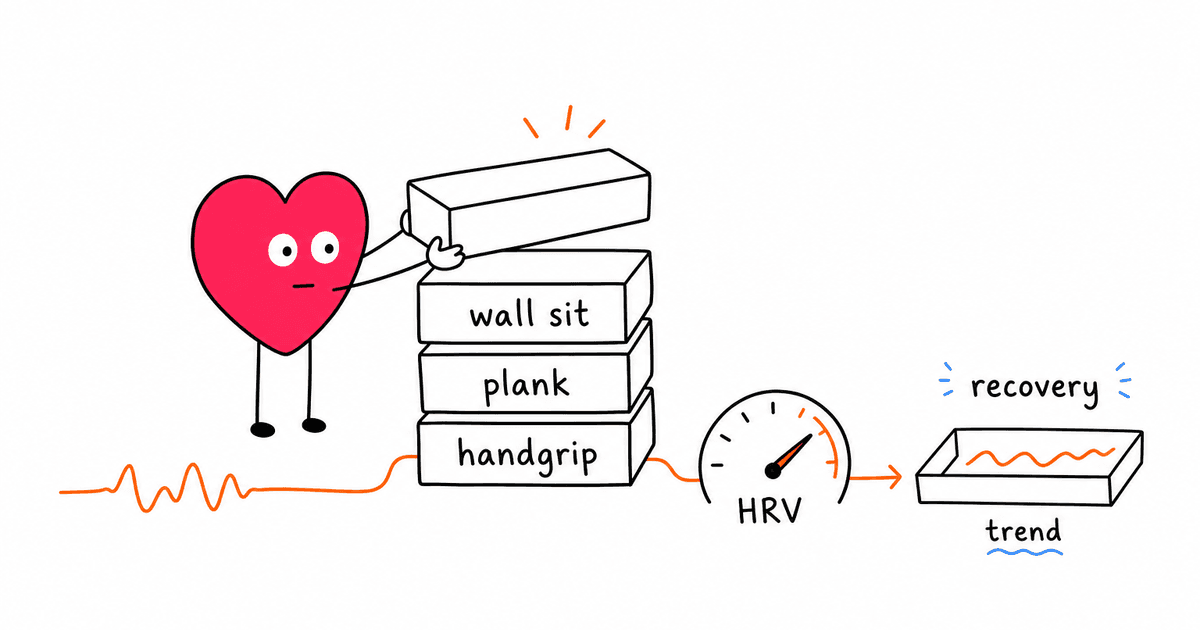
Wall sits, planks, and handgrip squeezes require no equipment, take just minutes per session, and may outperform traditional cardio for lowering blood pressure. They also appear to improve heart rate variability (HRV) by enhancing parasympathetic nervous system activity.
What Is Isometric Exercise?
Isometric exercise is any movement where a muscle contracts and generates force without changing length or producing visible joint movement. Unlike lifting a dumbbell (concentric contraction) or lowering it (eccentric contraction), isometric exercises involve holding a static position against resistance. Common examples include wall sits, planks, and squeezing a handgrip device. Isometric work also shows up inside grip-heavy activities such as rock climbing, where sustained tension and recovery both matter.
These exercises fall into two broad categories:
- Body-weight isometrics: Wall sits, planks, glute bridges (held), and static lunges
- Equipment-based isometrics: Handgrip dynamometers, isometric mid-thigh pulls, and pushing against an immovable object
The defining feature is the sustained contraction. During a wall sit, the quadriceps fire continuously even though the knee angle stays fixed. This creates a unique physiological response that differs from both aerobic and dynamic resistance exercise.
How Isometric Exercise Affects the Cardiovascular System
During an isometric hold, blood vessels within the contracting muscles become compressed. This temporarily reduces blood flow to the working tissue, a phenomenon called vascular occlusion. Heart rate and blood pressure both rise during the contraction to compensate.
The interesting part happens after the hold ends. When the muscle relaxes, blood rushes back through the previously compressed vessels in a surge called reactive hyperemia. This rapid increase in blood flow triggers shear stress on the vessel walls, which stimulates the release of nitric oxide, a powerful vasodilator.
Over weeks of consistent training, this repeated squeeze-and-release cycle appears to:
- Improve endothelial function (the ability of blood vessels to dilate)
- Reduce resting blood pressure
- Enhance baroreflex sensitivity
- Shift autonomic balance toward parasympathetic dominance
That last point is where HRV enters the picture.
The Research Linking Isometric Exercise to HRV
The Landmark Blood Pressure Meta-Analysis
A 2023 meta-analysis published in the British Journal of Sports Medicine examined 270 randomized controlled trials involving 15,827 participants. The researchers compared five categories of exercise: aerobic, dynamic resistance, combined training, high-intensity interval training (HIIT), and isometric exercise.
The findings were striking. While all exercise types reduced blood pressure, isometric exercises were nearly twice as effective as government-recommended aerobic guidelines. Wall sits and running produced the largest individual reductions in systolic and diastolic blood pressure.
The recommended protocol from the study: four sets of two-minute wall sits with two minutes of rest between sets, performed three times per week.
Handgrip Training and Autonomic Modulation
Research published in Medicine & Science in Sports & Exercise examined isometric handgrip training in older adults with hypertension. After eight weeks of training (four sets of two-minute contractions at 30% of maximum voluntary contraction, three days per week), participants showed:
- Significant reductions in resting systolic and diastolic blood pressure
- Increased vagal modulation, measured through HRV frequency-domain analysis
- Improved overall autonomic balance
A separate study published in the European Journal of Applied Physiology found that a single bout of isometric handgrip exercise produced acute improvements in neurocardiac regulation, with HRV exceeding baseline measures in the recovery period following the exercise.
Heart Rate Complexity and Parasympathetic Tone
Research on medicated hypertensive patients found that eight weeks of isometric handgrip training not only lowered blood pressure but also increased heart rate complexity, a nonlinear HRV measure associated with healthier autonomic function. Higher complexity in heart rate patterns generally reflects a more adaptable cardiovascular system.
Why Isometric Exercise May Improve HRV
The exact mechanisms are still being studied, but several pathways likely contribute:
Baroreflex Remodeling
The baroreflex is a feedback loop that adjusts heart rate in response to changes in blood pressure. During isometric exercise, blood pressure rises sharply, stimulating baroreceptors in the carotid sinus and aortic arch. Over time, repeated stimulation appears to improve baroreflex sensitivity, making the system more responsive.
Better baroreflex function is directly linked to higher vagal tone and improved RMSSD (a key HRV metric reflecting parasympathetic activity).
Vascular Shear Stress and Nitric Oxide
The reactive hyperemia that follows each isometric hold increases nitric oxide production. Beyond its vasodilatory effects, nitric oxide also modulates autonomic nerve signaling. Chronic improvements in nitric oxide availability may help shift the autonomic nervous system toward parasympathetic dominance.
Reduced Sympathetic Overactivation
Hypertension and low HRV often go hand in hand because both reflect sympathetic nervous system overactivity. By lowering resting blood pressure, isometric training may reduce the chronic sympathetic drive that suppresses HRV.
Muscle Metaboreflex Adaptation
When metabolites accumulate in contracting muscles (during the isometric hold), the muscle metaboreflex activates sympathetic pathways. With regular training, the muscles become more efficient at clearing metabolites, reducing the magnitude of this sympathetic response over time.
Practical Isometric Exercises for HRV
Wall Sits
Wall sits are the most studied isometric exercise for cardiovascular benefit.
How to perform:
- Stand with your back flat against a wall
- Slide down until your thighs are parallel to the floor (or as close as comfortable)
- Keep your knees directly above your ankles
- Hold for two minutes
Protocol: 4 x 2-minute holds with 2 minutes of rest between sets. Perform three times per week.
Progression: If two minutes feels easy, hold a weight plate against your chest. If two minutes is too challenging, start with a higher seat position and work your way down over several weeks.
Planks
Planks engage the core, shoulders, and back in a sustained isometric contraction.
How to perform:
- Start in a forearm plank position with elbows directly under shoulders
- Keep your body in a straight line from head to heels
- Engage your core and avoid letting your hips sag or pike up
- Hold for two minutes
Protocol: 4 x 2-minute holds with 2 minutes of rest between sets, three times per week.
Modification: Begin with 30-second holds and add 15 seconds each week until reaching two minutes.
Isometric Handgrip Training
Handgrip training is the most studied form of isometric exercise for blood pressure and HRV.
How to perform:
- Use a handgrip dynamometer or a stress ball with measurable resistance
- Squeeze at approximately 30% of your maximum grip strength
- Hold the squeeze for two minutes
- Alternate hands between sets
Protocol: 4 x 2-minute squeezes (2 per hand) with 1-2 minutes of rest between sets. Perform three times per week.
A dedicated handgrip dynamometer with a pressure gauge makes it easier to maintain consistent intensity.
Glute Bridge Hold
This targets the posterior chain while providing cardiovascular benefit.
How to perform:
- Lie on your back with knees bent and feet flat on the floor
- Drive your hips toward the ceiling until your body forms a straight line from shoulders to knees
- Squeeze your glutes and hold the position
- Maintain for two minutes
Protocol: Follow the same 4 x 2-minute pattern used for wall sits.
How to Track HRV Around Isometric Training
To measure the impact of isometric exercise on your HRV, consistent tracking is essential.
Morning Baseline Measurements
Take your HRV reading at the same time each morning, ideally within a few minutes of waking. Wearables like the Oura Ring 4, Whoop, or Garmin Forerunner 265 track HRV automatically during sleep, providing a reliable overnight baseline.
What to Expect
- Week 1-2: Possible slight decrease in morning HRV as your body adapts to the new stimulus
- Week 3-6: Gradual increase in RMSSD and overall HRV as autonomic adaptations develop
- Week 6-12: More consistent improvements, especially in HRV during rest and recovery periods
Most studies show significant autonomic improvements within 8-12 weeks of consistent isometric training.
Training Day HRV Patterns
Isometric exercise causes a temporary HRV dip during and immediately after the session (just like any exercise). This is normal and reflects acute sympathetic activation. The key metric is your morning baseline trend over weeks and months, not the immediate post-exercise reading.
Isometric Exercise vs. Other Training for HRV
| Exercise Type | Blood Pressure Reduction | HRV Improvement | Time Required | Equipment Needed |
|---|---|---|---|---|
| Isometric (wall sits, planks) | Strong (best evidence) | Moderate to strong | 20 min, 3x/week | None |
| Aerobic (running, cycling) | Moderate | Strong | 150 min/week | Varies |
| Dynamic resistance (weights) | Moderate | Moderate | 45-60 min, 3x/week | Gym access |
| HIIT | Moderate | Moderate | 20-30 min, 3x/week | Varies |
| Yoga | Moderate | Strong | 30-60 min, 3x/week | Mat |
The standout advantage of isometric exercise is the time efficiency. A complete wall sit session takes roughly 14 minutes (including rest periods), and the blood pressure reductions rival or exceed those of 150 minutes of weekly aerobic exercise.
Combining Isometric Exercise With Other HRV Strategies
Isometric training works best as part of a broader cardiovascular health strategy rather than a standalone intervention.
Pairing With Aerobic Exercise
Adding isometric holds to an existing cardio routine may produce additive benefits. For example, perform wall sits on rest days between runs or cycling sessions. Both exercise types improve HRV through different mechanisms: aerobic exercise enhances cardiac vagal tone through sustained heart rate elevation (particularly in zone 2), while isometric exercise works through vascular and baroreflex adaptations.
Pairing With Breathing Exercises
Breathing exercises directly stimulate the vagus nerve and enhance respiratory sinus arrhythmia. Practicing slow, deep breathing during rest periods between isometric holds can amplify the parasympathetic response. Try breathing at a rate of 5-6 breaths per minute during the two-minute rest intervals.
Pairing With Recovery Practices
On non-training days, activities like meditation, cold exposure, or sauna sessions can complement the autonomic benefits of isometric training.
Who Should (and Should Not) Do Isometric Exercise
Good Candidates
- People with elevated blood pressure looking for a time-efficient intervention
- Individuals with limited mobility who find aerobic exercise challenging
- Athletes wanting to supplement their existing training with cardiovascular benefits
- Anyone looking to improve HRV without adding more cardio volume
- Older adults seeking accessible, low-impact exercise options
Precautions
Isometric exercise causes a temporary spike in blood pressure during the hold. While this is generally safe for most people, certain populations should consult a healthcare provider first:
- Individuals with uncontrolled hypertension (resting systolic above 180 mmHg)
- People with a history of stroke or aneurysm
- Those with certain cardiac conditions, particularly aortic stenosis
- Anyone experiencing chest pain, dizziness, or unusual symptoms during holds
A key safety principle: never hold your breath during isometric exercises. Breathe steadily throughout each hold to prevent excessive blood pressure spikes (the Valsalva maneuver).
Getting Started: A 12-Week Isometric HRV Protocol
This progressive protocol builds from beginner to full intensity over 12 weeks.
Weeks 1-4 (Foundation)
- Exercise: Wall sits
- Duration: 4 x 1-minute holds
- Rest: 2 minutes between sets
- Frequency: 3 days per week
- Goal: Build tolerance and establish the habit
Weeks 5-8 (Progression)
- Exercises: Wall sits + planks (alternate days)
- Duration: 4 x 90-second holds
- Rest: 2 minutes between sets
- Frequency: 3 days per week
- Goal: Increase time under tension and add variety
Weeks 9-12 (Full Protocol)
- Exercises: Wall sits, planks, and handgrip training (rotate)
- Duration: 4 x 2-minute holds
- Rest: 2 minutes between sets
- Frequency: 3-4 days per week
- Goal: Reach the research-supported protocol and track HRV improvements
By the end of 12 weeks, compare your average morning RMSSD to your baseline from week one. Research suggests most people see measurable improvements in both blood pressure and HRV within this timeframe.
Frequently Asked Questions
How quickly do isometric exercises improve HRV?
Most studies show measurable improvements in autonomic function within 6-8 weeks of consistent training. Blood pressure reductions can appear as early as 4 weeks. Track your morning HRV trends using a wearable like the Oura Ring 4 or Whoop to monitor your progress.
Can I do isometric exercises every day?
While daily practice is generally safe for low-intensity isometric holds, the research protocols showing the best results use three sessions per week with rest days in between. This allows for full vascular and autonomic recovery between sessions.
Are wall sits better than planks for HRV?
Wall sits have more direct research supporting their cardiovascular benefits, likely because they involve larger muscle groups and create more pronounced vascular occlusion. However, planks still provide isometric cardiovascular stimulus and have the added benefit of core strength. Using both exercises in rotation is a practical approach.
Do I need a handgrip device?
A calibrated handgrip dynamometer makes it easier to train at the correct intensity (30% of maximum voluntary contraction). Squeezing a tennis ball or stress ball works as an alternative, though maintaining consistent intensity is harder without a measurement tool.
Can isometric exercise replace my regular workouts?
Isometric exercise is most effective as a complement to, not a replacement for, other forms of training. Aerobic exercise, strength training, and flexibility work like stretching and Pilates each provide unique cardiovascular and musculoskeletal benefits that isometric holds alone cannot replicate.
Need a quick read on your HRV number first?
Enter your HRV value, age range, device, and recovery context for a plain-English interpretation before you decide what to do next.
Interpret Your HRV NumberBuild the 30-day plan