HRV and Sleep Stages: What Your Wearable Reveals About REM, Deep, and Light Sleep
Trying to decode today's HRV number? Use the free interpreter first, then build a practical recovery plan. Interpret your HRV
Most people check their morning HRV number and move on. But that single number hides a rich, stage-by-stage story playing out across your entire night. Your heart rate variability shifts dramatically as you cycle through light sleep, deep sleep, and REM, and understanding these patterns can reveal far more about your recovery than any single score.
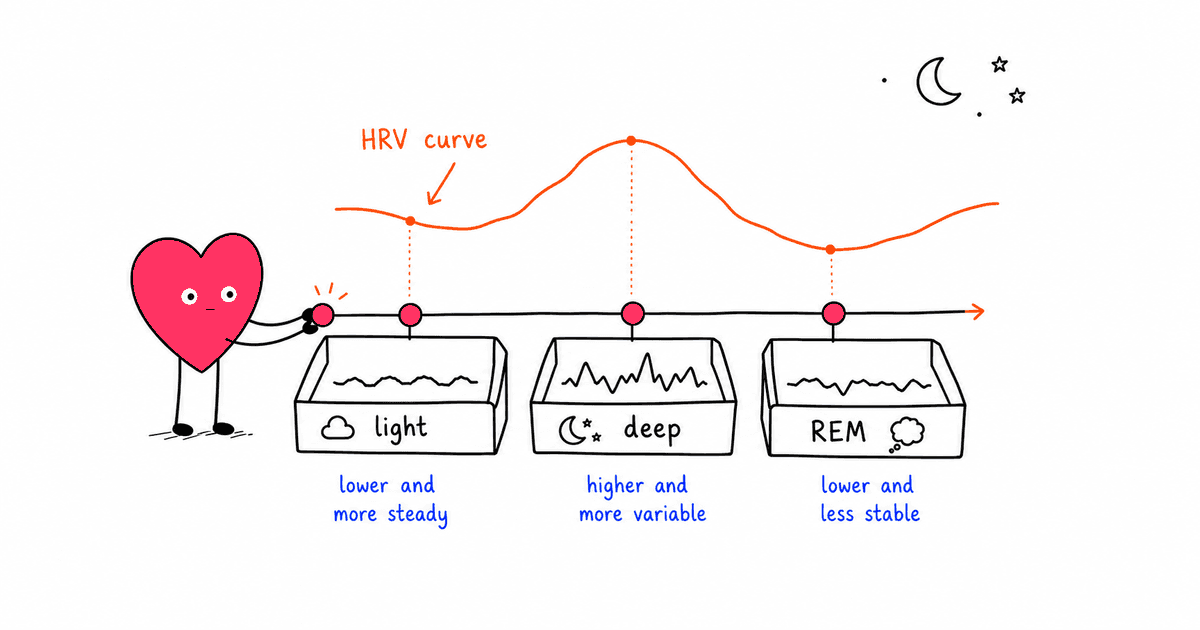
Heart rate variability during sleep stages reflects the shifting balance between your sympathetic and parasympathetic nervous systems as your brain cycles through NREM and REM sleep. HRV is highest during deep (slow-wave) sleep when parasympathetic dominance peaks, drops during REM sleep when sympathetic surges mimic wakefulness, and remains moderate during light sleep transitions.
Why HRV Changes Between Sleep Stages
Your autonomic nervous system (ANS) doesn't operate on a single setting throughout the night. Instead, it continuously adjusts based on the demands of each sleep stage. A landmark 1995 study published in Circulation by Vanoli et al. demonstrated that the ratio of low-frequency to high-frequency HRV power (LF/HF ratio) drops significantly from wakefulness to NREM sleep, then rebounds during REM sleep to near-waking levels.
This makes physiological sense. During NREM sleep, your body prioritizes restoration: tissue repair, immune function, and memory consolidation. The parasympathetic nervous system (your "rest and digest" branch) takes the wheel, slowing heart rate and increasing HRV. During REM sleep, your brain becomes highly active for dreaming and emotional processing, and sympathetic activity surges to support this increased metabolic demand.
HRV During Light Sleep (N1 and N2)
Light sleep, comprising stages N1 and N2, is where you spend roughly 50% of your total sleep time. It serves as the gateway into deeper stages and occurs between sleep cycles throughout the night.
What Happens to HRV
During N1 (the drowsy transition from wake to sleep), HRV begins to stabilize and may slightly increase compared to pre-sleep wakefulness. Your heart rate slows, breathing becomes more regular, and muscle tension decreases. The shift toward parasympathetic activity has started but isn't yet dominant.
In N2, sleep spindles and K-complexes appear in your brain waves, signaling a deeper level of unconsciousness. HRV continues to rise moderately as sympathetic activity decreases. Research shows that the LF/HF ratio begins its decline during N2, indicating a meaningful shift toward vagal dominance.
What to Watch For
Light sleep HRV that remains unusually low (close to your awake baseline) may indicate that your body is struggling to transition into recovery mode. Common culprits include:
- Late-night caffeine or alcohol consumption
- High stress or anxiety before bed
- Screen time exposure close to bedtime
- An irregular circadian rhythm
HRV During Deep Sleep (N3 Slow-Wave Sleep)
Deep sleep, also called slow-wave sleep (SWS) or N3, is the most restorative phase of your nightly cycle. It typically accounts for 15-25% of total sleep and concentrates in the first half of the night.
What Happens to HRV
This is where HRV typically reaches its nightly peak. Parasympathetic activity dominates during deep sleep, producing the highest high-frequency (HF) power and the lowest LF/HF ratios of any sleep stage. Heart rate drops to its lowest point, blood pressure decreases, and breathing becomes slow and rhythmic.
A 2013 study in Sleep examining circadian HRV variation across sleep stages confirmed that NREM deep sleep consistently shows the strongest parasympathetic cardiac modulation, regardless of the time of night. This makes deep sleep HRV one of the most reliable indicators of your body's recovery capacity.
Why Deep Sleep HRV Matters
The high HRV during deep sleep correlates with:
- Growth hormone release: Up to 75% of daily growth hormone secretion occurs during deep sleep, critical for tissue repair and muscle recovery
- Immune system restoration: Cytokine production peaks during SWS, supporting immune defense
- Memory consolidation: Slow oscillations during N3 facilitate the transfer of information from short-term to long-term memory
- Cardiovascular recovery: The pronounced parasympathetic dominance gives your heart and blood vessels a restorative break
If your wearable shows low HRV during deep sleep windows, it may signal that your body isn't fully shifting into recovery mode, even when you're technically in the right sleep stage.
HRV During REM Sleep
REM sleep is where things get interesting. While your brain is highly active (processing emotions, consolidating procedural memories, and generating dreams), your autonomic nervous system becomes remarkably unstable.
What Happens to HRV
HRV typically drops during REM sleep, often approaching waking levels. The sympathetic nervous system surges, producing irregular heart rate patterns, blood pressure fluctuations, and variable breathing rates. The LF/HF ratio increases significantly compared to NREM stages.
This autonomic instability isn't a sign of poor health. It's a normal feature of REM physiology. However, the magnitude of these sympathetic surges varies between individuals and can be influenced by factors like stress levels, fitness, and overall autonomic health.
Research from the American Heart Association has noted that the sympathetic surges during early-morning REM sleep may partially explain why cardiovascular events (heart attacks, strokes) are more common in the morning hours. The combination of increased REM proportion in the second half of sleep and the natural circadian rise in cortisol creates a period of heightened cardiovascular stress.
The REM Paradox
Many people are confused when their wearable shows lower HRV during sleep segments that should be "restful." Understanding the REM paradox helps:
- Low HRV during REM is normal and expected
- It does not mean your sleep quality is poor
- Your overall nightly HRV average may be pulled down by high REM proportion
- What matters is the contrast between your deep sleep HRV peaks and REM HRV dips
A healthy autonomic nervous system shows clear differentiation between stages: high HRV peaks during deep sleep and pronounced dips during REM. If your HRV remains flat across all stages, it may indicate reduced autonomic flexibility.
How Your Wearable Tracks Sleep Stage HRV
Modern wearables like the Oura Ring 4, WHOOP 5, and Garmin watches use HRV data as a core input for sleep stage classification. Understanding how this works helps you interpret your data more accurately.
The Classification Process
Without access to brain wave (EEG) data, wearables rely on a combination of signals to estimate sleep stages:
- Heart rate and HRV patterns: The primary signal. Lower HR and higher HRV correlate with deep sleep; higher HR and lower HRV suggest REM or light sleep
- Movement data (accelerometer): Minimal movement during deep sleep, occasional twitches during REM, more movement during light sleep
- Skin temperature: Slight increases during NREM, fluctuations during REM
- Respiratory rate: Slow and regular during NREM, irregular during REM
Machine learning algorithms trained on polysomnography (gold-standard sleep lab) data combine these inputs to classify each epoch (typically 30-second or 5-minute windows) into a sleep stage.
Accuracy Considerations
A 2019 study published in Scientific Reports demonstrated that HRV-based sleep staging using long short-term memory (LSTM) neural networks can achieve reasonable accuracy for distinguishing wake, REM, and NREM stages. However, separating light NREM (N1/N2) from deep NREM (N3) remains more challenging for wrist-worn and ring-based devices.
A 2025 validation study comparing the Oura Ring, WHOOP, and Garmin found that Oura and WHOOP showed the strongest agreement with clinical HRV measurements during sleep, with correlation coefficients exceeding 0.95. Garmin devices, while still useful for trend tracking, showed slightly more variance in HRV estimation.
What Each Device Reports
| Feature | Oura Ring 4 | WHOOP 5 | Garmin (Forerunner 265) | Apple Watch |
|---|---|---|---|---|
| Sleep stage breakdown | Yes | Yes | Yes | Yes |
| HRV by stage | Minute-by-minute overnight | Averaged during SWS | Nightly average (last 5 min of sleep) | Overnight samples |
| HRV metric | RMSSD | RMSSD | RMSSD (last 5 min) | SDNN |
| Recovery score | Readiness Score | Recovery Score | Body Battery / Training Readiness | Cardio Recovery (watchOS) |
Note that the timing and method of HRV measurement differ significantly between devices, which is why comparing raw HRV numbers across platforms isn't meaningful. Focus on trends within a single device over time.
How to Read Your Nightly HRV Curve
If your wearable provides an overnight HRV graph (Oura and WHOOP are particularly good at this), here's what to look for:
Healthy Pattern
A well-recovered night typically shows:
- Early night: High HRV peaks during the first deep sleep cycles (first 2-3 hours)
- Mid-night: Alternating dips (REM) and rises (NREM) as you cycle through stages
- Late night/early morning: Gradually decreasing HRV as REM proportion increases and cortisol begins rising
Warning Signs
Patterns that may indicate poor recovery or autonomic stress:
- Flat HRV throughout the night: Lack of stage-to-stage variation suggests reduced autonomic flexibility
- Late-night HRV spike: An unusual rise in HRV toward morning may indicate alcohol metabolism (the "rebound effect" after alcohol wears off) or other metabolic disturbance
- No early-night HRV peak: Missing the characteristic deep sleep HRV surge in the first sleep cycle could signal difficulty entering SWS
- Consistently low overnight HRV: If your HRV stays below your personal baseline across all stages, systemic stressors (illness, overtraining, chronic stress) may be at play
Factors That Alter Sleep Stage HRV Patterns
Several lifestyle and health factors can disrupt the normal HRV architecture across sleep stages:
Alcohol
Alcohol suppresses deep sleep HRV peaks in the first half of the night and often causes a sympathetic rebound in the second half. Even moderate drinking (2 drinks) can flatten the HRV curve, reducing the contrast between stages.
Late Exercise
Intense exercise too close to bedtime elevates sympathetic activity during early sleep, delaying the onset of high-HRV deep sleep. Allow at least 2-3 hours between vigorous workouts and bedtime for optimal sleep stage HRV patterns.
Stress and Anxiety
Chronic stress blunts the parasympathetic surge during deep sleep, reducing peak HRV values. Anxiety before bed can also extend the time spent in light sleep before the first deep sleep cycle begins.
Sleep Disorders
Sleep apnea fragments sleep architecture, preventing sustained deep sleep and causing repeated autonomic arousals that disrupt HRV patterns. If your wearable consistently shows fragmented staging with low HRV, it may be worth discussing with a healthcare provider.
Age
HRV during all sleep stages declines with age, but the decline is most pronounced during deep sleep. Older adults typically spend less time in N3 and show lower peak HRV values during SWS. This is a normal age-related change, though maintaining good fitness and sleep habits can slow the decline.
Practical Tips for Optimizing Sleep Stage HRV
Maximize Deep Sleep HRV
- Maintain a consistent sleep schedule to strengthen circadian rhythm cues
- Keep the bedroom cool (65-68°F / 18-20°C) to support the natural temperature drop that facilitates SWS
- Avoid alcohol within 3 hours of bedtime
- Consider magnesium supplementation, which supports parasympathetic activity
- Practice evening breathing exercises to shift your ANS toward parasympathetic dominance before sleep
Support Healthy REM Sleep
- Don't suppress REM with cannabis, alcohol, or certain medications (discuss with your doctor)
- Get adequate total sleep time (7-9 hours), since REM concentrates in later sleep cycles
- Manage stress to reduce exaggerated sympathetic surges during REM
- Maintain good hydration throughout the day
Track and Compare Over Time
- Use the same wearable consistently for trend tracking
- Note lifestyle factors (Tags in Oura, Journal in WHOOP) alongside your sleep data
- Look at 7-day and 30-day trends rather than any single night
- Compare your deep sleep HRV peaks against your personal baseline, not population averages
Frequently Asked Questions
Is Low HRV During REM Sleep a Bad Sign?
No, lower HRV during REM sleep is completely normal. It reflects the expected increase in sympathetic nervous system activity during this brain-active sleep stage. What matters more is whether your overall pattern shows clear differentiation between stages and whether your deep sleep HRV peaks are consistent with your personal baseline.
Which Wearable Is Best for Tracking Sleep Stage HRV?
The Oura Ring 4 offers the most detailed minute-by-minute overnight HRV tracking, making it excellent for observing stage-specific patterns. WHOOP 5 also provides strong overnight HRV data with clinically validated accuracy. Garmin devices focus more on the final sleep segment for their HRV reading, which may miss stage-specific detail.
Why Does My HRV Spike in the Middle of the Night?
A mid-night HRV spike usually corresponds to a deep sleep cycle. However, if it occurs in the second half of the night and is accompanied by restlessness, it could indicate alcohol metabolism effects, a blood sugar drop, or a sleep apnea event causing arousal followed by a parasympathetic rebound.
Can I Increase HRV During Deep Sleep Specifically?
While you can't directly control HRV during a specific sleep stage, improving the conditions that support deep sleep will naturally boost your SWS HRV peaks. Focus on sleep hygiene, consistent timing, temperature control, and managing evening stress. Regular exercise, meditation, and proper nutrition also support healthier sleep architecture over time.
How Many Sleep Cycles Should I Go Through Per Night?
Most adults complete 4-6 sleep cycles per night, each lasting roughly 90 minutes. Early cycles are deep-sleep dominant (higher HRV peaks), while later cycles are REM-dominant (lower HRV). Aiming for 7-9 hours of sleep ensures you get enough of both types for complete recovery.
Need a quick read on your HRV number first?
Enter your HRV value, age range, device, and recovery context for a plain-English interpretation before you decide what to do next.
Interpret Your HRV NumberBuild the 30-day plan