Float Tanks and HRV: How Sensory Deprivation Shifts Your Nervous System
Trying to decode today's HRV number? Use the free interpreter first, then build a practical recovery plan. Interpret your HRV
Floating in near-total darkness, suspended in body-temperature saltwater, sounds like an unusual wellness practice. But a growing body of research suggests that float tanks, also known as sensory deprivation or floatation-REST (Reduced Environmental Stimulation Therapy) chambers, produce measurable shifts in autonomic nervous system activity that directly improve heart rate variability.
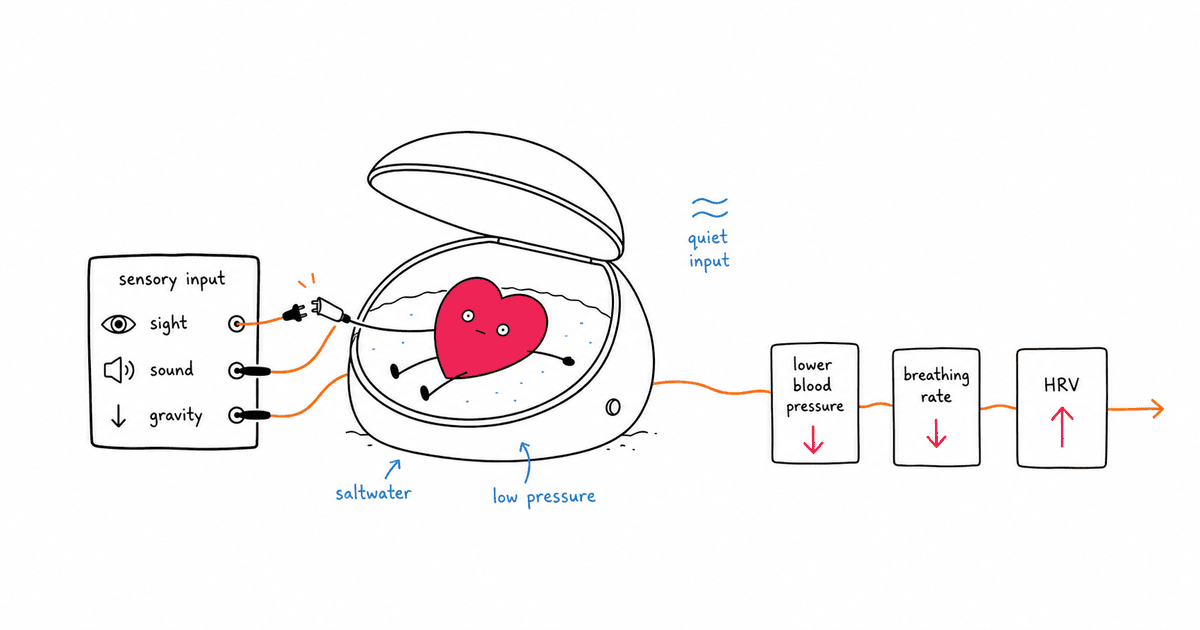
The science is compelling: a 2022 study published in Frontiers in Neuroscience found that a single 90-minute float session significantly increased high-frequency HRV while lowering blood pressure and breathing rate compared to a relaxation control condition. These are the exact cardiovascular markers associated with parasympathetic activation and stress resilience.
What Is Floatation-REST
Floatation-REST (Reduced Environmental Stimulation Therapy) is a practice in which you float effortlessly in a light-proof, sound-attenuated tank or pod filled with water supersaturated with approximately 1,000 pounds of magnesium sulfate (Epsom salt). The water and air are heated to skin temperature (around 93.5 to 95 degrees Fahrenheit), which eliminates thermal sensation and creates a near-weightless environment where the boundary between body and water becomes imperceptible.
The concept was developed in the 1950s by neuroscientist Dr. John C. Lilly, who wanted to study how the brain responds when external sensory input is reduced to an absolute minimum. Modern float tanks are a far cry from the original isolation chambers, offering comfortable pods or open pools with interior controls for lighting and session length.
How Float Tanks Affect HRV
The most rigorous float-HRV study to date comes from the Laureate Institute for Brain Research. Published in Frontiers in Neuroscience in 2022, this randomized crossover trial measured cardiovascular responses in 37 clinically anxious patients and 20 non-anxious participants during 90-minute float sessions compared to watching a relaxing nature documentary.
The results were striking across several HRV and cardiovascular metrics.
Increased High-Frequency HRV
Normalized high-frequency HRV (HF-HRV) increased significantly during floating compared to the film condition (p < 0.001). High-frequency HRV reflects vagal tone and parasympathetic nervous system activity, meaning the float environment actively pushed the body into a deeper state of autonomic balance than passive relaxation alone.
Reduced Sympathetic Markers
The study found significant decreases in several sympathetic nervous system indicators during floating:
- SDNN (standard deviation of interbeat intervals) decreased, indicating reduced overall autonomic variability consistent with deep physiological rest
- Low-frequency HRV dropped significantly, suggesting reduced sympathetic input
- Very low-frequency HRV also decreased, consistent with lower thermoregulatory and hormonal stress responses
Lower Blood Pressure and Breathing Rate
Both systolic and diastolic blood pressure decreased significantly during floating. Breathing rate also slowed considerably. These cardiovascular changes are consistent with what happens during deep parasympathetic activation and mirror the physiological state associated with higher resting HRV.
Effects Were Consistent Across Groups
One of the most notable findings was that both anxious and non-anxious participants showed the same cardiovascular response pattern. This suggests that float tanks produce a reliable autonomic shift regardless of baseline anxiety levels, making it a broadly applicable intervention for improving HRV.
Why Sensory Deprivation Shifts the Autonomic Nervous System
The autonomic nervous system constantly adjusts its output in response to environmental demands. Every sight, sound, temperature change, and gravitational force requires the brain to process information and modulate cardiovascular responses accordingly. Float tanks work by systematically removing these demands.
Reduced Sensory Processing Load
When exteroceptive sensory input drops to near zero, the central nervous system no longer needs to maintain the vigilance required for environmental monitoring. This reduces the tonic sympathetic arousal that most people carry throughout the day, even during "relaxation."
A 2024 study published in PLOS ONE found that floatation-REST was safe and well-tolerated even in anxious and depressed individuals, with anxiolytic effects persisting for over 48 hours after a single session. This extended duration suggests that floating doesn't just temporarily suppress the stress response: it may help recalibrate autonomic set points.
Magnesium Absorption
Float tanks contain roughly 1,000 pounds of Epsom salt (magnesium sulfate) dissolved in approximately 200 gallons of water. While the extent of transdermal magnesium absorption during floating remains debated, magnesium plays a critical role in HRV through its regulation of cardiac ion channels, parasympathetic neurotransmission, and cortisol metabolism.
Even if skin absorption is modest, the systemic relaxation response triggered by floating may independently optimize conditions for magnesium utilization in the body.
Gravity Elimination
Floating eliminates approximately 90% of gravitational input to the body. This unloading reduces muscle tension, decreases proprioceptive signaling to the brain, and lowers the metabolic demands on the cardiovascular system. The heart doesn't need to work as hard to circulate blood against gravity, which may partially explain the observed drops in blood pressure and heart rate during floating.
Float Tanks for Anxiety and HRV
The connection between float tanks, anxiety, and HRV is particularly well-documented. Research from the Laureate Institute has consistently shown that floating produces significant anxiolytic effects, even in patients with severe anxiety disorders including generalized anxiety disorder, social anxiety, panic disorder, agoraphobia, and PTSD.
What makes this finding especially interesting from an HRV perspective is a paradox identified by researchers: float tanks enhance interoceptive awareness (the ability to sense your own heartbeat, breathing, and internal sensations), which would normally increase anxiety in people with high anxiety sensitivity. Instead, the float environment appears to create conditions where heightened body awareness becomes calming rather than threatening.
This may involve a process similar to reciprocal inhibition: by pairing interoceptive awareness with deep physiological relaxation, floating may help rewire the association between body sensations and anxiety. Over time, this could support higher baseline HRV by reducing the chronic sympathetic activation that suppresses vagal tone.
Float Tanks vs. Other HRV-Boosting Practices
How does floating compare to other evidence-based approaches for improving HRV?
| Practice | HRV Mechanism | Session Duration | Frequency Needed |
|---|---|---|---|
| Float tanks | Parasympathetic shift via sensory reduction | 60 to 90 minutes | 1 to 2 times per week |
| Meditation | Vagal tone via focused attention | 10 to 20 minutes | Daily |
| HRV biofeedback | Resonance frequency breathing | 10 to 20 minutes | Daily |
| Cold exposure | Dive reflex and vagal stimulation | 2 to 5 minutes | 3 to 5 times per week |
| Sauna | Heat stress adaptation | 15 to 20 minutes | 2 to 4 times per week |
Float tanks offer a unique advantage: they require no active effort, skill, or training. Unlike meditation or biofeedback, which depend on cultivating a mental technique, floating works passively by removing environmental stimulation. This makes it particularly accessible for people who struggle with traditional mindfulness practices.
The tradeoff is accessibility and cost. While meditation and breathing exercises are free and can be done anywhere, float sessions typically cost $60 to $100 per session and require visiting a dedicated facility.
How to Track HRV Changes from Floating
If you want to measure how float sessions affect your HRV, consistent tracking methodology matters.
Before Your Float Session
- Take a baseline HRV reading at the same time each day for at least a week before your first float. Morning readings upon waking provide the most consistent baseline.
- Record your resting heart rate, HRV (RMSSD), and subjective stress level.
- A wearable like the Oura Ring or Whoop that tracks overnight HRV provides the most reliable trend data.
After Your Float Session
- Check your overnight HRV the night of your float session and compare it to your baseline average.
- Track morning HRV for the following 2 to 3 days to see how long the parasympathetic shift persists.
- Note any changes in resting heart rate, sleep quality, and subjective relaxation.
Building a Pattern
- Float consistently (ideally once per week) for at least 4 to 6 weeks before drawing conclusions about HRV trends.
- Keep other variables as stable as possible during your tracking period: sleep schedule, exercise, alcohol, and caffeine.
- Use your wearable's trend view to compare weekly HRV averages during floating periods versus non-floating periods.
What to Expect During Your First Float
For those new to floating, the first session is often more about acclimation than deep relaxation. Here is what to anticipate.
The First 15 to 20 Minutes
Most first-time floaters experience a period of adjustment. You may notice heightened awareness of your heartbeat and breathing, mild restlessness, or difficulty fully relaxing. This is normal and reflects your nervous system adapting to the absence of external stimulation.
Minutes 20 to 45
As your body settles, breathing typically slows naturally and muscle tension begins to release. Many floaters report a shift in awareness during this period where the boundary between body and water becomes less distinct.
Minutes 45 to 90
Deeper relaxation tends to occur in the second half of the session. This is when the most significant parasympathetic activation likely occurs, and where research shows the strongest HRV and blood pressure changes.
After the Session
Post-float, many people report feeling calm, mentally clear, and physically relaxed. Research suggests the anxiolytic effects can persist for 48 hours or longer, which may translate to sustained HRV improvements over the following days.
Practical Tips for Maximizing HRV Benefits from Floating
Based on the available research and practical experience, several strategies can help optimize the autonomic benefits of float sessions.
Session Length
Research protocols typically use 60 to 90-minute sessions. Shorter sessions (30 minutes) may not allow enough time for the full parasympathetic shift to develop, especially for newer floaters who need time to acclimate.
Session Frequency
Most float centers recommend once per week for ongoing benefits. A 2005 meta-analysis of 27 flotation studies found the strongest effects in participants who completed multiple sessions over weeks, suggesting that cumulative exposure may produce longer-lasting autonomic changes.
Timing
Floating in the afternoon or evening may complement your body's natural circadian shift toward parasympathetic dominance. Avoid floating immediately after intense exercise, as elevated sympathetic activity may compete with the relaxation response.
Avoid Caffeine Beforehand
Caffeine is a sympathetic nervous system stimulant that could blunt the parasympathetic shift floating is designed to produce. Avoid caffeine for at least 4 to 6 hours before your session.
Combine with Breathing Practices
Some experienced floaters use the first few minutes to practice slow breathing exercises at around 6 breaths per minute to accelerate the transition into parasympathetic dominance.
Who Should Consider Float Therapy for HRV
Float therapy may be particularly beneficial for certain populations.
High-Stress Professionals
People with chronically elevated sympathetic activity from demanding jobs may benefit from the forced sensory downtime that floating provides. If your HRV is consistently suppressed despite adequate sleep and exercise, floating offers a distinct recovery pathway.
Athletes in Recovery Phases
While the research on floating for athletic recovery is still emerging, the demonstrated blood pressure reduction and parasympathetic activation suggest that float sessions during deload or recovery weeks could support training adaptation.
People with Anxiety Disorders
The Laureate Institute research specifically demonstrated benefits for clinically anxious individuals, including those with PTSD, panic disorder, and generalized anxiety. For these populations, floating may offer HRV improvements that are difficult to achieve through traditional relaxation methods alone.
Chronic Pain Patients
The combination of gravity reduction, magnesium exposure, and parasympathetic activation may benefit people with chronic pain conditions that are associated with autonomic dysregulation and suppressed HRV.
Limitations and Considerations
While the evidence is promising, several important limitations deserve mention.
Small Sample Sizes
Most float-HRV studies involve relatively small samples (20 to 60 participants). Larger randomized controlled trials are needed to confirm and quantify the magnitude of HRV improvements.
Cost and Accessibility
At $60 to $100 per session, regular floating represents a significant investment. Unlike walking, stretching, or meditation, it cannot be practiced at home without purchasing or renting specialized equipment.
Not Suitable for Everyone
Floating may not be appropriate for people with claustrophobia (though open float pools can help), certain skin conditions, epilepsy, or uncontrolled cardiovascular conditions. Always consult a healthcare provider before starting float therapy, especially if you have existing health concerns.
Long-Term HRV Data Is Limited
While acute improvements in HRV during and shortly after floating are well-documented, long-term studies tracking whether regular floating produces sustained baseline HRV improvements over months are still lacking.
FAQ
How long does the HRV improvement from a float session last?
Research suggests the anxiolytic and parasympathetic effects of a single float session can persist for 48 hours or longer. HRV improvements may follow a similar timeline, though individual responses vary. Tracking your overnight HRV for 2 to 3 days post-float will help you determine your personal response duration.
Can I use my HRV wearable during a float session?
Most float centers ask you to remove all jewelry and electronics. Waterproof chest strap monitors could theoretically work, but the salt concentration may damage equipment. The best approach is to track overnight HRV before and after sessions rather than during them.
How many float sessions before I notice HRV changes?
Many people report subjective relaxation benefits after their first session. Measurable HRV changes may take 3 to 4 weekly sessions to become apparent in your trend data, as the first few sessions are often spent acclimating to the float environment.
Is floating better than meditation for HRV?
They work through different mechanisms and are best viewed as complementary rather than competing practices. Meditation builds an active skill you can deploy anywhere, while floating provides passive sensory reduction that requires no training. Combining both may produce greater HRV benefits than either alone.
Does the Epsom salt actually improve HRV through magnesium absorption?
The evidence for significant transdermal magnesium absorption during floating is limited. While magnesium is important for HRV, the primary HRV benefits of floating likely come from the sensory deprivation and parasympathetic activation rather than mineral absorption.
Need a quick read on your HRV number first?
Enter your HRV value, age range, device, and recovery context for a plain-English interpretation before you decide what to do next.
Interpret Your HRV NumberBuild the 30-day plan