Does Creatine Affect HRV? Recovery Scores and What to Check
Trying to decode today's HRV number? Use the free interpreter first, then build a practical recovery plan. Interpret your HRV
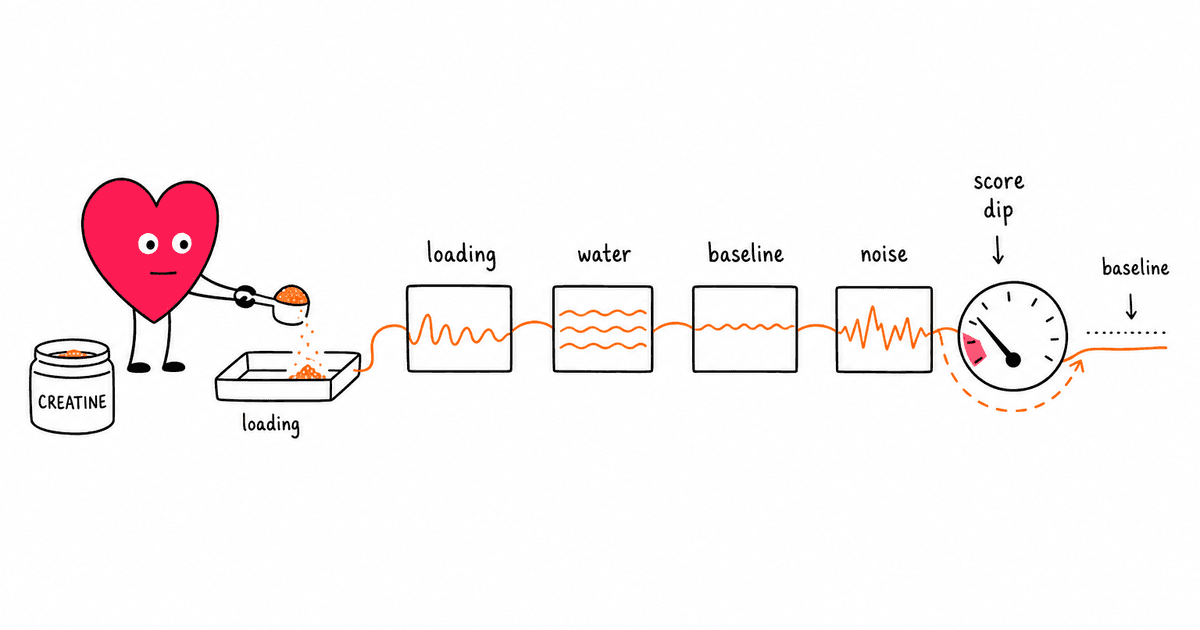
Yes, creatine can affect HRV readings, but usually indirectly. It is not accurate to say creatine always lowers HRV, and creatine is not a reliable direct HRV booster. The direct evidence that creatine itself predictably raises or lowers heart rate variability is limited. For many people, the change comes from the first week of supplementation: a loading dose, water-weight shifts, harder workouts, digestive discomfort, or sleep changes. Your wearable sees those inputs, not creatine directly.
The useful question is not just "does creatine affect HRV?" It is "did creatine change my baseline after accounting for training, sleep, hydration, digestion, and measurement noise?" Below, we break down the evidence, what patterns to watch, and how to run a cleaner self-test.
Quick Answer: Does Creatine Affect HRV?
Creatine can affect HRV indirectly, but direct human evidence that creatine reliably lowers or improves HRV is limited. The stronger evidence is that creatine monohydrate increases muscle creatine stores, supports short, high-intensity exercise, and can cause water-retention weight gain, especially during loading.
If your HRV or recovery score changed after starting creatine, check three things before blaming the supplement itself:
| Question | Why it matters for HRV |
|---|---|
| Did you load with 20 g per day instead of starting at 3 to 5 g? | Loading is more likely to create water-weight, digestion, and routine changes that wearables notice |
| Did your training get harder at the same time? | More reps, more weight, or more soreness can lower next-day HRV independent of creatine |
| Did sleep, hydration, electrolytes, caffeine, alcohol, or illness change? | These often move overnight HRV more than a supplement does |
Creatine is best treated as a performance-support supplement, not a direct HRV supplement. If you want the cleanest read, skip loading, hold your training plan steady, take a consistent daily dose, and compare 7-day averages for several weeks. If your main goal is improving HRV, start with the broader levers in how to improve HRV before using a supplement experiment to explain every recovery-score change.
If Your HRV Changed After Starting Creatine
Use the timing of the change before deciding what it means.
| What you see | Most likely interpretation | Better next step |
|---|---|---|
| HRV dips in the first 3 to 7 days of a loading phase | Loading, water-weight change, GI discomfort, or sleep disruption may be adding noise | Switch to a steady maintenance dose and compare 7-day averages |
| HRV drops after heavier lifting or more volume | Training strain is a stronger explanation than creatine alone | Hold volume steady for a week before changing the supplement |
| HRV drops while resting heart rate rises and sleep worsens | Sleep, alcohol, illness, heat, late meals, or digestive stress may be driving the score | Fix the recovery inputs first, then retest |
| HRV is unchanged but workouts improve | This is a common and reasonable pattern | Keep tracking without treating creatine as an HRV intervention |
| HRV stays below baseline for several weeks | Your dose, timing, training block, or overall routine may not fit well | Reassess the full experiment and involve a clinician if symptoms are present |
What the Evidence Says
The NIH Office of Dietary Supplements lists creatine as a supplement with evidence for strength, power, and high-intensity intermittent work, while noting typical side effects such as water-retention weight gain and occasional digestive symptoms. The International Society of Sports Nutrition position stand describes common loading and maintenance protocols and summarizes creatine monohydrate as one of the most studied sports supplements.
That matters for HRV because the strongest creatine evidence is about muscle energy and performance, not about a direct HRV effect. Most recovery scores are sensitive to fluid balance, resting heart rate, sleep quality, training strain, and routine disruption. A lower score after starting creatine may be real, but it does not prove creatine directly harmed your autonomic nervous system.
How Creatine Influences the Autonomic Nervous System
Understanding why creatine may affect a wearable HRV score requires looking at the inputs around supplementation.
Cellular Energy and Neural Signaling
Creatine works by increasing phosphocreatine availability, which helps regenerate ATP during short, high-intensity efforts. That is useful for lifting, sprinting, and repeated hard intervals. It does not automatically mean your HRV should rise or fall.
Water Retention and Blood Volume
One of creatine's most visible early effects is water-retention weight gain. The common loading protocol is about 20 g per day for up to a week, followed by 3 to 5 g per day. Some people feel heavier, more bloated, or less comfortable during that first week, and those changes can affect overnight sleep or resting heart-rate patterns.
Sleep and Digestion
Large loading doses can cause nausea, diarrhea, or stomach discomfort in some users. Even when the supplement itself is well tolerated, any sleep disruption, late-night bathroom trips, or digestive stress can lower overnight HRV more than creatine itself.
Workout Intensity Effects
Creatine often lets people lift more weight, complete more reps, or tolerate harder sessions. That extra work is a common HRV confounder. A next-day HRV dip after a harder leg session is different from a creatine-only effect.
This is the most common interpretation mistake: creatine gets blamed because it was the new variable, but the real HRV driver may be the training jump that creatine made possible.
Baseline Recalibration
Wearables such as Whoop, Oura, Garmin, and Apple Watch compare you against your own recent baseline. If creatine changes your scale weight, training output, sleep, or resting pulse for a few weeks, the device may need time to recalibrate your normal range.
What HRV Changes to Expect on Creatine
If you start taking creatine and track your HRV closely, look for patterns instead of one-day reactions. A wearable dip is most useful when you can match it to timing, dose, training load, sleep, resting heart rate, and symptoms.
| Pattern | What it may mean | What to do |
|---|---|---|
| HRV dips during a loading week | Fluid shifts, digestive discomfort, or routine disruption | Compare 7-day averages and consider switching to maintenance dosing |
| HRV drops after harder sessions | Training strain, not necessarily creatine itself | Track sets, reps, soreness, sleep, and resting heart rate together |
| Recovery score falls while sleep worsens | Sleep or GI disruption is likely part of the signal | Move dosing earlier, split the dose, or skip loading |
| HRV stays below baseline for several weeks | Your routine, dose, or training block may not be fitting well | Reassess the full stack: dose, sleep, hydration, alcohol, stress, and training |
| No HRV change | Also normal | Keep your dose and tracking routine consistent |
Should You Worry About Lower HRV on Creatine?
A single lower HRV score after starting creatine is not enough reason to panic. It is more useful to compare your 7-day average against your normal range and look at the surrounding context: sleep, hydration, alcohol, soreness, training volume, resting heart rate, and illness.
Creatine monohydrate has a large sports nutrition evidence base, and typical protocols are generally described as having few safety concerns for healthy adults. That does not make it the right choice for everyone. If you have kidney disease, cardiovascular disease, blood pressure concerns, are pregnant, or take medications that affect fluid balance or kidney function, discuss creatine with a qualified clinician before using it.
If HRV drops sharply and stays low, or if it comes with chest pain, fainting, unusual shortness of breath, palpitations, swelling, severe GI symptoms, or a major change in how you feel, treat that as a health question, not a wearable optimization question.
How to Track Creatine's Impact on Your HRV
To clearly isolate creatine's effects from other variables, follow this protocol:
- Establish a clean baseline: Track your HRV for at least 2 weeks before starting creatine, keeping your training, sleep, and nutrition consistent
- Log supplement timing: Note when you take creatine and at what dose in your tracking app or journal
- Use consistent measurement: Take HRV readings at the same time each day, ideally first thing in the morning. Wearables like the Apple Watch and Garmin automate this with overnight readings
- Control other variables: Avoid starting other new supplements, dramatically changing your diet, or altering your training program during the test period
- Give it 4 to 6 weeks: You need several weeks of maintenance data to see whether your baseline changed
- Compare weekly averages: Daily HRV fluctuates too much for meaningful comparisons. Use 7-day rolling averages to spot real trends
If you are still learning what your number means, start with understanding HRV numbers before interpreting a supplement response.
Creatine Dosing Strategies and HRV
How you dose creatine affects how much it impacts your HRV:
Standard Loading Protocol
Taking about 20 g per day, often split into several doses, for 5 to 7 days is the fastest way to saturate muscle creatine stores. It is also the approach most likely to create early noise in your wearable data because dose size, water retention, and digestive tolerance all change quickly.
No-Load Protocol
Taking 3 to 5 g daily from the start is slower, but simpler. Muscle saturation takes longer than loading, but the routine is easier to keep steady and is less likely to create a dramatic first-week change in sleep, digestion, or recovery scores.
Cycling
Some athletes cycle creatine around training blocks, but cycling is not required for most users. If you suspect creatine changes your HRV baseline, run a cleaner on/off comparison only after you have held training, sleep, alcohol, caffeine, and diet as steady as possible.
Creatine, Exercise, and the Combined Effect on HRV
The interaction between creatine and exercise makes the autonomic picture more nuanced. Regular strength training and zone 2 cardio are among the most reliable ways to improve HRV over time.
Creatine may help you complete more high-intensity work, but that does not prove it improves HRV. The likely long-term HRV driver is still the training plan: enough progressive overload to get fitter, enough easy aerobic work to support recovery, and enough rest to absorb the work.
If your HRV drops after starting creatine and increasing volume at the same time, blame the experiment design first. Change one variable at a time whenever possible.
Who Should Pay Attention to Creatine-HRV Interactions
Most recreational supplement users do not need to worry about creatine's modest HRV effects. However, certain groups should monitor more closely:
- Athletes using HRV-guided training: If you rely on morning HRV to decide training intensity, avoid changing creatine dose and training load in the same week
- People with kidney, cardiovascular, or blood pressure concerns: Discuss creatine with a clinician before starting, especially if you take medication that affects fluid balance or kidney function
- Those already experiencing low HRV: If your HRV is chronically low due to stress, poor sleep, illness, or overtraining, fix the bigger recovery inputs first
- Competitive athletes in taper phases: If recovery scores guide competition prep, avoid experimenting with loading doses right before a key event
Other Supplements and HRV
Creatine is far from the only supplement people ask about when tracking HRV. Keep the same rule for all of them: look for your own trend, avoid stacking changes, and do not treat a supplement as a substitute for sleep, training load, hydration, nutrition, and medical care.
- Magnesium: May support HRV when intake or status is low, especially through sleep, muscle relaxation, and parasympathetic pathways
- Omega-3 fatty acids: Associated with better autonomic and cardiovascular markers in some populations, but response depends on baseline diet and health status
- Adaptogens: Ashwagandha, rhodiola, and related supplements may affect stress and sleep for some people, but HRV effects are not guaranteed
- Vitamin D: Low status can overlap with lower HRV and poorer health context, so testing matters before supplementing heavily
- Electrolytes: Sodium, potassium, magnesium, and calcium help maintain fluid balance and normal cardiac signaling
Do not use another supplement to "cancel out" a bad HRV trend. First check the larger inputs: training load, sleep, alcohol, caffeine, hydration, total calories, and illness. The broader nutrition and HRV guide is a better starting point than stacking more capsules.
Common Questions About Creatine and HRV
Why did my Whoop recovery score drop after starting creatine?
Whoop calculates recovery from inputs such as HRV, resting heart rate, respiratory rate, and sleep. If creatine loading changes your sleep, body weight, resting pulse, training strain, or digestion, the recovery score can move even if the supplement is not directly lowering HRV.
Should I stop taking creatine if my HRV drops?
Not necessarily. First compare weekly averages and review what else changed. If the drop is large, persistent after several weeks of steady maintenance dosing, or paired with symptoms, stop treating it as a performance-tracking puzzle and consult a healthcare professional.
Does creatine affect overnight HRV differently than daytime HRV?
Overnight HRV is often more useful for this kind of experiment because it reflects a long, consistent measurement window. It is also sensitive to sleep quality, late meals, alcohol, heat, illness, and training strain, so do not isolate creatine without checking those variables.
Is creatine safe for long-term use?
For healthy adults, creatine monohydrate is one of the most studied sports supplements, and typical dosing protocols have few reported safety concerns in major sports nutrition summaries. People with kidney disease, cardiovascular conditions, pregnancy, or relevant medications should ask a clinician before starting.
Can creatine improve HRV?
Not reliably as a direct HRV supplement. Creatine may support harder training, and better fitness can support HRV over time, but that is not the same as creatine directly improving autonomic balance. If HRV is the main goal, start with sleep, aerobic fitness, training load, stress, alcohol, hydration, and food quality.
The Bottom Line
Creatine can affect what your wearable reports, but the direct evidence for a predictable HRV drop is thin. Treat any change as a baseline experiment, not a universal side effect.
If you track HRV and want the least noisy approach, skip loading, use a steady 3 to 5 g daily maintenance dose, hold your training and sleep routine as steady as possible, and compare 7-day averages for at least several weeks. If the trend still looks worse, reassess the dose, timing, training block, and whether creatine fits your current goals.
Need a quick read on your HRV number first?
Enter your HRV value, age range, device, and recovery context for a plain-English interpretation before you decide what to do next.
Interpret Your HRV NumberBuild the 30-day plan