Vitamin D and HRV: How the Sunshine Vitamin Affects Heart Rate Variability
Trying to decode today's HRV number? Use the free interpreter first, then build a practical recovery plan. Interpret your HRV
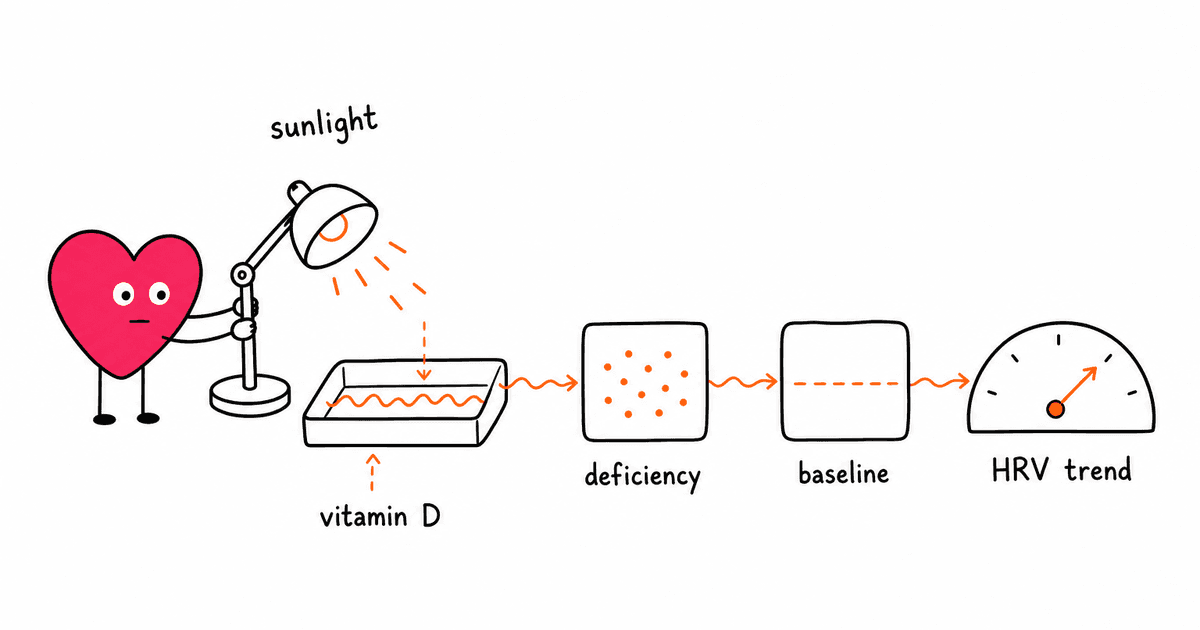
Yes, vitamin D affects HRV. Research shows that low vitamin D levels are associated with reduced heart rate variability, particularly lower rMSSD and pNN50 values, indicating impaired parasympathetic (vagal) tone. Supplementing vitamin D in deficient individuals has been shown to improve cardiac autonomic function, making it an important and often overlooked factor in HRV optimization.
What Is Vitamin D and Why Does It Matter?
Vitamin D is a fat-soluble hormone that your body produces when sunlight hits your skin. Unlike most vitamins, it functions more like a hormone, with receptors found in nearly every tissue in your body, including your heart and nervous system.
Most people know vitamin D is essential for bone health and immune function. But its role extends far beyond that. Vitamin D influences cardiovascular health, inflammation, mood, and, as recent research confirms, your autonomic nervous system, the branch of your nervous system that controls heart rate variability.
Despite its importance, vitamin D deficiency is remarkably common. An estimated 1 billion people worldwide have insufficient levels, and the problem gets significantly worse during winter months when sun exposure drops. If you're reading this in February, there's a good chance your vitamin D levels are at their lowest point of the year.
The Vitamin D and Autonomic Nervous System Connection
Your autonomic nervous system (ANS) has two main branches: the sympathetic ("fight or flight") and parasympathetic ("rest and digest") systems. HRV measures the balance between these two branches, and higher HRV generally indicates better autonomic flexibility and cardiovascular health.
Vitamin D receptors are present throughout the cardiovascular and nervous systems. Vitamin D influences autonomic function through several mechanisms:
- Calcium regulation: Vitamin D controls calcium homeostasis, which directly affects cardiac electrical activity and heart rhythm.
- Inflammation modulation: Chronic low-grade inflammation impairs vagal tone. Vitamin D is a potent anti-inflammatory agent that helps keep this in check.
- Renin-angiotensin system: Vitamin D suppresses renin production, which affects blood pressure regulation and sympathetic nervous system activity.
- Neurotransmitter synthesis: Vitamin D supports the production of acetylcholine and other neurotransmitters involved in parasympathetic signaling.
When vitamin D levels drop, these systems can become dysregulated, tipping the balance toward sympathetic dominance and reducing your HRV. This is the same pattern seen with chronic stress and poor nutrition.
What the Research Says
Several studies have investigated the relationship between vitamin D levels and heart rate variability, and the findings paint a consistent picture, especially for people with existing health conditions.
Vitamin D Deficiency Lowers HRV in Diabetic Patients
A study of 191 patients with type 2 diabetes (PMC9410659) found a clear link between vitamin D status and HRV. (For more on the diabetes-HRV connection, see blood sugar and HRV.) Participants with vitamin D deficiency or insufficiency had significantly lower rMSSD and pNN50 values, both key markers of parasympathetic activity (learn what these metrics mean in our guide to understanding HRV numbers). Serum 25(OH)D levels positively correlated with rMSSD (P=.002), meaning higher vitamin D was directly associated with better vagal tone. The vitamin D deficient and insufficient groups also showed higher LF/HF ratios, indicating a shift toward sympathetic dominance.
The Effect May Be Stronger in High-Risk Populations
Interestingly, a study of 105 subjects with low cardiovascular risk (PMC5420774) found that vitamin D deficiency did not significantly alter HRV in otherwise healthy individuals. This suggests that the impact of vitamin D on autonomic function may be more pronounced in people who already have metabolic or cardiovascular conditions. If you're managing diabetes, hypertension, or other chronic conditions, optimizing your vitamin D could be especially important for your HRV.
Vitamin D and HRV in Hypertension and Diabetic Complications
More recent research supports these findings. Li et al. (2025) found associations between vitamin D levels, coronary revascularization outcomes, and HRV in hypertensive patients. Bai et al. (2025) identified a nonlinear (threshold) relationship between 25(OH)D and cardiac autonomic dysfunction in patients with diabetic foot complications, suggesting there may be a critical vitamin D level below which autonomic function deteriorates more rapidly.
Supplementation Can Improve Autonomic Function
Perhaps the most actionable finding: a supplementation study showed that taking vitamin D3 (5,000 to 10,000 IU daily) for 28 days improved cardiac autonomic tone in healthy adults with vitamin D insufficiency. Specifically, participants showed increased high-frequency (HF) power during an acute physiological stressor, indicating stronger parasympathetic response when they needed it most.
A comprehensive review of micronutrients and HRV (PMC7231600) further confirms vitamin D's role in autonomic function, placing it alongside magnesium as one of the most important micronutrients for heart rate variability.
Who Is Most at Risk for Vitamin D Deficiency?
Certain groups are more likely to have low vitamin D levels:
- People living at higher latitudes: If you're above 35°N (most of the US, all of Canada and Europe), your skin produces little to no vitamin D from sunlight between October and March.
- Office workers and indoor lifestyles: Even in sunny climates, spending most of the day indoors limits UV exposure.
- Older adults: Aging skin produces vitamin D less efficiently, making this especially relevant for seniors tracking their HRV.
- People with darker skin: Higher melanin levels require more sun exposure to produce the same amount of vitamin D.
- Those with obesity or metabolic conditions: Fat tissue sequesters vitamin D, making it less bioavailable.
The seasonal factor is critical. Vitamin D levels typically reach their lowest point in late winter (January through March in the Northern Hemisphere), closely tied to circadian rhythm shifts. If your HRV tends to dip during winter months, vitamin D deficiency could be a contributing factor alongside reduced physical activity and less time outdoors.
How to Optimize Vitamin D for Better HRV
Get Tested First
Before supplementing, get a 25(OH)D blood test. This is the standard measure of vitamin D status:
- Deficient: Below 20 ng/mL (50 nmol/L)
- Insufficient: 20-29 ng/mL (50-72 nmol/L)
- Sufficient: 30-50 ng/mL (75-125 nmol/L)
- Optimal for HRV: Aim for 40-60 ng/mL based on the research linking higher levels to better autonomic function
Sunlight Exposure
Sunlight is the most natural way to boost vitamin D:
- Aim for 10 to 30 minutes of midday sun exposure on arms and legs, several times per week during summer months.
- Fair-skinned individuals need less time; darker-skinned individuals need more.
- Sunscreen with SPF 30+ blocks about 95% of vitamin D production, so brief unprotected exposure is needed (balance skin cancer risk appropriately).
- During winter at higher latitudes, sunlight alone is typically insufficient.
Vitamin D-Rich Foods
While food alone rarely provides optimal levels, these sources help:
- Fatty fish: Salmon, mackerel, sardines (600-1000 IU per serving)
- Cod liver oil: One tablespoon provides roughly 1,360 IU
- Egg yolks: About 40 IU each (from pasture-raised hens, closer to 100 IU)
- Fortified foods: Milk, orange juice, cereals (typically 100-150 IU per serving)
- Mushrooms exposed to UV light: Can provide 400+ IU per serving
Supplementation
For most people, especially during winter, supplementation is the most reliable approach:
- General maintenance: 1,000 to 2,000 IU of vitamin D3 daily
- Correcting deficiency: 5,000 to 10,000 IU daily for 8 to 12 weeks, then reassess
- Take with fat: Vitamin D is fat-soluble, so take it with a meal containing healthy fats for better absorption
- Pair with magnesium: Magnesium is required for vitamin D metabolism. Low magnesium can limit the effectiveness of vitamin D supplementation. Learn more in our magnesium and HRV guide.
- Consider vitamin K2: Helps direct calcium to bones rather than arteries, especially important at higher vitamin D doses
Track Your HRV
The best way to see whether improving your vitamin D levels affects your autonomic function is to track your HRV consistently. Wearables like the Oura Ring or WHOOP provide daily HRV measurements that can help you spot trends over weeks and months as your vitamin D levels improve. Pair supplementation with consistent tracking, and look for gradual improvements in your resting HRV over 4 to 8 weeks.
Practical Recommendations
- Get your levels tested this winter, especially if your HRV has been trending down.
- Supplement with D3 (not D2) at 1,000 to 5,000 IU daily depending on your current levels.
- Pair with magnesium and K2 for optimal absorption and safety.
- Prioritize sunlight when it's available. Even brief walks during midday help.
- Include fatty fish in your diet 2 to 3 times per week.
- Track your HRV to monitor the impact of changes. Check our complete guide to improving HRV for more strategies.
- Retest after 3 months to ensure you've reached optimal levels.
For a broader look at how diet affects heart rate variability, see our nutrition and HRV guide.
FAQ
How long does it take for vitamin D supplementation to improve HRV?
Research suggests improvements in autonomic function can begin within 4 weeks of consistent supplementation. The study showing improved HF power used a 28-day protocol with 5,000 to 10,000 IU daily. However, reaching optimal blood levels may take 8 to 12 weeks, and HRV improvements may continue to develop over that period.
What vitamin D level is best for heart rate variability?
While the general "sufficient" threshold is 30 ng/mL, the research linking vitamin D to better HRV outcomes suggests aiming for 40 to 60 ng/mL. Levels above 100 ng/mL can cause toxicity, so more is not always better. A blood test is the only reliable way to know your current level.
Can too much vitamin D hurt my HRV?
Yes. Vitamin D toxicity (typically from supplementing above 10,000 IU daily for extended periods without monitoring) can cause hypercalcemia, which affects cardiac rhythm and could worsen HRV. Always test your levels and supplement appropriately.
Does vitamin D deficiency affect HRV in healthy people?
The evidence is mixed. Studies in metabolically healthy, low-risk individuals show weaker associations between vitamin D and HRV. The effect appears most significant in people with diabetes, hypertension, or other cardiovascular risk factors. That said, maintaining sufficient vitamin D levels supports overall autonomic health regardless of risk status.
Should I take vitamin D in the morning or evening for HRV?
There's no definitive research on timing and HRV specifically. However, some evidence suggests vitamin D may interfere with melatonin production if taken late at night. Taking it with a fat-containing meal earlier in the day is generally recommended.
Need a quick read on your HRV number first?
Enter your HRV value, age range, device, and recovery context for a plain-English interpretation before you decide what to do next.
Interpret Your HRV NumberBuild the 30-day plan