Tennis and HRV: How Players Can Use Heart Rate Variability to Train Hard and Recover Better
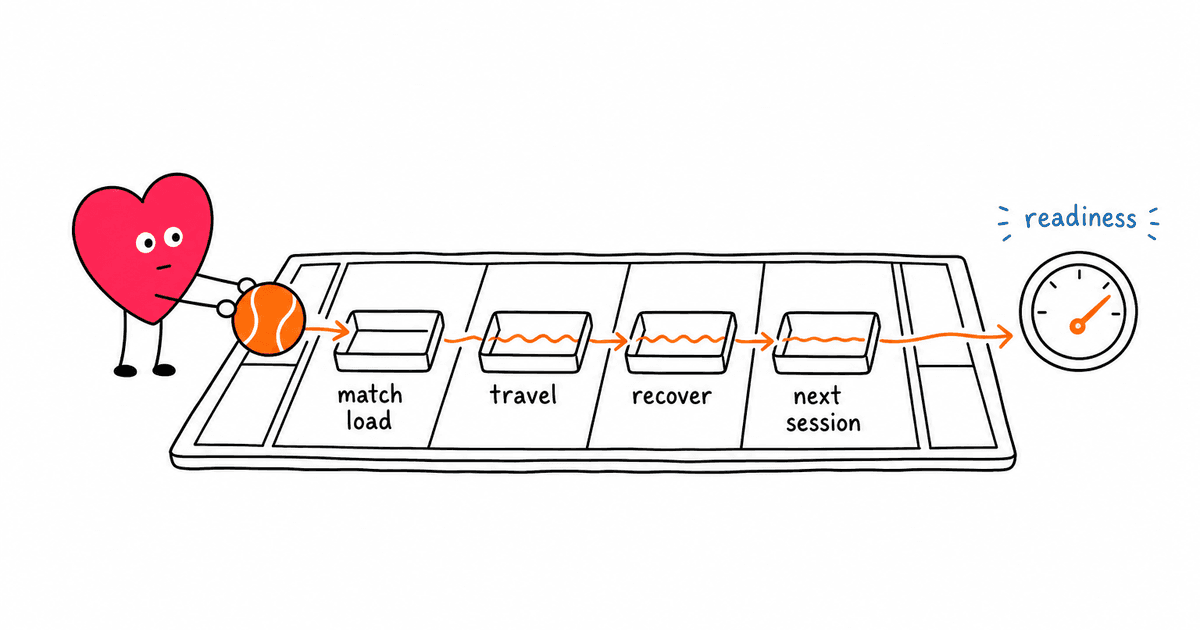
Trying to decode today's HRV number? Use the free interpreter first, then build a practical recovery plan. Interpret your HRV
Does Tennis Affect HRV?
Yes. Regular tennis can improve HRV over time when it builds fitness and you recover well, but hard matches, tournament weekends, heat, and travel often push HRV down in the short term while your body bounces back.
That makes tennis a very good fit for HRV tracking.
A lot of players think of tennis as skill work first and conditioning second. That is understandable, but incomplete. Like basketball and pickleball, tennis mixes repeated accelerations, decelerations, lateral movement, rotational power, concentration, and emotional swings. Even recreational matches can create more fatigue than they seem to in the moment, especially when rallies are long, conditions are hot, or you stack lifting and other training around your court time.
That is where heart rate variability helps. It gives you a way to see whether tennis is building fitness productively or quietly digging a recovery hole.
Why Tennis Is a Good Fit for HRV Tracking
Tennis creates variable stress, and variable stress is exactly where HRV becomes useful.
Unlike a simple steady-state workout, tennis load changes a lot based on:
- singles versus doubles
- match length and rally length
- court surface
- heat, humidity, and sun exposure
- tournament schedule and same-day match volume
- travel and time-zone changes
- how much sprinting and gym work you did around the match
- the emotional load of close sets, tiebreaks, and competition pressure
That variability makes it easy to misread your recovery. You might feel mentally sharp after a fun hit, then wake up with lower HRV, a higher resting heart rate, and heavier legs than expected. That does not mean tennis is bad for you. It means the sport carries a real recovery cost, and HRV can help you see it sooner.
What the Research Says About Tennis and HRV
The research on tennis and HRV is not as large as the literature on endurance sports, but it is strong enough to guide practical decisions.
A 2023 perspective article in Frontiers in Sports and Active Living argued that tennis professionals should track HRV alongside training load, sleep, and nutrition because the sport has a demanding and unpredictable schedule. The authors noted that high-level tennis players may compete around 30 weeks per year, leaving only about 20 weeks for training and recovery, which helps explain why fatigue management matters so much.
The same paper summarized previous tennis load research showing that official matches can create much higher perceived loads than training sessions. In one cited study of professional players, official match load averaged roughly 881 arbitrary units versus about 552 arbitrary units in training. That does not mean every practice is easy, but it does show why match weeks often feel different.
There is also broader health evidence in tennis's favor. The 2018 Copenhagen City Heart Study followed 8,577 adults for up to 25 years and found that tennis was associated with the largest life expectancy gain versus the sedentary group, about 9.7 years. That study was observational, so it does not prove tennis causes longer life, but it strongly supports tennis as a heart-healthy form of activity.
A 2021 study in Applied Psychophysiology and Biofeedback found that HRV biofeedback during short-term recovery improved cardiac variability markers and lowered recovery time after submaximal aerobic exercise. That study was not tennis-specific, but the implication fits tennis well because the sport is built around repeated efforts and repeated recovery windows.
The practical takeaway is simple. Tennis can absolutely support better long-term cardiovascular health and HRV, but your recovery habits still decide whether the sport helps or hurts on a given week.
How Tennis Can Improve HRV Over Time
When the total load is appropriate, tennis can help your HRV for several reasons.
1. It Builds Aerobic Fitness
Tennis is not just explosive movement. A good session can accumulate meaningful cardiovascular work, especially in longer singles matches and frequent training weeks. Better aerobic fitness is generally associated with healthier autonomic balance and better recovery capacity.
2. It Trains Recovery Between Efforts
Tennis is a stop-and-go sport. You sprint, decelerate, reset, and go again. Over time, that can improve your ability to recover between bouts when your overall program is sensible and not overloaded.
3. It Is Easier to Stick With Than Generic Cardio
A lot of people will play tennis consistently when they would never commit to the same amount of treadmill time. That matters because one of the most reliable ways to improve HRV over months and years is simply to stay physically active.
4. It Combines Physical and Social Benefits
Tennis gives you movement, challenge, and social interaction in one package. That combination may be one reason racket sports perform so well in long-term health studies. Our article on social connection and HRV explains why that matters for the nervous system too.
Why Your HRV Might Drop After Tennis
A lower HRV after tennis is not automatically a problem. Often it just means the session was hard enough to require recovery.
Common reasons HRV drops after tennis include:
- a long singles match
- multiple matches in one day
- hard serving volume and upper-body fatigue
- repeated changes of direction and eccentric leg load
- hot or humid weather
- dehydration and electrolyte loss
- underfueling before or after play
- late match times that disrupt sleep
- travel, jet lag, and unfamiliar routines
- stacking strength work or intervals around tennis
- the mental stress of close competition
That last point matters more than many players realize. A tight match can be psychologically draining even when the physical workload feels manageable. HRV responds to the total stress picture, not just the miles you covered.
How to Use HRV to Guide Tennis Training
HRV works best when you measure it consistently and compare it to your own recent baseline, not to somebody else's numbers online.
A useful setup is:
- measure HRV the same way each morning or use a consistent overnight wearable
- compare it with your 7 to 30 day baseline
- track sleep, soreness, mood, and resting heart rate alongside HRV
- look for patterns across several days instead of panicking over one low reading
Green Light: HRV Near Baseline
If HRV is close to normal and you feel good, that is usually a solid day for full training.
On green-light days, you can usually handle:
- a normal practice or match
- harder movement drills
- speed work
- a planned strength session
- a tougher singles session instead of a light hit
Yellow Light: HRV Mildly Below Baseline
If HRV is a bit lower than usual but you do not feel awful, keep the session and lower the cost.
Smart yellow-light adjustments include:
- turning a hard singles session into doubles or drilling
- reducing extra sprint work
- shortening the total session
- keeping the gym session lighter
- being aggressive about hydration, fuel, and an earlier bedtime
Red Light: HRV Clearly Suppressed for More Than a Day
If HRV is well below baseline for more than a day or two, especially with poor sleep, sore legs, shoulder fatigue, or an elevated resting heart rate, treat that as a recovery signal.
Better options on red-light days:
- make the session technical instead of competitive
- skip optional conditioning
- replace a hard lift with mobility or easy aerobic work
- take a full rest day if fatigue is obvious
This does not mean HRV should run your whole tennis life. It means it can help you avoid the common mistake of forcing intensity when recovery is already lagging.
What Tennis Players Should Watch Besides HRV
HRV is more useful when you pair it with a few other markers.
Resting Heart Rate
A lower HRV plus a higher resting heart rate often tells a clearer story than either one alone. If both are drifting the wrong way, recovery is probably behind.
Sleep
Tennis players often underestimate how much late matches, adrenaline, and travel can affect sleep. Since sleep drives recovery so strongly, HRV makes more sense when you read it alongside HRV and sleep instead of by itself.
Soreness and Joint Load
Calves, adductors, hips, shoulders, and elbows can all take a beating in tennis. If HRV is down and your body feels beat up, that combination matters.
Travel Stress
Tournament players and frequent adult competitors often get hit by schedule changes, hotel sleep, airport days, and irregular meals. If that is your pattern, our guide to travel and jet lag and HRV is worth reading too.
Mood and Motivation
Sometimes the first sign of accumulated stress is that you feel unusually flat, wired, or irritable before practice. That counts, even if your forehand still looks fine for the first twenty minutes.
The Best Wearables for Tracking Tennis Recovery
If you want to use HRV around tennis, the best device is the one you will use consistently.
Good options include the Oura Ring 4, Whoop 5, Apple Watch Ultra, Garmin wearables, and Polar wearables. The best choice depends on whether you care more about comfort, continuous wear, sleep tracking, training features, or overall ecosystem. If you are still comparing options, our best HRV monitors guide and Apple Watch HRV guide are the best starting points.
What to watch after practices and matches:
- overnight HRV versus your baseline
- resting heart rate the next morning
- whether tournament weekends suppress HRV longer than ordinary practice weeks
- how much hot conditions affect your next-day recovery
- how quickly HRV rebounds after your longest or most competitive matches
If your wearable shows that Saturday league singles always hurts Sunday recovery more than expected, that is useful. If travel weeks crush your numbers more than training weeks, that is useful too.
A Simple HRV-Based Tennis Recovery Framework
Here is a practical way to use HRV without becoming obsessive.
Club or Recreational Week
- 2 to 4 tennis sessions
- 1 to 2 strength sessions
- 1 easy recovery day
- enough low-stress time between your hardest efforts
In a normal week, a brief HRV dip after a hard match is fine. What you want is a rebound within about 24 to 72 hours.
Tournament Week
- expect more cumulative fatigue
- expect more sleep disruption and emotional load
- cut optional conditioning
- keep gym work short and simple
- use low-HRV mornings as a reason to protect recovery, not prove toughness
Tournament weeks are where HRV becomes especially valuable. You can feel mentally locked in while your body is quietly falling behind.
Offseason Build Week
- 2 to 3 focused tennis sessions
- 2 strength sessions
- 1 to 2 easy aerobic sessions
- enough recovery days to keep your baseline reasonably stable
If HRV trends downward for several days in a row during a build block, the answer usually is not more grit. It is better recovery, slightly less load, or both.
Recovery Habits That Matter Most for Tennis Players
If you want better HRV and better tennis, the basics still do most of the work.
Sleep First
If you play late, finish wired, scroll your phone, and sleep badly, do not be shocked when HRV is down the next morning. Protecting sleep is one of the most reliable ways to improve readiness.
Refuel Like the Match Counted
A lot of adult players underfuel because tennis feels playful compared with formal workouts. That is still a mistake. Hard matches can burn through glycogen quickly, and poor refueling often shows up as flatter energy and worse recovery. Start with a meal that includes protein and carbohydrates after play. If nutrition is the weak link, our nutrition and HRV and blood sugar and HRV guides can help.
Hydration and Electrolytes
Outdoor tennis in heat deserves respect. If you routinely finish sessions drained, crampy, or headachy, revisit the basics in hydration and HRV and electrolytes and HRV.
Strength and Tissue Capacity
Well-placed strength work can make tennis easier to tolerate, not harder. Stronger calves, hamstrings, hips, trunk muscles, and shoulders help you handle the repeated starts, stops, and serves. The mistake is stacking your hardest lift on top of your hardest tennis day when HRV is already suppressed. Our strength training and HRV guide goes deeper on that balance.
Easy Movement on Recovery Days
Not every low-HRV day needs complete rest, but many need lower stress. Light mobility, a walk, or an easy zone 2 session can help you recover without adding a new fatigue problem.
Common Mistakes Tennis Players Make With HRV
Treating Every Low Reading Like a Crisis
A lower HRV after a long match is usually normal. The important question is whether it rebounds.
Ignoring Heat and Travel
For many players, hot weather and schedule disruption explain more of the HRV drop than the tennis itself.
Keeping All the Extras in Place
Extra serves, extra sprints, extra lifting, and extra drilling all sound disciplined. Sometimes they are just extra fatigue.
Comparing Your Numbers With Other Players
Your baseline matters more than someone else's screenshot.
Forgetting That Doubles Can Still Add Load
Doubles is often easier to recover from than singles, but tournament doubles plus singles plus travel can still stack up fast.
The Bottom Line
Tennis can absolutely support better long-term HRV, heart health, and overall fitness. It gives you aerobic work, repeated high-intensity efforts, coordination, and social engagement in one sport, which is a pretty efficient package.
But tennis can also outpace recovery quickly, especially during tournament stretches, hot-weather play, poor sleep, travel, and heavy training blocks.
That is why HRV is useful. It helps you tell the difference between productive stress and accumulated fatigue.
Track it consistently, compare it to your own baseline, and read it together with sleep, resting heart rate, soreness, and mood. Done well, HRV becomes less about chasing a perfect score and more about staying healthy enough to keep showing up with good legs and a clear head.
FAQ
Is tennis good for heart health?
For most healthy adults, yes. Tennis can provide meaningful cardiovascular exercise, support long-term fitness, and make it easier to stay active consistently. People with known heart disease, symptoms, or medical restrictions should follow their clinician's guidance.
Does tennis increase or decrease HRV?
Both can happen. Regular tennis may improve baseline HRV over time, while long matches, hot conditions, poor sleep, and travel can temporarily decrease HRV during recovery.
Should I play tennis if my HRV is low?
Often you can still move, but it is smart to scale the session to your recovery status. Technical drilling, doubles, easy movement, or a lighter gym session often make more sense than another max-effort singles match.
How long does HRV take to recover after tennis?
That depends on your fitness, age, match load, heat, sleep, and travel. Many players rebound within 24 to 72 hours, but hard tournament weeks can take longer.
What is the best wearable for tennis recovery?
There is no perfect device for everyone. The best option is the one that gives you consistent HRV, sleep, and resting heart rate data and that you will actually wear every day.
Need a quick read on your HRV number first?
Enter your HRV value, age range, device, and recovery context for a plain-English interpretation before you decide what to do next.
Interpret Your HRV NumberBuild the 30-day plan