Basketball and HRV: How Players Can Train Hard, Recover Better, and Stay Ready
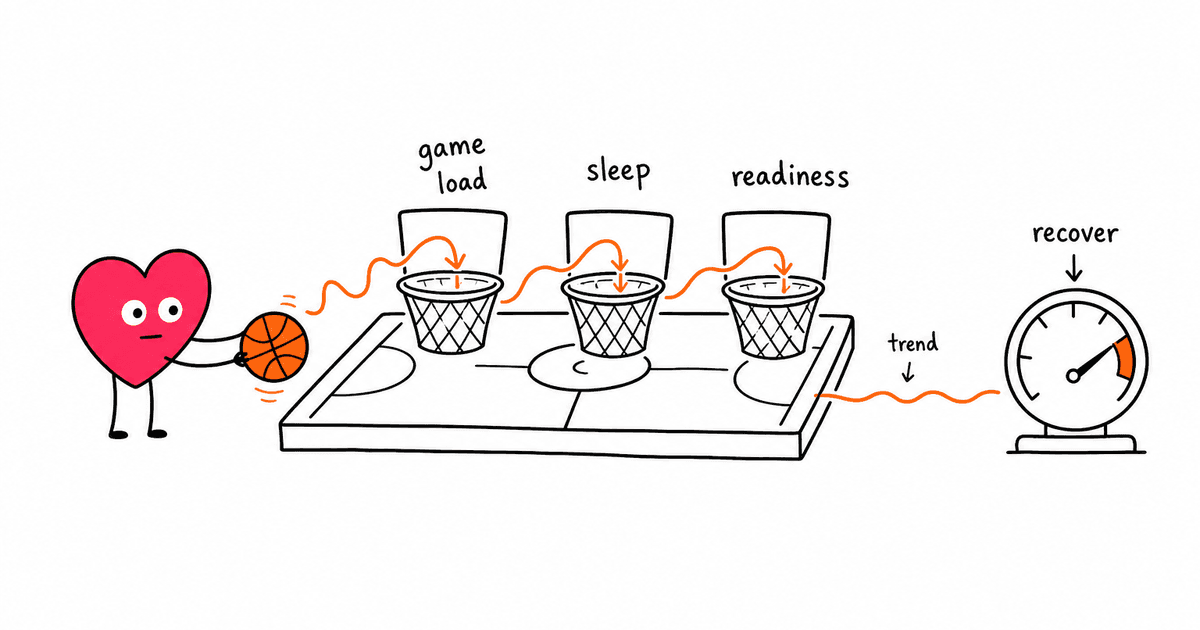
Trying to decode today's HRV number? Use the free interpreter first, then build a practical recovery plan. Interpret your HRV
Does Basketball Affect HRV?
Yes. Basketball can improve HRV over time by building cardiovascular fitness, but hard games, repeated sprints, jumping, contact, late nights, and tournament schedules can temporarily lower HRV while your body recovers.
Basketball is easy to underestimate because it is fun. A casual pickup run can feel less like a workout than a treadmill session, even when it includes accelerations, hard stops, jumps, defensive slides, collisions, and emotional spikes every few possessions.
That is exactly why heart rate variability can be useful for players. Basketball creates a mixed stress load. Some of it is physical. Some of it is nervous system load from competition, decision-making, and adrenaline. HRV helps you see whether that load is improving fitness or quietly outrunning recovery.
A lower HRV the morning after a hard run is not a failure. It is often a normal recovery signal. The useful question is whether your HRV rebounds after 24 to 72 hours or keeps sliding as games, lifts, travel, work, and sleep debt pile up.
Why Basketball Is a Good HRV Use Case
Basketball is not steady cardio. Like tennis and pickleball, it is a stop-and-go sport with frequent changes in speed, direction, posture, and intensity.
A single session can include:
- easy jogging up the floor
- short sprints in transition
- repeated jumping and landing
- hard decelerations and defensive slides
- contact in the paint
- short rest periods between possessions
- high mental demand from reading the game
- emotional stress from close scores, mistakes, and competition
That variability makes basketball harder to judge by time alone. Thirty minutes of shooting around is not the same as thirty minutes of full-court 5-on-5. A wearable, morning HRV trend, and a few subjective markers can help you separate useful training stress from accumulated fatigue.
What the Research Says About Basketball and HRV
Basketball-specific HRV research is smaller than the research base for endurance sports, but it is strong enough to give players practical direction.
A 2022 study in Frontiers in Physiology tested whether an HRV-based training load index could monitor basketball drills in elite male college players. The athletes completed 10-minute drills from 1-on-1 through 5-on-5 while researchers measured HRV-based load, TRIMP, rating of perceived exertion, speed, and distance. The HRV load measure correlated with TRIMP, perceived exertion, and training intensity, and it helped differentiate drills with the same duration but different intensity.
That matters because basketball load is often more about intensity than simple volume. Two sessions can both last an hour, but one may be mostly skill work while the other is repeated sprinting, contact, and full-court pressure.
A 2025 proof-of-concept study in Sensors looked at semi-professional basketball players and found that next-day ultra-short-term HRV, especially LnRMSSD, was influenced by previous-day training and match load. Matches appeared to create the strongest HRV changes, while intensity-related metrics, perceived exertion, minutes played, days since the last match, and recent load helped explain HRV variation.
A 2024 review in Applied Sciences described HRV as a promising tool for monitoring training load, recovery, competition stress, and adaptation in basketball, while also noting that the field still needs more standardized protocols. Translation: HRV is useful, but it is not a crystal ball. It works best when you track your own baseline and combine it with sleep, soreness, resting heart rate, and how you actually feel.
The broader health case is also strong. The American Heart Association has highlighted basketball as a heart-healthy form of exercise for many people, with potential benefits for blood pressure, weight management, cholesterol, stress, and social connection. It is intense, though, so the recovery side deserves respect.
How Basketball Can Improve HRV Over Time
Basketball can support a healthier HRV baseline when the workload is appropriate and recovery keeps up.
- It builds cardiovascular fitness. Basketball combines aerobic movement with repeated high-intensity bursts, which can support better autonomic flexibility over time.
- It trains repeated effort and recovery. The sport asks you to accelerate, recover, and accelerate again, similar to HIIT but with skill and decision-making layered on top.
- It supports social connection. Pickup games, leagues, and team practices add a social outlet, which can support stress regulation and consistency. See social connection and HRV for more.
- It is easier to repeat. For many people, basketball is more engaging than formal cardio. A sport you actually play week after week usually beats a perfect plan you abandon.
Why Your HRV Might Drop After Basketball
A lower HRV after basketball usually means your body is recovering from stress. That stress may be productive, but it still counts.
Common reasons HRV drops after basketball include:
- full-court games or intense pickup runs
- repeated sprinting and hard defensive possessions
- jumping, landing, and eccentric muscle damage
- contact, screens, rebounds, and collisions
- hot gyms or outdoor courts
- dehydration and electrolyte loss
- late-night games that delay sleep
- tournament weekends or multiple games in one day
- stacking basketball with heavy lifting or conditioning
- poor fueling before or after play
- competitive stress, frustration, or adrenaline
The key is duration. A one-day dip after a tough game is normal. HRV that stays suppressed for several days, especially with a higher resting heart rate, bad sleep, sore legs, or low motivation, is a stronger recovery warning.
Pickup Basketball vs. Organized Basketball
Not all basketball creates the same HRV response.
- Casual shooting or half-court play: usually low cost, and sometimes closer to active recovery.
- Competitive pickup: often sneakier than planned workouts because intensity, rest, and total games are poorly controlled.
- Team practice: depends on structure. Walkthroughs and shooting work are not the same as pressure drills, transition work, and conditioning finishers.
- Games and tournaments: usually create the biggest recovery demand because they combine intensity, minutes played, emotional load, travel, and disrupted routines.
HRV helps you learn which basketball formats actually cost you the most, instead of assuming every session with a ball is the same.
How to Use HRV to Guide Basketball Training
HRV works best when you compare your current reading to your own baseline, not to another player's number.
A simple setup:
- measure HRV consistently each morning or use the same overnight wearable
- watch your 7 to 30 day baseline
- track resting heart rate, sleep, soreness, and mood alongside HRV
- note basketball session type, intensity, and minutes played
- look for patterns across several days rather than reacting to one reading
Green Light: HRV Near Baseline
If HRV is close to normal and you feel good, you can usually handle normal basketball work.
Good green-light options include:
- full practice
- competitive pickup
- sprint or conditioning work
- strength training if it is already part of the plan
- normal minutes in a game
Yellow Light: HRV Mildly Below Baseline
If HRV is a little low but you feel okay, keep the session but trim the cost.
Smart yellow-light adjustments include:
- playing fewer games in pickup
- skipping extra conditioning after practice
- keeping lifting moderate rather than maximal
- emphasizing shooting, ball handling, and tactical work
- adding more rest between hard efforts
- prioritizing hydration, food, and sleep afterward
Red Light: HRV Clearly Suppressed
If HRV is clearly below baseline for more than a day or two, especially with poor sleep, heavy legs, irritability, or a higher resting heart rate, treat it as a recovery signal.
Better red-light choices include:
- easy shooting instead of full-court runs
- film, walkthroughs, or low-intensity skill work
- mobility and light aerobic movement
- a shorter lift with no max-effort sets
- a full rest day if fatigue is obvious
HRV should not make every decision for you. It should give you a more honest view of the cost of your training.
What Basketball Players Should Track Besides HRV
HRV becomes more useful when it sits next to a few simple signals:
- Resting heart rate: low HRV plus elevated resting heart rate is a stronger fatigue signal than either metric alone.
- Sleep quality: late games can push sleep later, which may explain a poor next-day reading better than training load alone. See HRV and sleep for the deeper guide.
- Soreness and joint irritation: HRV does not directly measure ankle, knee, calf, hip, or back stress.
- Mood and motivation: feeling unusually flat, irritable, or unmotivated can point to nervous system fatigue.
- Performance feel: watch first-step quickness, shooting legs, defensive focus, and recovery between possessions.
The Best Wearables for Basketball Recovery
For basketball, the best HRV tracker is usually the device you will wear consistently outside of games.
Most players should focus on overnight or morning recovery data rather than trying to wear a ring during contact play. Good options include the Oura Ring 4, Whoop 5, Apple Watch Ultra, Garmin wearables, and Polar wearables. If you are comparing platforms, start with our best HRV monitors guide and Apple Watch HRV guide.
What to watch after basketball:
- overnight HRV versus baseline
- resting heart rate the next morning
- sleep duration and timing after late games
- how HRV responds to pickup versus organized games
- whether tournament weekends suppress recovery for multiple days
- how fast HRV rebounds after your hardest sessions
The goal is not to chase a perfect score. The goal is to learn your recovery pattern.
A Simple Basketball Recovery Framework
Use HRV to make small adjustments before fatigue becomes obvious.
- One pickup run per week: a brief HRV dip is usually fine if it rebounds within a day or two.
- Two to three sessions per week: watch for a downward trend across the week. If it appears, trim extra games, optional conditioning, or heavy lower-body lifting.
- League game plus practice: treat the game as a high-cost session and keep the next day lighter unless HRV, resting heart rate, and legs all look normal.
- Tournament weekend: expect cumulative fatigue from multiple games, travel, poor food options, and adrenaline. Use the next 24 to 72 hours for sleep, easy movement, and normal meals.
Recovery Habits That Matter Most
Basketball recovery is not complicated, but it does require respecting the basics.
Sleep After Late Games
Late runs are fun, but they are rough on recovery. Build a short wind-down routine after night games: dim lights, shower, hydrate, eat a normal meal or snack, and stop scrolling earlier than your nervous system wants.
Fuel the Work
Basketball burns glycogen quickly. If you under-eat before or after play, your next-day energy and HRV may suffer. A normal post-game meal with carbohydrate, protein, and fluids is a better recovery tool than another supplement rabbit hole. See nutrition and HRV for the bigger picture.
Hydrate Before You Feel Behind
Hot gyms and outdoor courts can drive up cardiovascular strain. If your HRV is worse after sweaty sessions, review hydration and HRV and electrolytes and HRV, especially if you finish games with headaches, cramps, or salt stains.
Build Strength Without Stacking Stress
Strength training can make basketball easier to tolerate by improving tissue capacity, landing mechanics, and resilience. The mistake is putting heavy legs, plyometrics, and full-court runs on top of each other when recovery is already poor.
Use Easy Movement Wisely
A light walk, easy bike, mobility session, or low-effort shooting can help you feel better after hard play. Keep it easy enough that HRV rebounds rather than gets hit again.
Common HRV Mistakes Basketball Players Make
- Calling every pickup run recovery: some pickup is light, and some is war. Judge the session by intensity, duration, and next-day recovery.
- Obsessing over one low reading: one low HRV reading after a hard game is normal. A multi-day trend deserves more attention.
- Comparing yourself to teammates: a guard, center, weekend player, and former college athlete can have very different baselines.
- Ignoring late-night sleep debt: if you play late and sleep five hours, sleep may explain the HRV drop.
- Using HRV to override pain: HRV is not an injury detector. Adjust if your Achilles, knee, ankle, or back is irritated.
Who Should Be Careful With Basketball Intensity
Basketball can be excellent exercise, but it is not gentle. The stops, starts, jumps, and competitive bursts can be demanding.
Be more cautious if you are returning after a long layoff, managing heart disease risk, dealing with dizziness or chest symptoms, recovering from injury, or starting from very low fitness. In those cases, build gradually and talk with a qualified clinician if you are unsure what level of intensity is safe for you.
HRV can help you monitor recovery, but it is not medical clearance.
The Bottom Line
Basketball can be a powerful way to build fitness, support heart health, reduce stress, and stay consistent with exercise. It is also intense enough to suppress HRV when the workload, sleep debt, heat, or competition stress gets too high.
Use HRV as a trend, not a verdict. If your HRV rebounds after hard runs, the load is probably productive. If it stays low while resting heart rate, soreness, and fatigue rise, your body is asking for a lighter day.
The best basketball plan is not the one that proves you can grind forever. It is the one that lets you keep playing well, recover fully, and still want the next run.
FAQ
Is basketball good for HRV?
Basketball can be good for HRV over time because it builds cardiovascular fitness, consistency, and social connection. Short-term HRV dips after hard games are normal and usually reflect recovery demand.
Why is my HRV low after basketball?
Your HRV may be low after basketball because of sprinting, jumping, contact, dehydration, late-night play, poor sleep, or tournament fatigue. Look for rebound over the next 24 to 72 hours.
Should I skip basketball if my HRV is low?
Not always. If HRV is mildly low but you feel fine, reduce volume or intensity. If HRV is clearly suppressed for multiple days and you also feel tired, sore, or run down, choose recovery or light skill work.
Is pickup basketball enough cardio?
For many people, competitive pickup basketball can provide meaningful cardio because it mixes moderate movement with high-intensity bursts. It still needs recovery, especially if you play full court or stack it with lifting.
Need a quick read on your HRV number first?
Enter your HRV value, age range, device, and recovery context for a plain-English interpretation before you decide what to do next.
Interpret Your HRV NumberBuild the 30-day plan