HRV During Pregnancy: What to Expect and How to Support Your Autonomic Health
Trying to decode today's HRV number? Use the free interpreter first, then build a practical recovery plan. Interpret your HRV
Pregnancy triggers one of the most dramatic cardiovascular transformations your body will ever undergo. Blood volume increases by up to 50%, resting heart rate rises, and your autonomic nervous system shifts to support a growing baby. All of these changes show up clearly in your HRV data.
If you are tracking HRV during pregnancy, understanding what is normal can help you avoid unnecessary worry and make informed decisions about rest, activity, and recovery.
How Pregnancy Affects the Autonomic Nervous System
During pregnancy, the autonomic nervous system shifts toward increased sympathetic activity and reduced parasympathetic tone, resulting in lower heart rate variability compared to pre-pregnancy levels. This shift supports the increased cardiac output needed to supply blood to both mother and baby.
A systematic review published in JMIR Bioinformatics and Biotechnology (2022) analyzed HRV studies across all trimesters and confirmed that pregnant women consistently show reduced HRV compared to non-pregnant controls. This is a normal physiological adaptation, not a sign of poor health.
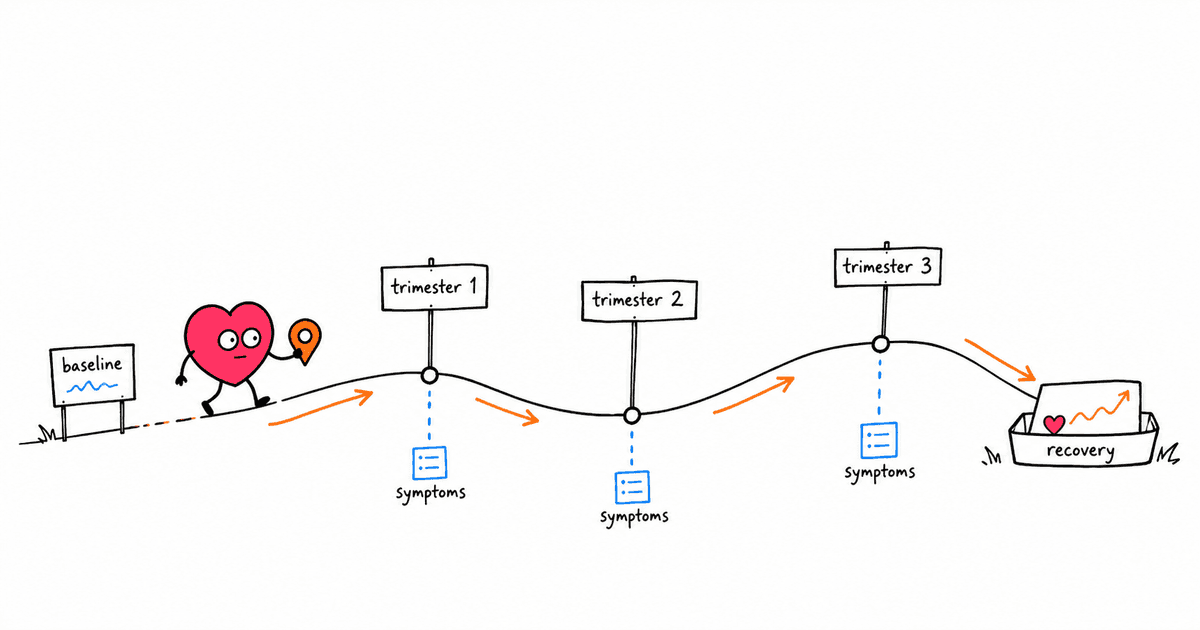
HRV Changes by Trimester
First Trimester (Weeks 1 to 12)
The first trimester marks the beginning of significant cardiovascular changes. Blood volume starts increasing, and your resting heart rate may rise by 10 to 20 beats per minute over the course of pregnancy. Early HRV changes can be subtle, but research from a cross-sectional study published in PMC (2020) found that HRV is already reduced in the first trimester compared to non-pregnant women.
Key changes during this period include a slight decrease in RMSSD and HF (high-frequency) power, indicating reduced parasympathetic activity, along with a mild increase in LF/HF ratio as sympathetic influence grows.
Second Trimester (Weeks 13 to 26)
The second trimester often feels like the most comfortable period of pregnancy, and HRV data reflects a relative stabilization. While HRV remains lower than pre-pregnancy levels, the rate of decline often plateaus during this phase.
Blood volume continues to increase, and the placenta is now fully functional. Research from Frontiers in Physiology (2023) suggests that the autonomic nervous system reaches a new equilibrium during this period, with both branches adapting to the increased cardiovascular demands.
Third Trimester (Weeks 27 to 40)
The third trimester typically shows the most pronounced HRV reduction. The growing uterus places mechanical pressure on the inferior vena cava (especially when lying flat), and blood volume reaches its peak. Studies have found that HRV metrics, particularly SDNN and RMSSD, reach their lowest values during the final weeks of pregnancy.
A study in PMC (2022) using continuous wearable monitoring confirmed that resting heart rate peaks and HRV reaches its nadir in the third trimester. This is the period where paying attention to recovery and stress management becomes especially important.
What Is a "Normal" HRV During Pregnancy?
There is no single number that defines normal HRV during pregnancy, just as there is no single normal HRV for the general population. Your baseline matters more than any absolute value.
However, here are general patterns supported by research:
| Metric | Pre-Pregnancy | First Trimester | Second Trimester | Third Trimester |
|---|---|---|---|---|
| RMSSD | Baseline | 5-15% decrease | 10-20% decrease | 15-30% decrease |
| SDNN | Baseline | Mild decrease | Moderate decrease | Lowest point |
| Resting HR | 60-80 bpm | +5-10 bpm | +10-15 bpm | +15-20 bpm |
| LF/HF Ratio | Baseline | Slight increase | Moderate increase | Highest point |
These are approximate ranges based on available research. Individual variation is significant, and factors like fitness level, age, and stress all influence the specific numbers.
Why Lower HRV During Pregnancy Is Normal
It can be alarming to watch your HRV decline week after week, especially if you are used to tracking it as a health metric. But lower HRV during pregnancy is an expected and healthy adaptation.
Your body is prioritizing blood flow to the uterus and placenta, maintaining higher cardiac output, supporting fetal growth and development, and preparing for the physical demands of labor and delivery.
Think of it as your autonomic nervous system redirecting resources. The sympathetic shift keeps your cardiovascular system performing at the higher level pregnancy demands.
Tracking HRV During Pregnancy: Practical Tips
Choose the Right Device
Wrist-based wearables like the Oura Ring 4 and Apple Watch are comfortable options during pregnancy. Chest straps can become uncomfortable as your body changes, though devices like the Garmin HRM-600 remain accurate for those who prefer them.
Measure at the Same Time Daily
Consistency is even more important during pregnancy because your HRV is already changing due to gestational factors. Morning measurements within five minutes of waking provide the most comparable data day to day.
Track Trends, Not Individual Readings
A single low reading does not indicate a problem. Look at weekly trends and compare them to your own baseline from earlier in pregnancy or pre-pregnancy levels.
Do Not Compare to Non-Pregnant Norms
Standard HRV norms by age do not account for pregnancy. Comparing your third-trimester HRV to population averages will only cause unnecessary anxiety.
6 Ways to Support Healthy HRV During Pregnancy
1. Prioritize Sleep Quality
Sleep becomes increasingly difficult in later pregnancy, but it remains the single most important factor for HRV recovery. Use pregnancy pillows for support, keep your bedroom cool, and maintain a consistent bedtime.
2. Practice Gentle Breathing Exercises
Breathing exercises activate the parasympathetic nervous system and can help counterbalance the sympathetic shift of pregnancy. Slow, diaphragmatic breathing at a rate of five to six breaths per minute for 10 minutes daily has shown benefits for HRV in multiple studies.
3. Stay Hydrated
Hydration is critical during pregnancy as blood volume expands significantly. Even mild dehydration can reduce HRV and increase heart rate. Aim for 8 to 12 cups of water daily, more if you are active or in a warm climate.
4. Continue Moderate Exercise
Moderate exercise during pregnancy supports cardiovascular health and autonomic balance. Walking is particularly beneficial as it is low-impact and accessible throughout all three trimesters. Follow your healthcare provider's guidance on exercise intensity.
5. Manage Stress Proactively
Pregnancy brings its own set of stressors, from physical discomfort to emotional changes. Meditation, prenatal yoga, and social connection all support parasympathetic activity and can help maintain healthier HRV levels.
6. Monitor Nutrition and Supplements
Proper nutrition supports autonomic health during pregnancy. Magnesium, which many pregnant women are deficient in, plays a direct role in parasympathetic function. Omega-3 fatty acids have also been linked to improved HRV and are commonly recommended during pregnancy for fetal brain development. Pregnancy also raises iron needs, so persistent fatigue, a higher resting heart rate, or a sharper-than-expected HRV drop may be worth discussing with your clinician; our guide to iron deficiency and HRV explains how low iron can confuse wearable recovery data.
HRV as an Early Warning Sign During Pregnancy
While lower HRV is normal during pregnancy, unusually sharp drops or patterns that deviate significantly from your personal trend may warrant attention.
Research from Frontiers in Physiology (2023) explored using wearable-based HRV monitoring to predict pregnancy complications like preeclampsia. While this research is still in its early stages, abnormal autonomic patterns, such as a sudden and sustained drop in HRV beyond what is expected for gestational age, may be worth discussing with your healthcare provider.
This is not a reason to self-diagnose based on wearable data. It is a reason to track consistently and share your data with your medical team if something looks unusual.
Postpartum HRV Recovery
After delivery, your cardiovascular system begins returning to its pre-pregnancy state. Research suggests the autonomic nervous system takes approximately three to four months to fully recover after birth.
During the postpartum period, you can expect resting heart rate to gradually decrease back toward your pre-pregnancy baseline, HRV metrics to slowly improve over weeks to months, and the timeline to vary based on factors like breastfeeding, sleep deprivation, and physical recovery.
Sleep deprivation is one of the biggest challenges to postpartum HRV recovery. Newborn care often means fragmented sleep, which directly suppresses parasympathetic activity. Be patient with your numbers and prioritize rest when possible. Once your baby arrives, you may also be curious about their heart rate variability. See our guide on HRV in children for what to expect from infancy through adolescence.
When to Talk to Your Doctor
HRV tracking during pregnancy is a useful self-monitoring tool, but it is not a diagnostic device. Contact your healthcare provider if you notice a sudden, dramatic drop in HRV that does not recover within a few days, persistent resting heart rate increases beyond what is expected for your trimester, or HRV changes accompanied by symptoms like dizziness, severe swelling, or visual disturbances.
Your wearable data can be a useful conversation starter with your healthcare team, providing objective data to complement how you are feeling.
The Bottom Line
Pregnancy naturally lowers HRV as your autonomic nervous system adapts to support both you and your baby. This shift toward sympathetic dominance is a normal part of the cardiovascular changes that make pregnancy possible.
By tracking your HRV trends consistently, focusing on sleep, gentle exercise, breathing practices, and proper nutrition, you can support your autonomic health throughout pregnancy and set the stage for a smoother postpartum recovery.
Frequently Asked Questions
Is it safe to track HRV during pregnancy?
Yes. Wearable HRV monitors are completely safe during pregnancy. They use optical sensors or electrical signals that pose no risk to you or your baby. The data can provide valuable insights into your recovery and stress levels.
How much does HRV drop during pregnancy?
Most research shows HRV decreases by 15 to 30% by the third trimester compared to pre-pregnancy levels. However, individual variation is significant. Fitness level, age, and stress all influence the degree of change.
Will my HRV return to normal after pregnancy?
Yes. For most women, HRV returns to pre-pregnancy levels within three to four months postpartum. The timeline can be longer if postpartum sleep deprivation is severe or if there were pregnancy complications.
Can low HRV during pregnancy predict complications?
Early research suggests that abnormal HRV patterns may be associated with conditions like preeclampsia, but this science is still developing. Do not use wearable data to self-diagnose. Share unusual patterns with your healthcare provider.
Need a quick read on your HRV number first?
Enter your HRV value, age range, device, and recovery context for a plain-English interpretation before you decide what to do next.
Interpret Your HRV NumberBuild the 30-day plan