Hormones and HRV: How Your Endocrine System Shapes Heart Rate Variability
Trying to decode today's HRV number? Use the free interpreter first, then build a practical recovery plan. Interpret your HRV
If you have been tracking your HRV for more than a few weeks, you have probably noticed that some dips and spikes are hard to explain. You slept well, trained appropriately, avoided alcohol, and yet your HRV dropped 15 points. Or your readings have been gradually declining over months despite no obvious lifestyle changes.
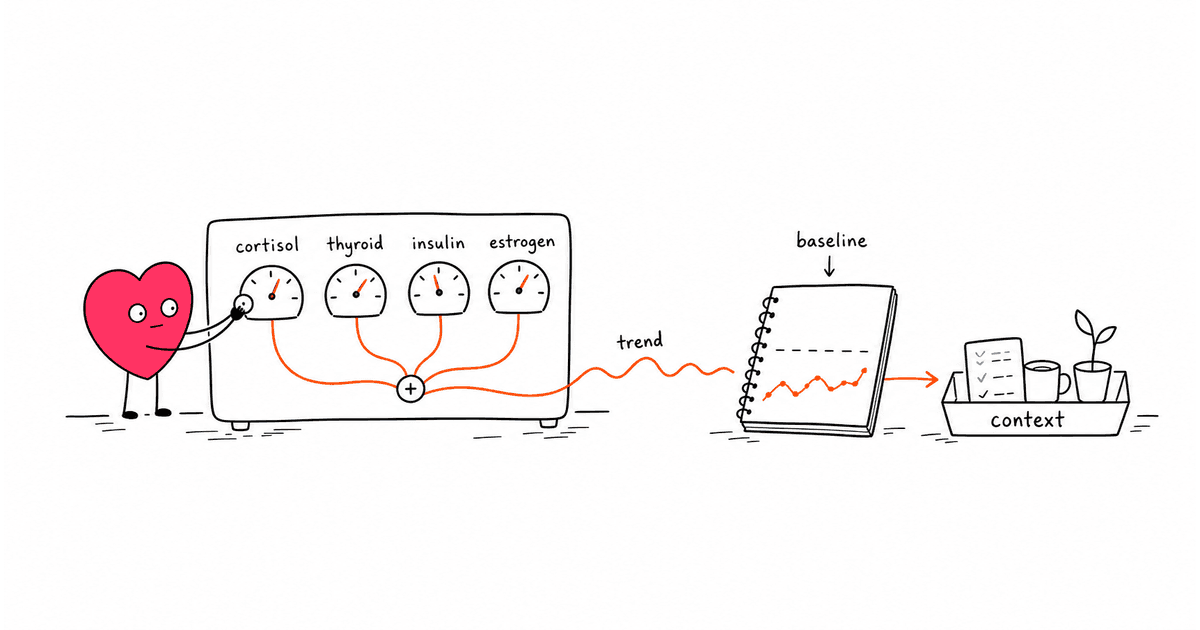
In many cases, the hidden variable is hormonal. Your endocrine system has a direct, powerful influence on autonomic nervous system function. Cortisol, thyroid hormones, testosterone, insulin, and growth hormone all modulate the balance between your sympathetic and parasympathetic branches, and that balance is exactly what your HRV measures.
How Hormones Influence Autonomic Function
Hormones regulate heart rate variability by directly acting on the autonomic nervous system, with cortisol and thyroid hormones having the strongest documented effects on HRV metrics. Hormonal imbalances can shift autonomic tone toward sympathetic dominance, lowering HRV, or disrupt the normal circadian patterns of autonomic regulation.
The connection works through several mechanisms:
- Direct cardiac effects. The heart has receptors for cortisol, thyroid hormones, estrogen, and testosterone. These hormones alter how cardiac cells respond to autonomic signals.
- Central nervous system modulation. Hormones influence the brainstem regions that regulate vagal output.
- HPA axis interaction. The hypothalamic-pituitary-adrenal axis (your stress response system) directly interfaces with autonomic regulation.
- Metabolic effects. Hormones that alter metabolism (thyroid, insulin) change the baseline energy demands on the cardiovascular system.
Cortisol: The Stress Hormone
Cortisol is the hormone most directly tied to stress and HRV. Produced by the adrenal glands under control of the HPA axis, cortisol follows a natural circadian rhythm: peaking in the early morning and declining throughout the day.
How Cortisol Affects HRV
Under normal conditions, cortisol's morning peak helps you wake up and mobilize energy. This is healthy and does not suppress HRV when the system is functioning properly.
The problem is chronic elevation. When cortisol remains elevated due to ongoing stress, poor sleep, overtraining, or illness, it shifts your autonomic balance toward sympathetic dominance:
- Reduced vagal tone. Chronic cortisol suppresses parasympathetic output, lowering HF-HRV.
- Elevated resting heart rate. Sustained sympathetic activation keeps heart rate higher than it should be at rest.
- Blunted circadian variation. Normally, HRV is highest during deep sleep and lowest during peak daytime activity. Chronic cortisol flattens this curve.
A study in critical care personnel found that during high-stress periods, cortisol was significantly correlated with cardiovascular responses, including reduced HRV. During low-stress periods, these associations weakened, suggesting the relationship is most clinically relevant when the stress system is chronically activated (Pruett et al., 2010).
What to Watch For
- Persistently low morning HRV despite adequate sleep
- Loss of normal HRV variation between day and night
- HRV declining in parallel with increasing life stress or training load
- Symptoms of overtraining paired with low HRV
What Helps
- Prioritize sleep quality and duration, as sleep is the primary cortisol regulator
- Breathing exercises directly stimulate vagal tone and can lower cortisol
- Reduce training volume if HRV trends are declining (see our athlete's guide)
- Meditation has been shown to reduce cortisol and improve HRV simultaneously
- Adaptogens like ashwagandha have preliminary evidence for cortisol modulation (see our adaptogens post)
Thyroid Hormones: The Metabolic Regulators
Thyroid hormones (T3 and T4) regulate your metabolic rate, and they have a profound effect on cardiac autonomic function. Both overactive and underactive thyroid conditions significantly alter HRV.
Hypothyroidism and HRV
A 2022 meta-analysis in PLOS ONE found that hypothyroidism is associated with significantly decreased HRV. The mechanism involves elevated TSH (thyroid-stimulating hormone) and its effects on autonomic regulation:
- Reduced parasympathetic activity. Lower RMSSD and HF-HRV compared to healthy controls.
- Increased sympathetic dominance. Higher LF/HF ratio, indicating autonomic imbalance.
- Possible mechanism: Elevated TSH may directly alter catecholamine sensitivity, shifting the balance toward sympathetic activation (Falcone et al., 2022).
The clinical implication is significant: if your HRV has been gradually declining over months and you also experience fatigue, weight gain, cold intolerance, or brain fog, thyroid function is worth investigating.
Hyperthyroidism and HRV
Hyperthyroidism also reduces HRV, but through different mechanisms. A meta-analysis including over 1,000 hyperthyroid patients found significant decreases across nearly all HRV metrics:
- SDNN decreased (reduced overall variability)
- RMSSD decreased (reduced vagal tone)
- HF-HRV decreased (reduced parasympathetic activity)
- LF/HF ratio increased (sympathetic dominance)
The excess thyroid hormone essentially keeps the cardiovascular system in an elevated state, similar to chronic sympathetic activation. Heart rate increases, variability decreases, and the normal autonomic flexibility is impaired (Galetta et al., 2022).
What to Watch For
- Persistent low HRV without clear lifestyle explanation
- Low HRV paired with unexplained fatigue, weight changes, or temperature sensitivity
- HRV that does not respond to typical improvement strategies (sleep, exercise, stress management)
What Helps
- Get thyroid function tested (TSH, free T3, free T4) if HRV trends are unexplainably low
- Treatment of underlying thyroid dysfunction typically restores normal HRV patterns
- Monitor HRV as a complementary marker during thyroid treatment
Testosterone
Testosterone influences cardiovascular function in both men and women, though research on its direct relationship with HRV is less extensive than for cortisol or thyroid hormones.
The Testosterone-Cortisol Ratio
One of the most clinically useful concepts is the testosterone-to-cortisol (T:C) ratio, which reflects the balance between anabolic (building) and catabolic (breaking down) states. A study examining this ratio during a 9-week high-intensity training program found that changes in HRV tracked meaningful shifts in the T:C ratio (Flatt et al., 2021).
When testosterone is high relative to cortisol, the body is in an anabolic, recovery-oriented state, and HRV tends to be higher. When cortisol dominates, the body is in a catabolic, stress-oriented state, and HRV drops.
This has practical implications for athletes and anyone monitoring recovery:
- A declining HRV trend during a training block may reflect a worsening T:C ratio
- Recovery days that restore HRV may be partially driven by testosterone recovery
- Chronic overtraining suppresses testosterone while elevating cortisol, creating a double hit to HRV
Age-Related Testosterone Decline
Testosterone naturally declines with age, roughly 1-2% per year after age 30 in men. This parallels the well-documented age-related decline in HRV. While the direct causal relationship is still being studied, the correlation suggests that hormonal changes contribute to the autonomic shifts seen in aging.
For more on age-related HRV changes, see our guide on HRV for seniors.
Insulin and Blood Sugar
Blood sugar regulation is tightly connected to autonomic function, and insulin plays a central role.
Insulin Resistance and HRV
Insulin resistance, a precursor to type 2 diabetes, is consistently associated with reduced HRV. The mechanism involves:
- Chronic low-grade inflammation. Insulin resistance promotes systemic inflammation, which suppresses vagal tone.
- Autonomic neuropathy. Chronically elevated blood sugar damages autonomic nerve fibers over time.
- Sympathetic activation. Insulin resistance triggers compensatory sympathetic activation to maintain glucose homeostasis.
Multiple large population studies have confirmed that lower HRV predicts the development of insulin resistance and type 2 diabetes, sometimes years before clinical diagnosis. This makes HRV a potentially useful early warning signal.
What Helps
- Maintain stable blood sugar through balanced nutrition (see our nutrition guide)
- Regular exercise, especially zone 2 training, improves insulin sensitivity
- Intermittent fasting can improve insulin sensitivity in some people
- Monitor fasting glucose and HbA1c alongside HRV trends
Growth Hormone
Growth hormone (GH) is released primarily during deep sleep and intense exercise. While direct studies on GH and HRV are limited, the connection is likely mediated through sleep quality and recovery.
The Sleep-GH-HRV Connection
- Deep (slow-wave) sleep is when both GH secretion and HRV reach their highest points
- Poor sleep reduces both GH release and nighttime HRV
- Sleep deprivation suppresses GH and simultaneously crashes HRV
This suggests that interventions which improve deep sleep quality, such as consistent sleep schedules, cool bedroom temperatures, and avoiding late-night eating, may benefit both GH release and HRV.
Estrogen and Progesterone
Female sex hormones have well-documented effects on HRV that fluctuate throughout the menstrual cycle. In brief:
- Estrogen tends to enhance parasympathetic activity and increase HRV
- Progesterone shifts autonomic balance toward sympathetic dominance, lowering HRV
- The luteal phase (high progesterone) typically shows lower HRV than the follicular phase (higher estrogen relative to progesterone)
For a detailed breakdown of how menstrual cycle hormones affect HRV tracking and training, see our dedicated guide on HRV and the menstrual cycle. If you are looking at hormone-related HRV changes through the lens of irregular cycles or insulin resistance, our guide to PCOS and HRV is the better next read. If severe menstrual or pelvic pain is the bigger issue, see endometriosis and HRV.
Putting It All Together: Using HRV to Monitor Hormonal Health
HRV is not a diagnostic tool for hormonal conditions, but it can serve as an early warning system and a monitoring tool:
Red Flags in Your HRV Data
| Pattern | Possible Hormonal Connection |
|---|---|
| Gradual decline over months | Thyroid dysfunction, testosterone decline, chronic cortisol elevation |
| Loss of day/night variation | Cortisol rhythm disruption (adrenal dysfunction) |
| HRV crashes during luteal phase | Normal progesterone effect, but extreme drops may warrant investigation |
| Low HRV + fatigue + weight gain | Hypothyroidism |
| Low HRV + anxiety + weight loss | Hyperthyroidism |
| Declining HRV during training block | Worsening testosterone-to-cortisol ratio |
| Low HRV + poor sleep quality | Growth hormone disruption, cortisol elevation |
When to Get Tested
Consider hormonal testing if:
- Your HRV has been trending down for 4+ weeks without a clear lifestyle explanation
- You have additional symptoms (fatigue, weight changes, mood changes, temperature sensitivity)
- Standard HRV improvement strategies (sleep, exercise, stress management, breathing) are not working
- You are over 40 and experiencing a steady, progressive HRV decline
Basic panels to discuss with your doctor:
- Thyroid: TSH, free T3, free T4
- Stress/adrenal: Morning cortisol, DHEA-S
- Metabolic: Fasting insulin, fasting glucose, HbA1c
- Sex hormones: Testosterone (total and free), estradiol, progesterone (if applicable)
Tracking Hormones and HRV Together
If you are monitoring a hormonal condition or undergoing treatment:
- Use a consistent HRV tracker like the Oura Ring or Whoop for reliable daily data
- Track HRV trends alongside treatment changes
- Look for correlation between HRV improvements and symptom resolution
- Share your HRV data with your healthcare provider as supplementary information
For guidance on choosing a tracker, see our best HRV monitors guide.
The Bottom Line
Your hormones are constantly influencing your HRV, whether you realize it or not. Cortisol, thyroid hormones, testosterone, insulin, and growth hormone all modulate the autonomic nervous system balance that your HRV reflects.
Understanding these connections gives you two advantages: first, you can better interpret puzzling patterns in your HRV data. Second, you can use HRV as an early signal that something may be off hormonally, prompting investigation before symptoms become severe.
HRV alone cannot diagnose hormonal conditions. But combined with symptom awareness and appropriate testing, it becomes a powerful tool for monitoring your overall endocrine health.
Need a quick read on your HRV number first?
Enter your HRV value, age range, device, and recovery context for a plain-English interpretation before you decide what to do next.
Interpret Your HRV NumberBuild the 30-day plan