Daylight Saving Time and HRV: How the Clock Change Affects Your Heart Rate Variability
Trying to decode today's HRV number? Use the free interpreter first, then build a practical recovery plan. Interpret your HRV
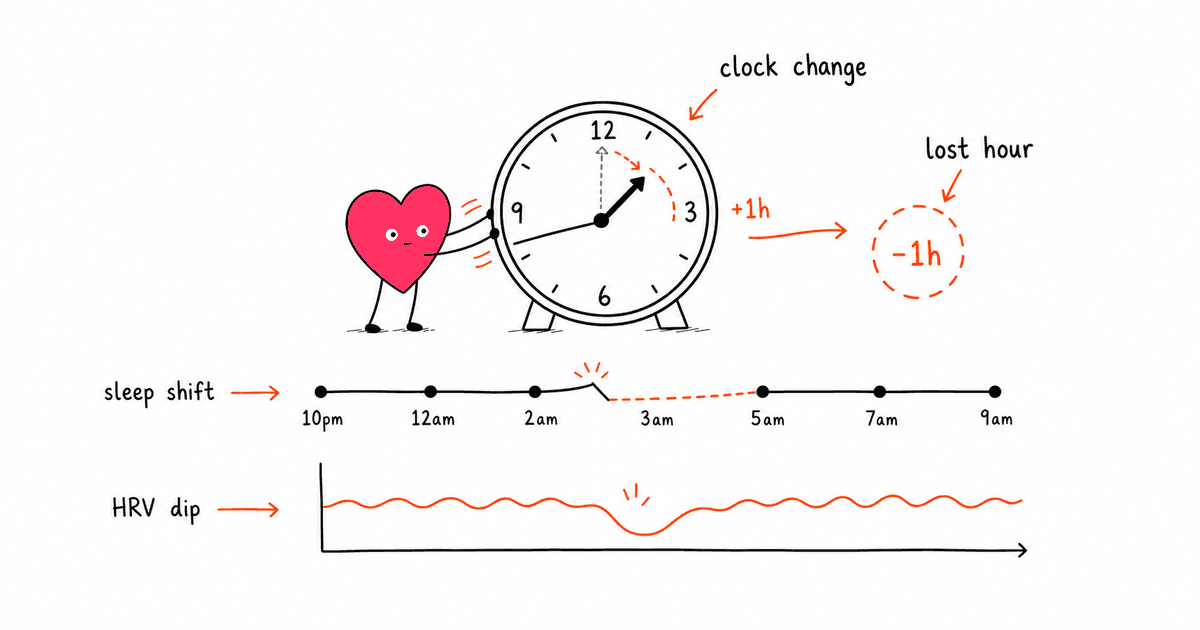
Every March, clocks spring forward by one hour, and millions of people feel the effects for days afterward. But the impact of daylight saving time (DST) goes beyond grogginess. Research shows that this seemingly small shift measurably disrupts your autonomic nervous system, lowering heart rate variability and increasing cardiovascular stress.
If you track HRV with a wearable, you may have already noticed the pattern: lower readings, higher resting heart rate, and worse recovery scores in the days following the spring transition. Here's what the science says and how to minimize the damage.
What Happens to Your Body During the DST Transition
When clocks spring forward, your body experiences a form of acute circadian misalignment. Your internal clock, governed by the suprachiasmatic nucleus in the brain, relies on consistent light-dark cycles to regulate sleep, hormone release, and autonomic nervous system function. Shifting the external clock by one hour forces every system in your body to recalibrate.
This creates a cascade of physiological disruptions:
- Cortisol timing shifts. The stress hormone cortisol normally peaks shortly after waking. During DST transitions, this peak can occur at the wrong biological time, leaving you waking before your body is ready.
- Sympathetic nervous system activation. Sleep loss, even by one hour, increases sympathetic (fight-or-flight) activity and suppresses parasympathetic (rest-and-digest) tone.
- Melatonin suppression. Your body produces melatonin based on light exposure, not clock time. The mismatch between social time and solar time delays melatonin onset.
Think of it as a one-hour jet lag that affects your entire autonomic nervous system.
Who Is Most Vulnerable to the DST Shift
Not everyone responds to the clock change equally. Several groups tend to experience larger HRV disruptions:
- Night owls (evening chronotypes). People who naturally prefer later bedtimes are essentially forced to wake up two hours earlier relative to their biological clock, not just one.
- People with existing sleep debt. If you're already sleeping less than 7 hours per night, losing another hour has an outsized impact on autonomic balance.
- Individuals with cardiovascular conditions. Pre-existing hypertension, arrhythmias, or heart disease mean less autonomic reserve to absorb the added stress.
- Parents of young children. Children's circadian systems are less flexible, leading to disrupted household schedules and secondary sleep loss for caregivers.
- Shift workers. Anyone already dealing with circadian misalignment from shift work faces compounded disruption during DST transitions.
Understanding your personal risk profile can help you decide how aggressively to prepare for the transition.
How DST Affects HRV: What the Data Shows
Data from Oura Ring's analysis of over 100,000 US-based members during the March 2025 spring transition revealed several patterns:
- Deep sleep dropped by 1.14%, despite total sleep time only decreasing by 0.3%, suggesting the lost hour disproportionately affects the most restorative sleep stage
- Sleep latency increased by 2%, indicating members' circadian rhythms lagged behind the new clock time
- The fall 2024 "fall back" transition (644,000 members analyzed) showed a 0.74% decrease in average HRV and a 0.35% increase in resting heart rate in the following week
These numbers may look small in percentage terms, but for someone with an average HRV of 40ms, a 0.74% drop translates to roughly a 0.3ms decrease. More importantly, these are population averages. Individual responses can be significantly larger, particularly for people who are already sleep-deprived or under chronic stress.
Spring Forward vs. Fall Back: Which Is Worse for HRV
The two DST transitions are not equal in their physiological impact. The spring-forward transition is consistently shown to be more disruptive:
- Spring forward removes an hour from your sleep, creating acute sleep deprivation. Your body must advance its circadian rhythm, which is physiologically harder than delaying it.
- Fall back adds an hour, which might seem beneficial. However, the Oura data showed that even the fall transition led to lower HRV and higher resting heart rate, likely because the circadian disruption itself, not just the sleep loss, is stressful.
This asymmetry mirrors what jet lag researchers have found: traveling east (advancing your clock) is harder to recover from than traveling west (delaying it). Your circadian system naturally runs slightly longer than 24 hours, so delaying is easier than advancing.
The Cardiovascular Risk Connection
The link between DST transitions and cardiovascular events has been studied extensively, though findings are nuanced.
A study published in Open Heart examining hospital admissions across Michigan found a 24% increase in heart attacks on the Monday following the spring time change. Research from Finland reported an 8% increase in ischemic stroke rates during the first two days after a DST transition. The American Heart Association has cited these findings as evidence that DST disrupts cardiovascular health.
However, a larger 2025 study from Duke University School of Medicine, analyzing 170,000 patients, found no significant spike in cardiac events around DST transitions. A 2024 meta-analysis in Sleep Medicine Reviews found the pooled relative risk of acute myocardial infarction after spring DST was 1.04, a statistically significant but modest increase.
The mechanism likely involves the autonomic nervous system. Sleep loss increases sympathetic activity, raises blood pressure, and reduces vagal tone, all of which are reflected in lower HRV. For people with pre-existing cardiovascular conditions, this added stress may push them past a threshold.
Why "Just One Hour" Matters More Than You Think
The DST transition is uniquely disruptive compared to losing an hour of sleep on a random night. Several factors compound the effect:
- It happens suddenly. Unlike gradual seasonal changes in daylight, DST is an abrupt one-hour shift that every person in participating regions experiences simultaneously.
- It hits on a workday schedule. Most people cannot simply sleep an hour later on Monday morning, so the sleep debt is forced rather than voluntary.
- It conflicts with circadian biology. Your body has been entrained to a specific light-dark pattern for months. The clock change creates a sudden mismatch between social time and biological time.
- It compounds existing sleep debt. The average adult already sleeps less than the recommended 7-9 hours. Losing another hour from an already insufficient baseline amplifies the autonomic impact.
The American Academy of Sleep Medicine has taken a formal position recommending the elimination of DST transitions, citing the accumulated evidence on health, safety, and performance impacts.
How Long Does the HRV Dip Last
For most people, the acute HRV disruption from the spring transition resolves within 5-7 days. However, research on circadian rhythm realignment suggests the timeline varies by individual:
- Chronotype matters. Evening chronotypes ("night owls") tend to be more affected by the spring-forward transition because they already struggle with early wake times. Morning chronotypes typically adjust faster.
- Age plays a role. Older adults and children may take longer to realign, as their circadian systems are less flexible.
- Baseline sleep quality. If you were already experiencing poor sleep before the transition, recovery takes longer.
- Fitness level. Higher baseline cardiovascular fitness is associated with faster autonomic recovery from stressors.
Research from the Journal of Clinical Sleep Medicine indicates that some individuals show disrupted sleep patterns for up to two weeks after the spring transition, with the circadian system taking 4-5 days per hour of shift to fully adjust in some cases.
9 Strategies to Protect Your HRV During the Time Change
1. Shift Your Schedule Gradually Before the Change
Start going to bed and waking up 15 minutes earlier each day for the four days leading up to the spring-forward transition. This gradual approach minimizes the circadian shock your body experiences.
2. Prioritize Morning Light Exposure
Get 10-20 minutes of bright, natural light within 30 minutes of waking in the days after the transition. Morning light is the most powerful signal for resetting your circadian rhythm, advancing your internal clock to match the new schedule.
3. Avoid Compensating with Caffeine
It's tempting to reach for extra caffeine to fight the fatigue, but additional caffeine after noon will delay your already-disrupted sleep onset even further. Stick to your normal caffeine routine and cut off intake by early afternoon.
4. Use Strategic Napping
A short 20-minute nap in the early afternoon (before 2 PM) can reduce sleep debt without interfering with nighttime sleep. Avoid longer naps, which can further shift your circadian rhythm.
5. Reduce Alcohol in the Transition Week
Alcohol suppresses deep sleep and lowers HRV even under normal circumstances. During the DST transition, when deep sleep is already compromised, even moderate drinking compounds the recovery hit.
6. Keep Exercise Timing Consistent
Maintain your regular exercise schedule rather than shifting it with the clock. If you normally work out at 7 AM standard time, continue at what feels like 7 AM to your body (8 AM on the new clock) for the first few days. Physical activity helps reset circadian rhythms, but exercising at an unfamiliar biological time can temporarily worsen sleep quality.
7. Control Evening Light Exposure
Dim screens and overhead lights at least one hour before bed in the days following the transition. Blue light exposure in the evening delays melatonin release, which is already struggling to adjust to the new schedule. Consider blue-light-blocking glasses if screen use is unavoidable.
8. Support Your Nervous System with Proven Basics
The week around the DST transition is not the time to experiment with new supplements or drastic routine changes. Instead, double down on the fundamentals that support parasympathetic tone:
- Stay well hydrated, as even mild dehydration increases sympathetic activity
- Eat balanced meals at consistent times to support blood sugar stability
- Consider a short breathing exercise before bed to activate vagal tone
- Ensure adequate magnesium intake, which supports both sleep quality and HRV
9. Track Your Recovery Metrics
Use your HRV wearable to monitor your recovery trajectory. Watching your RMSSD, resting heart rate, and sleep scores return to baseline provides objective confirmation that your circadian system has realigned. Most HRV monitors will show the dip and recovery clearly in their trend views.
What Your HRV Wearable Can Tell You
The DST transition is one of the clearest real-world demonstrations of how environmental changes affect autonomic function. If you wear an Oura Ring, Whoop, Apple Watch, or Garmin, look for these patterns:
- Lower morning HRV in the 3-5 days after the transition
- Higher resting heart rate during sleep, often by 1-3 BPM
- Reduced deep sleep percentage, even if total sleep time appears normal
- Lower readiness/recovery scores that gradually return to baseline over the following week
Comparing your data from the week before and after the transition can help you understand your personal sensitivity to circadian disruptions. This information is also useful for planning around future disruptions like travel and jet lag or shift work.
The Broader Debate: Should DST Be Abolished
The scientific consensus has shifted strongly toward eliminating biannual clock changes. The American Academy of Sleep Medicine, the European Biological Rhythms Society, and the Society for Research on Biological Rhythms have all issued position statements favoring permanent standard time over permanent daylight saving time.
Their reasoning centers on several factors:
- Standard time more closely aligns social schedules with the solar cycle
- Permanent DST would mean darker mornings year-round, delaying circadian entrainment
- The biannual transitions create measurable spikes in accidents, health events, and productivity loss
The U.S. Senate passed the Sunshine Protection Act in 2022, which would have made DST permanent, but it did not pass the House. The debate continues, with sleep researchers generally preferring permanent standard time as the healthier option.
For HRV trackers, this debate is more than academic. The data clearly shows that clock changes create measurable autonomic stress, and eliminating them would remove one unnecessary source of circadian disruption from modern life.
Using DST as a Circadian Stress Test
One practical upside to the DST transition: it functions as a natural stress test for your autonomic nervous system. By comparing your HRV data from the week before and after the clock change, you can learn valuable information about your circadian resilience.
If your HRV bounces back within 2-3 days, your circadian system is likely robust and well-entrained. If the dip lasts a full week or longer, it may signal underlying issues worth addressing, such as chronic sleep deprivation, excessive stress, or poor overall sleep hygiene.
This same information applies to planning for any circadian disruption, from international travel to schedule changes at work. Your DST response is a reliable preview of how your body handles clock shifts in general.
Key Takeaways
- The spring DST transition lowers HRV by disrupting circadian rhythms, increasing sympathetic activity, and reducing deep sleep
- Population data from over 100,000 wearable users shows measurable drops in HRV and increases in resting heart rate lasting 5-7 days after the clock change
- Spring forward is harder on the body than fall back, mirroring the eastward-travel jet lag effect
- The cardiovascular risk increase is real but modest, with a pooled 4% increase in heart attack risk during spring transitions
- Night owls, people with sleep debt, and those with cardiovascular conditions are most vulnerable
- Gradual schedule shifting, morning light exposure, and avoiding alcohol and late caffeine are the most effective mitigation strategies
- Your HRV wearable can objectively track your recovery timeline and reveal your personal sensitivity to circadian disruptions
- Use the DST transition as an annual stress test for your circadian resilience
Need a quick read on your HRV number first?
Enter your HRV value, age range, device, and recovery context for a plain-English interpretation before you decide what to do next.
Interpret Your HRV NumberBuild the 30-day plan