Soccer and HRV: How Players Can Use Heart Rate Variability to Train Hard and Recover Better
Trying to decode today's HRV number? Use the free interpreter first, then build a practical recovery plan. Interpret your HRV
Does Soccer Affect HRV?
Yes. Regular soccer can improve HRV over time when it builds fitness, but matches, repeated sprint sessions, travel, and poor sleep often push HRV down in the short term while your body recovers.
Soccer, or football outside the US, is one of the clearest examples of why HRV is useful. The sport is not just cardio. It mixes easy movement with accelerations, hard decelerations, changes of direction, contact, technical focus, and plenty of emotional stress. A 90 minute session can feel fun and familiar while still creating a surprisingly large recovery cost.
That is why soccer players often misread fatigue. You might feel mentally fresh after training because you enjoyed it, then wake up with a lower heart rate variability, a higher resting heart rate, and legs that feel heavier than expected. That does not mean the session was bad. It means soccer is real training, and HRV can help you decide when the stress is productive versus when it is starting to pile up.
Why Soccer Is a Good Fit for HRV Tracking
Soccer creates a messy kind of fatigue, which is exactly where HRV earns its keep.
Unlike a steady walking session or a clearly hard HIIT workout, soccer load is highly variable. Two sessions of the same length can hit you very differently based on:
- match intensity and competitiveness
- your playing position
- total sprint and deceleration volume
- field surface and weather
- whether the session included contact
- how much lifting or conditioning you did around it
- travel, kickoff time, and sleep disruption
- the emotional load of winning, losing, or fighting for minutes
That makes soccer a great use case for trend-based recovery tracking. HRV will not tell you whether you should start at left back this weekend, but it can help you notice when a normal training week is becoming a fatigue problem.
What the Research Says About Soccer and HRV
The research on soccer and HRV is strong enough to be useful, but not clean enough to treat HRV like a magic answer.
A 2024 scoping review in Scandinavian Journal of Medicine & Science in Sports looked at HRV research in professional and semiprofessional soccer and concluded that morning vagally mediated HRV, especially orthostatic measurements, can be an efficient way to assess training adaptations and readiness to perform. The same review also noted that soccer still lacks a single agreed-upon HRV protocol, which is a good reminder not to obsess over one perfect measurement method.
A 2025 systematic review in Physiological Reports found that most included soccer studies showed links between HRV indices and markers related to training load, adaptation, fatigue, recovery, physical performance, or psychological stress. In plain English, HRV often tracks something meaningful in soccer, especially when workload starts drifting too high.
But the nuance matters. A 2021 Frontiers in Physiology study in high-level female soccer players found large individual variability across nocturnal HRV and sleep data during a competitive period. Training and match workload were associated with shorter sleep, but not every workload change showed up neatly in nocturnal HRV. That matters because it shows why HRV should sit next to sleep, soreness, mood, and resting heart rate rather than replace them.
A 2017 study in high-level female players found that weekly changes in training load were strongly related to changes in lnRMSSD, but the direction and size of those changes varied by athlete. Some players benefited from less load, some from more, and others did fine without any adjustment. That is basically the whole point of HRV in team sports. Your baseline matters more than your teammate's.
The practical takeaway is simple: HRV is useful in soccer, but it works best as one part of a recovery dashboard, not as a stand-alone verdict.
How Soccer Can Improve HRV Over Time
When the total load is appropriate, soccer can support better long-term HRV for several reasons.
1. It Builds Aerobic Fitness
Even though soccer is full of short explosive bursts, the sport also accumulates a meaningful aerobic load. Better cardiovascular fitness is consistently associated with healthier autonomic balance and better recovery capacity. That is one reason recreational soccer can be such a heart-healthy form of exercise.
2. It Improves Your Ability to Handle Mixed Demands
Soccer asks your body to switch gears constantly. Jog, sprint, recover, repeat. That blend of aerobic and anaerobic work can improve work capacity when it is programmed sensibly. Over time, a fitter nervous system and a better conditioned cardiovascular system often show up as more stable recovery markers.
3. It Makes Exercise Easier to Stick With
A lot of people will happily play soccer longer than they will spend on a treadmill. That matters. One of the most powerful ways to improve HRV over months and years is simply to stay active consistently. A sport you enjoy is easier to repeat.
4. It Supports Mood and Social Connection
Team sports are not just physical. Training with other people can reduce stress, improve motivation, and add a social outlet that supports overall wellbeing. Those benefits matter because chronic stress and isolation tend to drag HRV in the wrong direction. Our guide to social connection and HRV goes deeper on that side of the equation.
Why Your HRV Might Drop After Soccer
A lower HRV after practice or a match is not automatically a problem. Often it just means the session was demanding enough to require recovery.
Common reasons HRV drops after soccer include:
- a hard match or scrimmage
- repeated sprint work or small-sided games
- heavy deceleration and change-of-direction load
- contact and muscle soreness
- hot or humid conditions
- dehydration and electrolyte losses
- poor sleep after a late kickoff
- travel and schedule disruption
- stacking lifting, conditioning, and soccer in the same 24 to 48 hours
- mental stress from competition, selection, or performance pressure
That last point is underrated. Soccer creates psychological load, not just physical load. If you had a rough match, got limited minutes, or are dealing with roster uncertainty, your nervous system may reflect that too. HRV is sensitive to the whole stress picture.
How to Use HRV to Guide Soccer Training
HRV works best when you measure it consistently and compare it to your own recent baseline, not to internet averages.
A useful setup is:
- measure HRV the same way each morning or use a consistent overnight wearable
- track your 7 to 30 day baseline
- watch resting heart rate, sleep, soreness, and mood alongside HRV
- look for patterns across several days, not panic over one off reading
Green Light: HRV Near Baseline
If HRV is close to normal and you feel good, that is usually a solid day for full training.
On green-light days, you can usually handle:
- normal team training
- sprint work
- harder conditioning
- a match or intense scrimmage
- strength work later in the day if that is already part of your routine
Yellow Light: HRV Mildly Below Baseline
If HRV is a little lower than usual but you do not feel wrecked, keep the session but reduce the cost.
Smart yellow-light adjustments include:
- trimming total volume
- reducing extra conditioning after practice
- swapping max effort sprint work for technical reps
- keeping the gym session lighter
- prioritizing hydration, fuel, and an earlier bedtime
Red Light: HRV Clearly Suppressed for More Than a Day
If HRV is well below baseline for more than a day or two, especially with poor sleep, irritability, sore legs, or an elevated resting heart rate, treat that as a recovery signal.
Better options on red-light days:
- make practice technical rather than all-out
- skip bonus conditioning
- replace a hard lift with mobility or easy aerobic work
- take a full rest day if fatigue is obvious
This does not mean HRV should control every training decision. It means it can help you avoid the classic soccer mistake of forcing intensity when your body is already waving a yellow flag.
What Soccer Players Should Watch Besides HRV
HRV is more useful when you pair it with a few other simple markers.
Resting Heart Rate
A lower HRV plus a higher resting heart rate often tells a clearer story than either metric alone. If both are drifting in the wrong direction, recovery is probably lagging.
Sleep
Late training, travel, adrenaline, screen time, and stress can all crush sleep quality. Since sleep is one of the strongest drivers of recovery, HRV usually makes more sense when you read it next to HRV and sleep rather than in isolation.
Soreness and Leg Heaviness
Soccer creates a lot of eccentric load through braking and direction changes. If HRV is down and your legs feel flat or heavy, that combo matters.
Mood and Motivation
Sometimes the first sign of accumulated stress is not physical. You just feel unusually flat, irritable, or mentally cooked. That counts.
The Best Wearables for Tracking Soccer Recovery
If you want to use HRV around soccer, the best device is the one you will use consistently.
Good options include the Oura Ring 4, Whoop 5, Apple Watch Ultra, Garmin wearables, and Polar wearables. Each has tradeoffs, but the most important thing is consistent overnight HRV, resting heart rate, and sleep data. If you are still comparing platforms, our best HRV monitors guide and Apple Watch HRV guide are the best starting points.
What to watch after training and matches:
- overnight HRV versus your baseline
- resting heart rate the next morning
- how well you slept after late sessions
- whether match weeks suppress HRV longer than training weeks
- how quickly HRV rebounds after your hardest workload days
If your wearable shows that Tuesday sprint sessions always tank your Thursday readiness, that is useful. If away matches consistently hit harder than home matches, that is useful too.
A Simple HRV-Based Soccer Recovery Framework
Here is a practical way to use HRV across different soccer weeks without becoming obsessive.
Single-Match Week
- 1 match
- 2 to 3 normal training sessions
- 1 strength session
- 1 true recovery day or very easy session
In a single-match week, a brief HRV dip after the match is normal. What you want is a rebound within the next 24 to 72 hours.
Two-Match Week or Tournament Week
- expect more cumulative fatigue
- expect more sleep disruption and emotional load
- cut optional conditioning
- keep lifts short and simple
- use low-HRV mornings as a reason to protect recovery, not push harder
Congested schedules are where HRV is especially helpful. A player can feel mentally ready for everything while their recovery markers say otherwise.
Offseason Build Week
- 2 to 4 soccer sessions depending on level
- 2 strength sessions
- 1 to 2 lower-intensity aerobic sessions
- enough easy days to let HRV stay reasonably stable
If HRV keeps trending downward across a build block, the answer is usually not more grit. It is better recovery or slightly less load.
Recovery Habits That Matter Most for Soccer Players
If you want better HRV and better performance, the basics still do most of the work.
Sleep First
Late practices and match adrenaline often delay sleep, which is terrible for next-day recovery. If your HRV is always worst after night games, that is not random. Protecting sleep is one of the most reliable ways to improve readiness.
Fuel Like It Was Real Exercise
A lot of players underfuel training because they view team sessions as skill work, not serious workload. That is a mistake. Soccer can burn through glycogen quickly, and poor refueling often shows up as flatter energy and worse recovery. Start with a normal meal that includes protein and carbohydrate after training or a match. If nutrition is the weak link, our nutrition and HRV and blood sugar and HRV guides are worth reviewing.
Hydration and Electrolytes
Even mild dehydration can make cardiovascular strain feel worse. Outdoor matches in heat deserve extra respect. If you regularly finish sessions salt-stained, headachy, or unusually drained, revisit the basics in hydration and HRV and electrolytes and HRV.
Strength and Tissue Capacity
Soccer players often think of strength work as extra fatigue, but done well it can make the sport easier to tolerate. Stronger hamstrings, calves, hips, and trunk muscles help you absorb the stop-and-go demands of the game. The trick is not stacking your hardest lift on top of your hardest field day if HRV is already suppressed. See strength training and HRV for more on that balance.
Easy Movement on Recovery Days
A full day off is sometimes the right call, but many players recover well with light movement, mobility, or an easy zone 2 ride or walk. The goal is to restore, not compete with yesterday's load.
Common Mistakes Soccer Players Make With HRV
Treating Every Low Reading Like a Disaster
A lower HRV after a tough match is usually normal. The real question is whether it rebounds.
Ignoring Position and Context
A goalkeeper, center back, and winger can have very different match loads. Use your own trend, not somebody else's number.
Keeping Optional Work When Recovery Is Already Poor
Extra running, extra lifting, and extra skill work all sound disciplined. Sometimes they are just extra fatigue.
Forgetting That Sleep Can Explain the Whole Picture
If you played at night, got home late, stared at your phone, and slept badly, do not overanalyze the next morning. Sometimes the answer is just sleep debt.
Looking at HRV Without Asking How You Actually Feel
HRV is helpful, but it is not a replacement for paying attention to your body. The best decisions happen when your data and your self-awareness match.
The Bottom Line
Soccer can absolutely support better long-term HRV, heart health, and overall fitness. It combines aerobic work, repeated high-intensity efforts, skill, and social connection in a way that is hard to match with ordinary exercise.
But soccer can also outpace recovery fast, especially during match congestion, late kickoffs, travel, heat, and heavy training blocks.
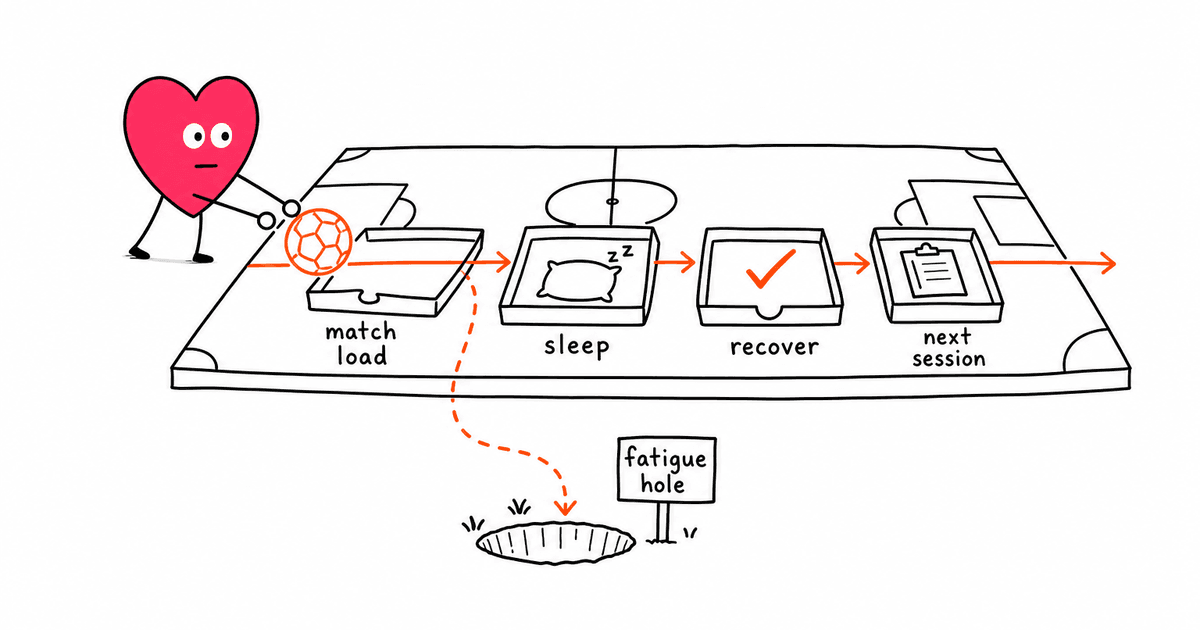
That is why HRV is useful. It gives you a practical way to spot when soccer is building fitness versus when it is quietly digging a fatigue hole.
Track it consistently, compare it to your own baseline, and read it together with sleep, resting heart rate, soreness, and mood. Do that well, and HRV becomes less about obsessing over readiness scores and more about staying available, durable, and healthier across the season.
FAQ
Is soccer good for heart health?
For most healthy adults, yes. Soccer can provide meaningful cardiovascular exercise, improve fitness, and make it easier to stay active consistently. People with known heart disease, symptoms, or medical restrictions should follow their clinician's guidance.
Does soccer increase or decrease HRV?
Both can happen. Regular soccer may improve baseline HRV over time, while hard matches or heavy training weeks can temporarily decrease HRV during recovery.
Should I train if my HRV is low after a match?
Usually you can still move, but it is smart to scale the day to your recovery status. Technical work, easy aerobic movement, or a lighter gym session often make more sense than another max effort day.
How long does HRV take to recover after soccer?
That depends on your fitness, age, match load, sleep, travel, heat, and how much extra training you stack around soccer. Many players rebound within 24 to 72 hours, but congested weeks can take longer.
What is the best wearable for soccer recovery?
There is no perfect device for everyone. The best choice is the one that gives you consistent HRV, sleep, and resting heart rate data and that you will actually wear every day.
Need a quick read on your HRV number first?
Enter your HRV value, age range, device, and recovery context for a plain-English interpretation before you decide what to do next.
Interpret Your HRV NumberBuild the 30-day plan