Massage and HRV: How Bodywork Boosts Your Nervous System
Trying to decode today's HRV number? Use the free interpreter first, then build a practical recovery plan. Interpret your HRV
Most people book a massage to loosen tight muscles or relieve stress. But research reveals that massage therapy has a much deeper effect on your body, shifting your autonomic nervous system toward parasympathetic dominance and measurably improving heart rate variability.
Whether you get professional bodywork weekly or use a foam roller at home, understanding the HRV connection can help you time sessions for maximum recovery benefit.
How Massage Affects Your Nervous System
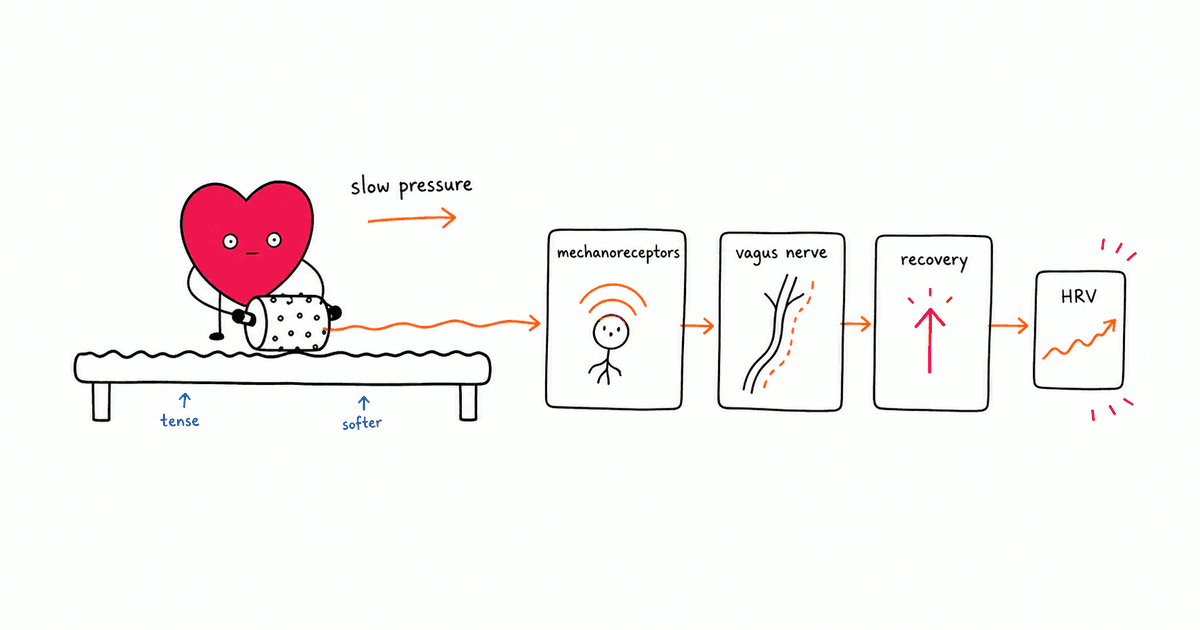
Massage therapy activates the parasympathetic nervous system by stimulating mechanoreceptors in the skin and soft tissue, which send calming signals through the vagus nerve to the brain. This shift from sympathetic (fight-or-flight) to parasympathetic (rest-and-digest) activity is reflected in higher HRV readings after a session.
A 2020 randomized controlled trial published in Scientific Reports found that standardized massage protocols led to significant increases in high-frequency HRV (HF-HRV) compared to a resting control group. HF-HRV is the component most directly linked to parasympathetic, or vagal, tone.
This means massage does not just feel relaxing. It creates a measurable physiological shift that your HRV monitor can detect.
The Vagus Nerve Connection
The vagus nerve is the primary pathway through which massage influences HRV. This cranial nerve runs from the brainstem through the neck, chest, and abdomen, regulating heart rate, digestion, and inflammation.
Massage techniques that target the neck, shoulders, and upper back are particularly effective at stimulating vagal afferent fibers. When these fibers are activated, they send signals to the brainstem that slow heart rate and increase the beat-to-beat variability that defines high HRV.
This is the same mechanism behind other vagus nerve stimulation techniques like deep breathing and cold exposure, though massage provides a more passive route to the same benefit.
What the Research Shows
Multiple studies have examined the relationship between massage and autonomic function:
Swedish Massage: A study in Frontiers in Public Health examined workplace massage for Swedish employees and found that massage groups showed favorable changes in HRV metrics and reductions in cortisol compared to control groups.
Slow-Stroke Massage: Research on massage velocity demonstrates that slower, more rhythmic strokes produce stronger parasympathetic responses. Fast, vigorous techniques tend to initially activate the sympathetic system before a delayed parasympathetic rebound.
Frequency Matters: Studies consistently show that regular massage sessions (weekly or biweekly) produce more sustained HRV improvements than occasional one-off appointments. The autonomic benefits appear to accumulate over time, similar to the compound effects of regular meditation.
Duration: Sessions of 20 minutes or longer produce the most significant HRV changes. Shorter sessions still offer benefit, but the parasympathetic shift deepens with time on the table.
Best Massage Types for HRV
Not all massage techniques affect HRV equally. Here is how the most common styles compare:
Swedish Massage
The classic relaxation massage uses long, flowing strokes with moderate pressure. This is one of the most studied techniques for HRV improvement. The rhythmic, predictable movements are particularly effective at activating the parasympathetic nervous system.
Best for: General HRV improvement, stress reduction, relaxation
Deep Tissue Massage
This technique targets deeper muscle layers with more intense pressure. While it can initially spike sympathetic activity due to the discomfort, it produces a strong parasympathetic rebound in the hours following the session.
Best for: Athletes recovering from training, chronic muscle tension
Myofascial Release
Slow, sustained pressure on fascial restrictions can activate mechanoreceptors that signal the nervous system to release holding patterns. This technique pairs well with conscious breathing for compounded vagal activation.
Best for: Chronic pain, postural issues, people with consistently low HRV due to stress
Craniosacral Therapy
This gentle technique focuses on the head, spine, and sacrum. Given its direct proximity to vagus nerve pathways, craniosacral therapy may produce outsized parasympathetic effects relative to the light pressure involved.
Best for: Anxiety, headaches, nervous system regulation
Self-Massage and Foam Rolling
You do not need a therapist for every session. Foam rolling, massage guns, and self-massage techniques can activate similar mechanoreceptor pathways. While the effects may be less pronounced than professional bodywork, consistency matters more than intensity.
Best for: Daily recovery, post-workout parasympathetic activation, budget-friendly option
When to Schedule a Massage for Maximum HRV Benefit
Timing your massage sessions strategically can amplify the autonomic benefits:
After intense training: Massage within 2 to 4 hours of a hard workout can accelerate the shift from sympathetic to parasympathetic dominance, speeding recovery. Athletes who track HRV with devices like the Whoop 5 or Oura Ring 4 often see faster recovery scores after post-workout bodywork.
During high-stress periods: If your HRV has been trending downward due to work stress, poor sleep, or overtraining, a massage session can help break the sympathetic cycle. Pair it with other parasympathetic-boosting habits like quality sleep and time in nature.
Evening sessions: Massage before bed can enhance sleep quality by priming the nervous system for rest. If your wearable shows low overnight HRV, an evening massage may help raise those numbers.
Not right before competition: Athletes should avoid deep tissue work within 24 hours of competition. The temporary muscle soreness can elevate sympathetic activity and transiently lower HRV.
How to Track Massage Effects on Your HRV
To see how massage affects your personal HRV, follow this tracking protocol:
- Establish a baseline: Track your resting HRV for at least one week before your first session using a consistent measurement protocol (same time, same position)
- Measure before and after: Take an HRV reading 30 minutes before your massage and again 1 to 2 hours after
- Track overnight HRV: Check your next-morning HRV reading, as many wearables like the Apple Watch and Garmin capture this automatically
- Look for trends: A single session provides useful data, but the real signal emerges after 4 to 6 weeks of regular massage
- Note the type and duration: Log which massage technique you received and for how long, so you can identify which styles produce the best results for your body
Combining Massage With Other HRV-Boosting Practices
Massage works best as part of a broader recovery strategy. Consider pairing sessions with:
- Breathing exercises: Slow, deep breathing during massage compounds the vagal stimulation effect
- Meditation: A short meditation after massage can extend the parasympathetic window
- Magnesium supplementation: Magnesium supports muscle relaxation and parasympathetic function, complementing the effects of bodywork
- Sauna sessions: Some recovery centers offer massage followed by sauna, which provides sequential parasympathetic activation
- Adequate hydration: Dehydration blunts the autonomic benefits of massage, so drink water before and after
- Chiropractic care: Spinal adjustments may complement massage by addressing structural alignment that influences autonomic function through the spinal cord
How Often Should You Get a Massage for HRV Benefits
Research suggests the following frequency guidelines:
- For general wellness: One to two sessions per month can maintain elevated parasympathetic tone
- For active athletes: Weekly massage during heavy training blocks supports recovery and prevents overtraining
- For chronic stress: Weekly sessions for 4 to 8 weeks can help reset a dysregulated nervous system, then taper to biweekly maintenance
- Self-massage: Daily foam rolling or massage gun use for 10 to 15 minutes provides consistent, low-level parasympathetic stimulation
The key principle is consistency. Sporadic sessions provide temporary relief, but regular bodywork creates lasting autonomic adaptations.
Who Benefits Most From Massage for HRV
While nearly everyone can benefit, certain groups tend to see the largest HRV improvements from regular massage:
- People with high baseline stress: If your HRV is chronically low due to work pressure, relationship stress, or anxiety, massage provides a powerful parasympathetic intervention
- Athletes in heavy training: Massage helps balance the sympathetic load of intense exercise, preventing the HRV suppression that comes with overtraining
- Desk workers: Prolonged sitting creates chronic tension patterns that keep the sympathetic system activated. Regular massage can interrupt this cycle
- People recovering from illness: Low HRV often accompanies illness recovery. Gentle massage supports the return to parasympathetic balance
- Older adults: Age-related HRV decline may be partially offset by regular massage, as it provides external stimulation of vagal pathways that become less responsive over time
Common Questions About Massage and HRV
Does a massage gun work as well as professional massage?
Massage guns (percussive therapy) activate mechanoreceptors similarly to manual massage, though the effect tends to be more localized. They are effective for targeted recovery but may not produce the same whole-body parasympathetic shift as a full Swedish massage session. For HRV purposes, combine massage gun use with slow breathing for better results.
How quickly does HRV improve after a massage?
Most people see an HRV increase within 30 to 60 minutes of completing a session. The effect typically peaks 2 to 4 hours post-massage and can persist into the following morning. Deep tissue work may show a delayed response, with HRV dipping slightly before rising above baseline.
Can massage lower HRV?
Rarely, but it is possible. Extremely deep or painful massage can trigger a sympathetic stress response that temporarily lowers HRV. If you find that your HRV consistently drops after massage, try a gentler technique or communicate your pressure preferences more clearly with your therapist.
Is there anyone who should avoid massage for HRV purposes?
People with certain cardiovascular conditions, active infections, or acute injuries should consult a healthcare provider before massage therapy. Those on blood thinners should also exercise caution with deep tissue work.
The Bottom Line
Massage therapy is one of the most accessible and enjoyable ways to boost HRV. By activating the vagus nerve and shifting your autonomic nervous system toward parasympathetic dominance, regular bodywork creates measurable improvements in heart rate variability that compound over time.
For the best results, choose techniques that emphasize slow, rhythmic pressure, schedule sessions consistently, and track your HRV response to find the approach that works best for your body. Combined with other recovery practices like quality sleep, breathing exercises, and proper nutrition, massage can be a cornerstone of your HRV optimization strategy.
Need a quick read on your HRV number first?
Enter your HRV value, age range, device, and recovery context for a plain-English interpretation before you decide what to do next.
Interpret Your HRV NumberBuild the 30-day plan