Chiropractic Care and HRV: Can Spinal Adjustments Improve Heart Rate Variability?
Trying to decode today's HRV number? Use the free interpreter first, then build a practical recovery plan. Interpret your HRV
If you track your HRV, you may have noticed fluctuations after physical therapy sessions, bodywork, or even a visit to the chiropractor. Chiropractic care is one of the most widely used complementary therapies in the world, with over 35 million Americans visiting a chiropractor each year. But can a spinal adjustment actually move the needle on your heart rate variability?
The answer is nuanced. A growing body of research suggests chiropractic adjustments can influence autonomic nervous system activity, and some studies show measurable changes in HRV immediately after treatment. However, the evidence is still evolving, and the effects appear to depend on the spinal region treated, the type of adjustment, and the individual.
What Chiropractic Adjustments Actually Do
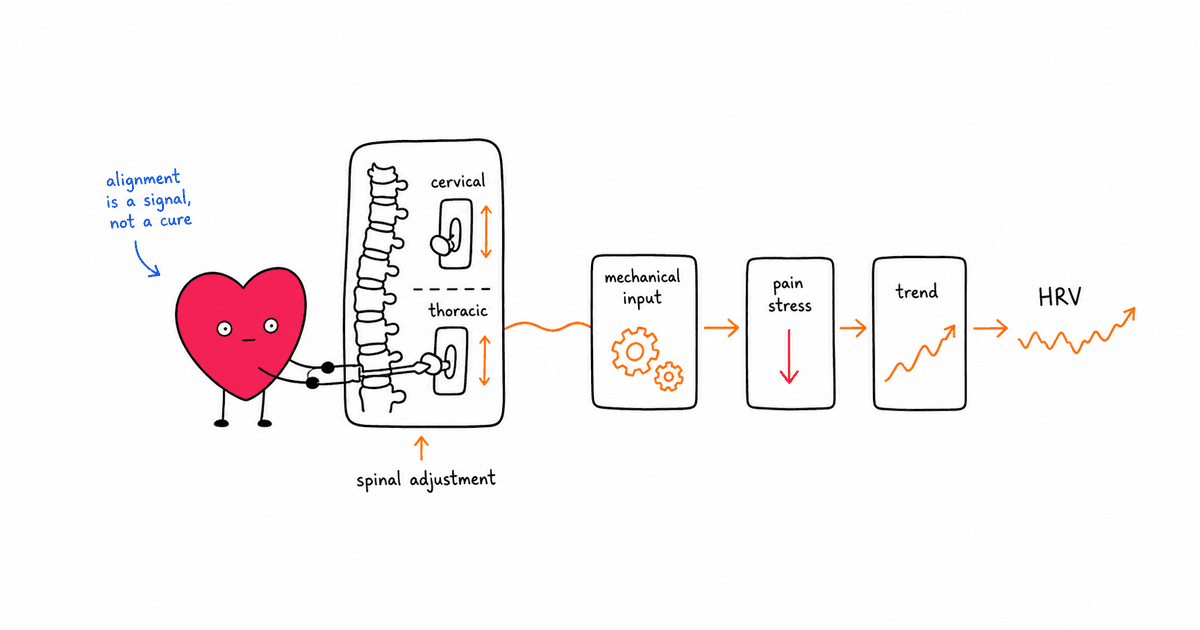
Chiropractic spinal manipulation is a manual therapy that applies controlled force to specific joints of the spine, restoring mobility and reducing nerve interference. The theory behind chiropractic care centers on the relationship between the spine and the nervous system. When spinal segments become restricted or misaligned, the resulting mechanical stress may alter the signaling of nearby spinal nerves, including those that regulate autonomic function.
Most chiropractic adjustments target one of three spinal regions: cervical (neck), thoracic (mid-back), or lumbar (lower back). Each region has different autonomic innervation, which helps explain why different adjustment sites produce different autonomic responses.
There are also multiple techniques. Diversified technique uses a manual high-velocity, low-amplitude thrust. Activator method uses a spring-loaded instrument for a lighter, more precise force. Gonstead technique involves specific hand positions and precise lines of drive. Each technique produces different amounts of mechanical input, which may explain some of the variability in research findings.
The Autonomic Nervous System Connection
Your autonomic nervous system has two primary branches: the sympathetic ("fight or flight") and parasympathetic ("rest and digest") divisions. HRV reflects the balance between these two branches, with higher HRV generally indicating stronger parasympathetic influence and better stress resilience.
The spine plays a direct role in autonomic regulation. Sympathetic nerve fibers exit from the thoracic and upper lumbar regions, while parasympathetic fibers originate from the brainstem (via the vagus nerve) and the sacral spinal cord. This anatomical arrangement means that adjustments to different spinal segments may influence different branches of the autonomic nervous system.
What the Research Shows
The Multisite Clinical Study
One of the most cited studies on chiropractic care and HRV was a large multisite trial involving 96 chiropractors and hundreds of patients. Researchers measured HRV before and after chiropractic adjustments in two groups: a single-visit group and a 4-week group receiving regular care.
After a single adjustment, the results were notable:
- SDNN (a key HRV metric) increased significantly
- High-frequency power (reflecting parasympathetic activity) increased
- Total power increased
- Mean heart rate decreased from 76.7 to 74.3 bpm
- Pain scores dropped from 3.7 to 2.1 on a visual analog scale
In the 4-week group, improvements in SDNN, total power, and low-frequency components remained statistically significant across the treatment period. However, the high-frequency component did not reach significance over 4 weeks, suggesting the acute parasympathetic boost may not accumulate linearly with repeated sessions.
Cervical vs. Thoracic Adjustments
Research has found that the autonomic response to chiropractic adjustment differs depending on which part of the spine is treated. A study examining diversified adjustments to cervical and thoracic vertebrae found that cervical (neck) adjustments produced a stronger parasympathetic shift, as reflected by an increase in the high-frequency component of HRV and a decrease in the LF/HF ratio.
This makes anatomical sense. The vagus nerve, the primary parasympathetic highway in your body, passes directly through the cervical region. Upper cervical adjustments may reduce mechanical compression or irritation of vagal fibers, allowing for improved parasympathetic signaling.
Thoracic adjustments, by contrast, tend to influence sympathetic nerve fibers more directly. Some studies show thoracic manipulation can produce a transient sympathetic response (increased heart rate and blood pressure) before the system settles into a new equilibrium.
The Systematic Review Perspective
A 2023 systematic review and meta-analysis published in Chiropractic and Manual Therapies examined the overall evidence for spinal manipulation's effect on the autonomic nervous system. The review included studies measuring HRV, blood pressure, heart rate, and other autonomic markers.
The findings were cautious: the overall evidence was rated as low quality, and the meta-analysis did not find a consistent, statistically significant effect of spinal manipulation on HRV across all included studies. However, a subgroup analysis did show that cervical spine manipulation may specifically influence the high-frequency component of HRV, supporting the vagus nerve connection.
This is an important distinction. The evidence is not that chiropractic care does not affect the autonomic nervous system. Rather, the studies are heterogeneous, with different techniques, spinal regions, populations, and measurement protocols making it difficult to draw sweeping conclusions.
How Chiropractic Adjustments May Influence Vagal Tone
Several mechanisms have been proposed for how spinal manipulation could affect vagal tone and HRV:
Mechanical Decompression
The atlas (C1) and axis (C2) vertebrae sit in close proximity to the brainstem and the origin of the vagus nerve. Misalignment or restricted motion in this region could theoretically compress or irritate vagal fibers. An upper cervical adjustment aims to restore proper alignment and reduce this mechanical stress.
Neurological Reflexes
Spinal manipulation stimulates mechanoreceptors and proprioceptors in the joints, muscles, and ligaments surrounding the spine. This barrage of sensory input travels to the central nervous system and can trigger reflex changes in autonomic output. The result may be a temporary shift toward parasympathetic dominance, especially after cervical adjustments.
Pain Reduction and Stress Relief
Chronic pain is a powerful driver of sympathetic activation and low HRV. If a chiropractic adjustment reduces pain (as measured in multiple studies), the downstream effect on HRV may be partly attributable to reduced nociceptive signaling rather than a direct autonomic mechanism. In other words, less pain means less stress, which means better HRV.
Inflammation Modulation
Emerging research connects vagus nerve stimulation to anti-inflammatory pathways (the cholinergic anti-inflammatory pathway). If chiropractic adjustments enhance vagal tone, they could theoretically reduce systemic inflammation, though this connection remains speculative at this stage.
How to Track HRV Around Chiropractic Visits
If you are curious about how chiropractic care affects your autonomic nervous system, HRV tracking provides an objective way to find out. Here is how to set up a meaningful self-experiment:
Establish a Baseline
Track your morning HRV consistently for at least two weeks before starting chiropractic care. Use the same device, the same body position, and the same time of day. This gives you a stable baseline to compare against.
A wrist-based device like the Whoop or Oura Ring can passively track overnight HRV, while chest straps like the Garmin HRM-600 offer clinical-grade accuracy for morning readings.
Record Pre- and Post-Adjustment Readings
Take a 3-5 minute HRV reading before your appointment and another one 15-30 minutes after. Many HRV biofeedback apps allow short recordings that capture RMSSD and other time-domain metrics.
Track Trends Over Time
A single reading after one adjustment is interesting but not definitive. Look for patterns over 4-8 weeks of regular care. Is your weekly HRV average trending upward? Are your nighttime readings improving? Is your HRV recovering faster after stressors?
Control for Confounders
Chiropractic visits often overlap with other recovery behaviors: reduced stress from taking time off work, relaxation during the appointment, or simply lying down for 30 minutes. Try to keep your schedule, sleep, exercise, and nutrition consistent around appointments so you can isolate the chiropractic effect.
What Chiropractic Is (and Is Not) Good For
Based on the current evidence, here is a realistic assessment of how chiropractic care fits into an HRV optimization strategy:
Strengths
- Cervical adjustments show the most consistent evidence for acute parasympathetic shifts
- Pain reduction from adjustments can indirectly boost HRV by lowering sympathetic drive
- Non-invasive and drug-free, making it easy to combine with other recovery strategies
- Many chiropractors now use HRV as an assessment tool in practice
Limitations
- The evidence base is still small and of mixed quality
- Effects may be acute (lasting hours) rather than sustained
- Mechanism of action is not fully understood
- Results vary widely between individuals and practitioners
- Not all chiropractic techniques have been studied for autonomic effects
How It Compares to Other Modalities
Chiropractic joins a growing list of manual and complementary therapies studied for autonomic effects. Massage therapy has comparable evidence for acute HRV improvements, while acupuncture has a slightly larger body of research supporting parasympathetic effects. Interventions like HRV biofeedback training and meditation generally have stronger evidence for sustained HRV improvements.
| Modality | Acute HRV Effect | Sustained Effect | Evidence Quality |
|---|---|---|---|
| Chiropractic (cervical) | Moderate increase in HF power | Unclear | Low-moderate |
| Massage therapy | Moderate increase in RMSSD | Possible with regular sessions | Moderate |
| Acupuncture | Moderate-strong parasympathetic shift | Possible over treatment course | Moderate |
| HRV biofeedback | Strong, self-directed | Strong with consistent practice | High |
| Meditation | Moderate-strong | Strong with daily practice | High |
The most effective approach is likely a combination: use active practices (biofeedback, breathing exercises, exercise) as the foundation, and consider manual therapies like chiropractic as complementary tools.
Who Might Benefit Most
Chiropractic care for HRV purposes may be particularly relevant for:
- People with chronic neck or back pain whose HRV is suppressed by ongoing sympathetic activation. Research consistently shows that chronic pain drives the autonomic nervous system toward sympathetic dominance, and anything that reduces pain may help restore parasympathetic balance.
- Athletes dealing with overtraining who need multiple recovery modalities to restore parasympathetic balance. Some sports chiropractors now use pre- and post-adjustment HRV readings to guide treatment intensity.
- Desk workers with cervical tension whose poor posture may contribute to mechanical stress on vagal pathways. Hours of forward head posture can compress cervical structures, and regular adjustments may help counteract this.
- Individuals with anxiety who want non-pharmaceutical approaches to improving autonomic balance. The parasympathetic shift from cervical adjustments aligns with the goal of increasing vagal tone in anxiety management.
- Older adults experiencing autonomic decline. HRV naturally decreases with age, and maintaining spinal health may support autonomic function as part of a broader longevity strategy.
Practical Recommendations
If you decide to incorporate chiropractic care into your HRV optimization routine, consider these guidelines:
- Find a practitioner who measures HRV. A growing number of chiropractors use HRV assessment to guide treatment. This signals evidence-based practice.
- Focus on the cervical spine. The strongest evidence for parasympathetic effects comes from upper cervical adjustments. Discuss this with your chiropractor.
- Give it time. Research suggests that consistent care over 4 or more weeks may produce more meaningful autonomic changes than a single visit.
- Track your data. Use your HRV device to objectively assess whether adjustments are making a difference for you specifically.
- Combine with proven strategies. Chiropractic care is best viewed as one tool in a comprehensive approach that includes exercise, sleep optimization, stress management, and proper nutrition.
Frequently Asked Questions
Can a single chiropractic adjustment improve HRV?
Research shows that a single adjustment can produce measurable short-term changes in HRV, including increased SDNN, higher parasympathetic (high-frequency) power, and reduced heart rate. These effects have been observed within minutes of treatment. However, whether a single visit produces lasting autonomic changes is less clear.
How long do HRV improvements last after an adjustment?
Current studies suggest the acute autonomic effects of a chiropractic adjustment last anywhere from a few hours to a day. For sustained HRV improvements, consistent care over several weeks appears more effective than sporadic visits.
Is chiropractic care safe for HRV purposes?
Chiropractic adjustments are generally considered safe when performed by a licensed practitioner. Serious adverse events are rare. If you have a history of cervical artery dissection, osteoporosis, or spinal cord conditions, discuss risks with your doctor before pursuing cervical manipulation.
Do all types of chiropractic adjustments affect HRV?
No. The autonomic response depends on the spinal region and technique. Cervical adjustments (particularly upper cervical) show the most consistent parasympathetic effects. Thoracic and lumbar adjustments may influence the sympathetic branch differently. Techniques studied include diversified (manual thrust), Activator (instrument-assisted), and Gonstead methods.
Should I track HRV to evaluate chiropractic care?
Tracking HRV provides objective data about how your nervous system responds to chiropractic adjustments. It removes the guesswork and helps you and your practitioner make informed decisions about treatment frequency and approach.
How often should I get adjusted for HRV benefits?
There is no established "dose" for HRV-specific chiropractic care. The multisite study used twice-weekly adjustments over four weeks and found sustained autonomic changes. Many practitioners recommend weekly or biweekly visits for maintenance. Your HRV data can help determine the right frequency: if your weekly average is trending up, the current schedule is working.
Can chiropractic care replace other HRV improvement strategies?
No. Chiropractic care is best viewed as one component of a broader strategy. Sleep optimization, regular exercise, stress management, and proper nutrition remain the foundational pillars of HRV improvement. Manual therapies like chiropractic can complement these practices but should not replace them.
Need a quick read on your HRV number first?
Enter your HRV value, age range, device, and recovery context for a plain-English interpretation before you decide what to do next.
Interpret Your HRV NumberBuild the 30-day plan