Skin Temperature and HRV: What Wearable Trends Can Tell You About Recovery
Trying to decode today's HRV number? Use the free interpreter first, then build a practical recovery plan. Interpret your HRV
What Is Skin Temperature Tracking?
Skin temperature tracking measures temperature changes at the surface of your body, usually during sleep, so your wearable can compare each night against your personal baseline. It is not the same as core body temperature, but it can reveal patterns related to thermoregulation, illness, recovery, hormones, and sleep environment.
That distinction matters. A wearable on your finger or wrist is not diagnosing a fever. It is measuring local skin temperature and reporting a trend, often as a deviation from your normal range. When you pair that trend with heart rate variability, resting heart rate, respiratory rate, and sleep quality, it becomes much more useful.
Skin temperature answers one question: is your body managing heat normally tonight?
HRV answers a different question: how balanced is your autonomic nervous system?
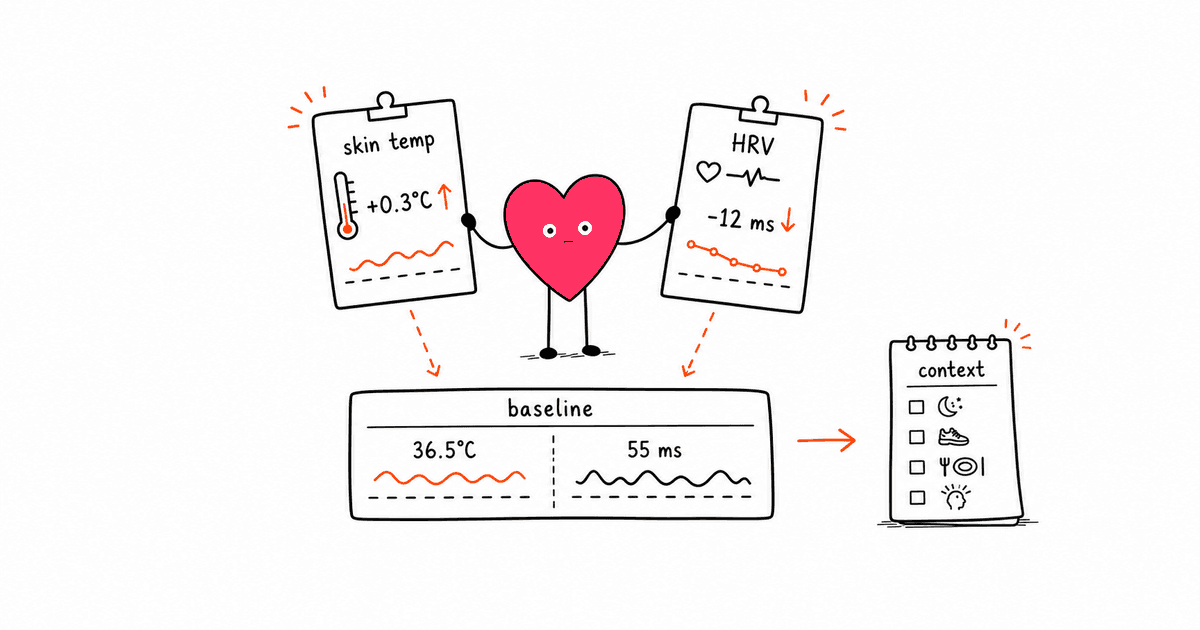
Together, they can help you spot when a warm night is just a warm bedroom, when it may signal illness, and when a low HRV reading deserves more context before you change your training or recovery plan.
How Skin Temperature and HRV Are Connected
Skin temperature and HRV are both influenced by the autonomic nervous system. Your sympathetic nervous system can narrow blood vessels near the skin, pushing blood toward the core and lowering peripheral temperature. Your parasympathetic system supports rest, recovery, digestion, and more stable cardiovascular regulation.
This is why temperature and HRV often move together during illness, heat stress, poor sleep, or heavy training. The body is trying to solve multiple problems at once: regulate heat, maintain blood pressure, manage immune activity, and recover from stress.
The thermoregulation loop works like this:
- Your body senses temperature and stress signals through the brain, skin, blood vessels, and immune system
- Blood vessels adjust by widening or narrowing to release or conserve heat
- Heart rate and blood pressure shift to support circulation
- HRV changes as sympathetic and parasympathetic activity rebalance
- Sleep quality changes if the body has to work harder to cool down, warm up, or fight inflammation
That is why a skin temperature spike means very little by itself. A skin temperature spike plus low HRV, higher resting heart rate, elevated respiratory rate, and poor sleep is a much stronger signal.
Skin Temperature Is Not Core Temperature
This is the most common mistake people make with wearable temperature data.
Core temperature is the temperature of your internal tissues. It is what a clinical thermometer is trying to estimate. Skin temperature is affected by room temperature, bedding, sensor placement, sweat, blood flow, and whether your body is sending heat toward or away from the surface.
| Metric | What It Measures | Best Use |
|---|---|---|
| Core temperature | Internal body temperature | Fever screening and medical evaluation |
| Skin temperature | Surface temperature at the wrist, finger, or skin | Personal trend tracking and recovery context |
| Temperature deviation | Difference from your own baseline | Spotting unusual nights or multi-day patterns |
| HRV | Beat-to-beat heart rhythm variation | Autonomic balance and recovery trends |
A wearable temperature deviation can be genuinely useful. It is just not a replacement for a thermometer, a sleep study, or medical advice.
What the Research Shows
Heat Stress Can Suppress HRV
A classic human physiology study published in Experimental Physiology tested skin surface cooling and heating in 11 healthy volunteers. Researchers found that skin surface heating decreased the high-frequency component of HRV and increased the low-to-high frequency ratio, a pattern consistent with lower cardiac vagal activity and higher sympathetic activity.
In plain English: when the body is exposed to strong heat stress, HRV can fall because the nervous system shifts toward a more activated state.
This helps explain why hot bedrooms, heavy blankets, heat waves, late sauna sessions, and heat and humidity can all affect overnight recovery data. The body may still be resting, but it is also working to dump heat.
Wearable Temperature Can Detect Illness-Related Changes
A 2020 Scientific Reports paper from the TemPredict study analyzed wearable temperature data from the first 50 participants who reported COVID-19 infection. The researchers found that illness-associated elevations in peripheral temperature were observable using wearable sensors and correlated with self-reported fever. In their sample, temperature during the symptom window increased by an average of 0.63 degrees Celsius compared with baseline.
A later 2022 Scientific Reports TemPredict paper used Oura Ring data from more than 63,000 participants. In 73 PCR-confirmed COVID-19 cases with high-quality data, a machine learning model identified COVID-19 an average of 2.75 days before participants sought diagnostic testing, with 82% sensitivity and 63% specificity. Adding continuous temperature data improved model performance, raising AUC by 4.9% compared with the model without temperature.
That does not mean your ring can diagnose an infection. It does mean temperature becomes more informative when it is continuous, personalized, and combined with other signals.
A 2022 Journal of Medical Internet Research validation study compared Oura Ring nocturnal HR and HRV with a medical-grade ECG monitor in 35 healthy adults. The ring measured nocturnal heart rate and RMSSD accurately in both 5-minute and average-per-night analyses, while average-per-night HRV measures were generally more reliable than short 5-minute windows.
That principle applies to skin temperature too. The useful signal is the overnight pattern and multi-night trend, not a single odd value taken out of context.
How to Read Skin Temperature and HRV Together
Use temperature and HRV like a pattern detector, not a daily pass-fail grade.
| Pattern | What It May Suggest | What To Do |
|---|---|---|
| Warm skin temperature + low HRV | Illness, inflammation, heat stress, late alcohol, poor sleep | Take an easier day and watch for symptoms |
| Warm skin temperature + normal HRV | Warm room, heavy bedding, menstrual-cycle shift, normal variation | Check environment before worrying |
| Cool skin temperature + low HRV | Cold stress, poor circulation, acute stress, hard training | Look at room temperature, training load, and fatigue |
| Cool skin temperature + normal HRV | Cooler sleep environment or normal baseline variation | Usually not concerning |
| Normal skin temperature + low HRV | Stress, sleep debt, overtraining, alcohol, travel, mental strain | Use HRV context from other metrics |
| Temperature spike + high RHR + high respiratory rate + low HRV | Stronger illness or recovery signal | Prioritize rest and consider checking with a thermometer |
The strongest signal is usually a cluster: skin temperature up, HRV down, resting heart rate up, respiratory rate up, and sleep worse than usual.
Why Skin Temperature Often Rises at Night
A warmer-than-usual skin temperature can come from several different causes. Some are harmless. Some are worth paying attention to.
- Illness and immune activation: Temperature regulation can change before you feel obviously sick. A rising temperature deviation paired with low HRV and elevated resting heart rate may be an early sign that your body is fighting something. This fits broader inflammation and HRV research, where immune activation often pushes the body toward sympathetic dominance.
- A warm bedroom: Sometimes the explanation is boring and useful: your room was too hot. Warm bedding, trapped mattress heat, or a hot bedroom can raise skin temperature, fragment sleep, and suppress HRV.
- Late meals or alcohol: Late meals can increase digestive heat production. Alcohol can disrupt sleep architecture, increase heart rate, and impair overnight recovery. If temperature rises and HRV drops after drinking, the pattern may reflect metabolic and autonomic stress rather than infection. For more, see alcohol and HRV.
- Menstrual-cycle changes: Skin temperature often changes across the menstrual cycle, especially around ovulation and the luteal phase. A warmer temperature trend may be normal if it matches a predictable cycle pattern.
- Heat exposure and sauna timing: Sauna can support cardiovascular adaptation when used appropriately, but a hot session close to bedtime can temporarily elevate skin temperature and delay cooling. Compare sauna timing against your sleep and HRV trends for two weeks.
Why Skin Temperature Can Drop
Cooler skin temperature is not automatically bad. It depends on the context.
- Cold room or light bedding: Peripheral skin temperature can fall if the room is cold or your bedding is too light. That may be fine if you sleep well and HRV stays stable. If HRV drops too, your body may be spending extra energy maintaining warmth.
- Sympathetic vasoconstriction: Acute stress can narrow peripheral blood vessels, lowering skin temperature in the hands and feet. If you had a stressful evening, poor sleep onset, and low HRV, a cooler finger or wrist reading may reflect sympathetic activation.
- Cold exposure: Cold exposure can temporarily increase sympathetic activity. Depending on timing, dose, and adaptation level, it may lower skin temperature and affect HRV.
- Sensor and fit issues: A loose ring, watch, or strap can create strange temperature data. So can sleeping with your hand outside the blanket, charging your wearable partway through the night, or wearing the device on a different finger or wrist. Check the boring stuff first.
The Best Way to Use Temperature Trends
1. Build a Two-Week Baseline
Do not judge temperature data on night one. Wearables need a personal baseline because skin temperature varies widely between people. Give the device at least two weeks of consistent wear before making decisions from the data.
2. Compare Temperature With HRV and Resting Heart Rate
Temperature alone is weak. Temperature plus HRV and resting heart rate is much stronger.
A useful morning check looks like this:
- Is skin temperature above or below your normal range?
- Is HRV meaningfully lower than your baseline?
- Is resting heart rate higher than usual?
- Is respiratory rate elevated?
- Did sleep quality or sleep duration change?
- Do you feel symptoms, soreness, or unusual fatigue?
If only one metric is off, do not overreact. If several are off in the same direction, adjust.
3. Look for Three-Night Patterns
Single-night spikes happen. Three-night patterns matter more.
If temperature is elevated for several nights and HRV remains suppressed, consider whether you are dealing with illness, accumulated training stress, sleep disruption, or heat exposure. If temperature normalizes and HRV rebounds, it was likely a short-lived stressor.
4. Keep the Bedroom Cool and Consistent
A consistent sleep environment makes wearable data easier to interpret. Try to keep room temperature, bedding, fan use, and sleepwear relatively stable. If your sleep setup changes every night, your skin temperature trend becomes harder to read.
This is especially important if you are trying to use HRV for training decisions. A bad recovery score from a hot bedroom is not the same as a bad recovery score from overtraining.
5. Use a Thermometer When You Need a Real Temperature
If you feel feverish, use a thermometer. If you have concerning symptoms, seek medical care. A wearable trend can prompt you to pay attention, but it should not be treated as a diagnosis.
Which Wearables Track Skin Temperature and HRV?
Several popular recovery wearables now combine temperature trends with HRV data:
- Oura Ring 4: Tracks nighttime temperature deviation from the finger and pairs it with HRV, resting heart rate, respiratory rate, and sleep data. See the full Oura Ring 4 review.
- Whoop 5.0: Includes skin temperature as part of its recovery ecosystem, alongside HRV, resting heart rate, respiratory rate, and sleep strain. See the Whoop 5.0 review.
- Apple Watch Series 11: Uses wrist temperature during sleep and records HRV in Apple Health, although interpretation often requires looking across multiple Health app trends. See the Apple Watch HRV guide.
- Samsung Galaxy Ring: Tracks skin temperature and recovery-related sleep metrics in a ring form factor.
For temperature plus HRV analysis, the best device is usually the one you will wear consistently overnight. Missing data is worse than a slightly less polished dashboard.
Common Mistakes to Avoid
- Treating skin temperature like a fever reading: A temperature deviation is not the same as a clinical fever. It is a personal trend. Use it to decide whether to pay closer attention, not to diagnose yourself.
- Ignoring the room: If your temperature rises every time the bedroom is warm, the wearable is doing its job. Fix the environment before assuming your recovery system is broken.
- Comparing your number to someone else's: Skin temperature is highly individual. Your baseline is what matters. Someone else's wrist or finger temperature does not tell you whether your trend is healthy.
- Changing training after one bad night: HRV and temperature are noisy. If you feel fine and only one metric is unusual, consider a moderate adjustment rather than canceling everything. If multiple metrics are off and you feel run down, that is different.
- Forgetting hormonal context: For people who menstruate, temperature changes may be cyclical and predictable. Interpreting those changes as illness every month creates unnecessary noise.
Practical Recovery Rules
Use these rules when temperature and HRV disagree:
- Warm temp, low HRV, high resting heart rate: Take it seriously. Reduce intensity, hydrate, prioritize sleep, and watch for symptoms.
- Warm temp, normal HRV, good sleep: Check room heat, bedding, cycle phase, and late meals before worrying.
- Cool temp, low HRV, poor sleep: Look for cold stress, anxiety, poor circulation, or hard training load.
- Normal temp, low HRV: The problem may be stress, sleep debt, alcohol, travel, or training load rather than thermoregulation.
- All metrics normal but you feel bad: Trust your symptoms. Wearables are useful, not omniscient.
Frequently Asked Questions
Is skin temperature the same as body temperature?
No. Skin temperature is measured at the surface of the body, usually on the finger or wrist. Body temperature usually refers to core temperature, which is what a thermometer estimates. Skin temperature is better for trend tracking than fever diagnosis.
Does high skin temperature always lower HRV?
No. High skin temperature can occur with a warm bedroom, heavier bedding, menstrual-cycle changes, late meals, illness, or heat exposure. HRV usually drops when the temperature shift reflects real physiological stress, especially if resting heart rate and respiratory rate rise too.
Why did my wearable show high temperature but I felt fine?
The most likely explanations are environment, bedding, sensor fit, menstrual-cycle timing, alcohol, or a late meal. If the pattern disappears the next night and your HRV is normal, it was probably not meaningful.
Can low skin temperature mean I am recovering better?
Sometimes, but not automatically. A cooler room can improve sleep for some people, which may support HRV. But cold stress can also lower HRV if your body is working to stay warm. Context decides the interpretation.
Should I train hard if temperature is high and HRV is low?
Usually not. One unusual night is not a disaster, but elevated temperature plus low HRV, higher resting heart rate, or symptoms is a good reason to reduce intensity for the day. Think adjustment, not panic.
Bottom Line
Skin temperature is most useful when you treat it as context for HRV, not as a standalone score. A warm or cool night can reflect your room, bedding, hormones, illness, training load, or stress. The signal gets stronger when temperature, HRV, resting heart rate, respiratory rate, sleep, and symptoms all point in the same direction.
Use the trend to make smarter recovery decisions. Do not let one strange wearable reading run your day.
Need a quick read on your HRV number first?
Enter your HRV value, age range, device, and recovery context for a plain-English interpretation before you decide what to do next.
Interpret Your HRV NumberBuild the 30-day plan