Respiratory Rate and HRV: How Breathing Speed Changes Your Recovery Data
Trying to decode today's HRV number? Use the free interpreter first, then build a practical recovery plan. Interpret your HRV
Your breathing rate is one of the easiest metrics to ignore on a wearable dashboard. HRV gets the recovery score. Resting heart rate gets the obvious number. Respiratory rate sits quietly in the background.
That is a mistake.
Respiratory rate can meaningfully affect HRV because breathing directly changes the timing of your heartbeats. Faster breathing, slower breathing, shallow sleep breathing, illness, altitude, anxiety, and deliberate breathwork can all change the HRV signal your watch, ring, or chest strap reports.
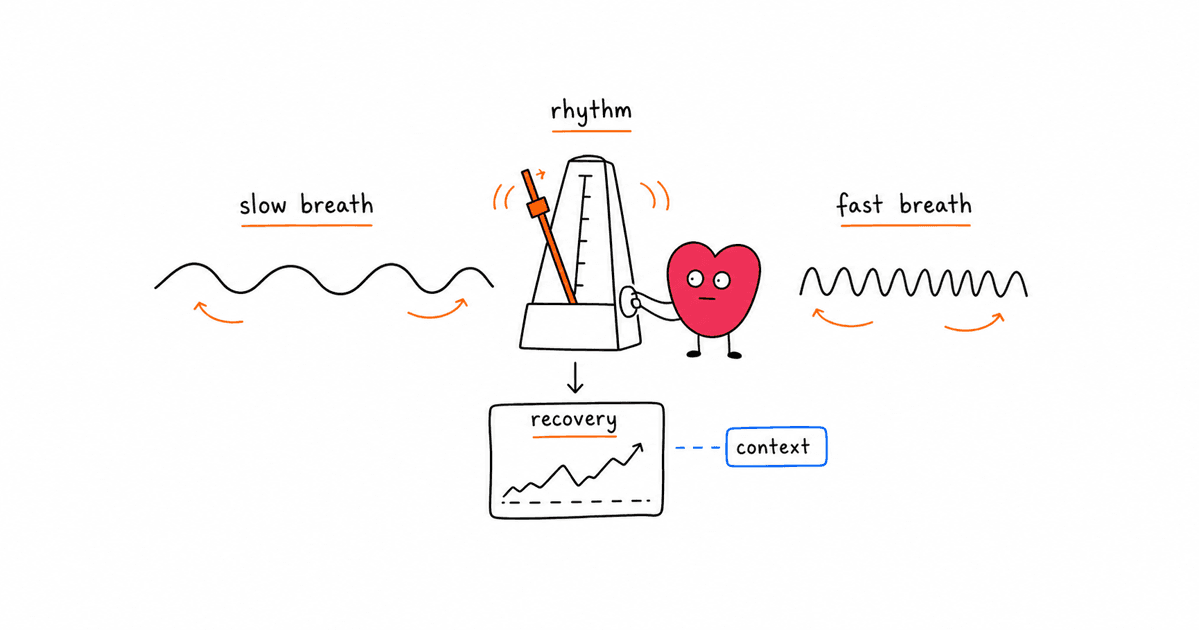
The key is not to treat respiratory rate as a replacement for HRV. Treat it as context. When HRV moves, breathing rate often helps explain why.
What Is Respiratory Rate?
Respiratory rate is the number of breaths you take per minute, usually measured at rest or during sleep. In healthy adults at rest, a typical clinical range is about 12 to 20 breaths per minute, although your personal baseline matters more than one universal number when using wearable data.
Respiratory rate is controlled mostly by the autonomic nervous system. That is the same system involved in HRV, resting heart rate, blood pressure, temperature regulation, and stress responses.
But breathing is unusual because you can control it voluntarily. You can slow it down during breathwork, speed it up during hard exercise, or hold it briefly. Then the automatic system takes over again.
That dual control is exactly why respiratory rate is so useful. It reflects both body state and behavior.
Does Respiratory Rate Affect HRV?
Yes. Respiratory rate affects HRV because heart rate naturally rises during inhalation and falls during exhalation. This breathing-linked heartbeat pattern is often called respiratory sinus arrhythmia, or more recently respiratory heart rate variability.
This does not mean an irregular heartbeat. It is a normal physiological rhythm.
When you inhale, heart rate tends to speed up slightly. When you exhale, heart rate tends to slow down. That back-and-forth movement contributes to common HRV metrics, especially short-term metrics like RMSSD and high-frequency HRV.
A 2025 expert recommendation in Nature Reviews Cardiology argued that the term respiratory sinus arrhythmia can be misleading because it sounds pathological. The authors suggested the term respiratory heart rate variability instead, since the phenomenon is a normal breathing-linked part of HRV.
For everyday tracking, the practical point is simple: if your breathing pattern changes, your HRV can change too.
Why Breathing Speed Changes HRV
Your HRV score is not measuring one single thing. It is a summary of beat-to-beat variation influenced by autonomic tone, heart rate, posture, sleep stage, movement, illness, stress, and breathing.
Respiratory rate matters for three main reasons.
1. Breathing shifts vagal activity
Slow, steady breathing tends to increase parasympathetic activity through the vagus nerve. This can increase HRV during the breathing session.
That is one reason breathing exercises and HRV biofeedback often use slow breathing around 5 to 7 breaths per minute.
A 2021 randomized cross-sectional study measured HRV while healthy volunteers breathed at 4, 5, 6, 7, and 8 breaths per minute. SDNN was highest at 5 breaths per minute, while RMSSD was highest at 7 breaths per minute. The authors concluded that 5 to 7 breaths per minute produced the strongest HRV response, but no single breathing rate maximized every metric.
A 2024 study in athletes found a similar pattern: five minutes of slow-paced breathing between 5 and 7 cycles per minute increased cardiac vagal activity compared with spontaneous breathing.
The useful takeaway: slow breathing can raise HRV acutely. That does not always mean your baseline recovery improved overnight. It may mean you changed the measurement condition.
2. Faster breathing can reflect strain
Respiratory rate often rises when the body is under load.
Common reasons include:
- Exercise
- Heat exposure
- Altitude
- Fever or respiratory illness
- Pain
- Anxiety or acute stress
- Alcohol or stimulant effects
- Poor sleep or sleep-disordered breathing
When breathing rate rises because the body is working harder, HRV often drops at the same time. That combination is usually more meaningful than either metric alone.
If your overnight respiratory rate is above your usual baseline and your HRV is also suppressed, your body may be dealing with stress, illness, poor sleep, or environmental strain.
3. Breathing changes measurement repeatability
Short HRV readings are sensitive to the conditions of the measurement.
A 2016 study in Frontiers in Physiology found that changes in heart rate and respiratory rate were associated with differences between repeated HRV measurements. In that study, heart rate was the strongest independent driver of HRV repeatability, but breathing rate still mattered as part of the measurement context.
This is why a one-minute HRV reading taken after scrolling in bed, talking, stretching, or breathing differently from yesterday is not as clean as a consistent morning measurement.
If you want better HRV data, standardize the measurement:
- Measure at the same time of day
- Use the same posture
- Avoid talking or moving
- Let your breathing settle naturally
- Do not force slow breathing unless you are specifically doing an HRV biofeedback session
Respiratory Rate vs. HRV: What Each Metric Tells You
Respiratory rate and HRV answer different questions.
| Metric | What It Measures | Best Use |
|---|---|---|
| Respiratory rate | Breaths per minute | Breathing load, illness signals, sleep disruption, altitude response |
| HRV | Beat-to-beat heart timing variation | Recovery, autonomic balance, stress load, training readiness |
| Resting heart rate | Beats per minute at rest | Cardiovascular strain, fitness trends, illness context |
| SpO2 | Blood oxygen saturation | Oxygenation, altitude response, possible breathing disruption |
Respiratory rate is not automatically good when it is low or bad when it is high. Context matters.
A temporarily higher breathing rate during exercise is normal. A higher sleeping respiratory rate for several nights, especially with low HRV and elevated resting heart rate, is more worth attention.
What Is a Normal Respiratory Rate?
For adults at rest, the American Lung Association lists a normal respiratory rate as 12 to 20 breaths per minute. It also notes that rates below 12 or above 25 breaths per minute can be concerning when paired with symptoms.
Wearables add another wrinkle: they usually track respiratory rate during sleep, not in a clinic while you are sitting still.
That means your own baseline is more useful than a generic range.
For example:
- If your normal sleeping respiratory rate is 14.2 and it rises to 16.8 for two nights, that may be a meaningful change for you
- If your normal is 17.5 and it stays around 17 to 18, that may be normal for you
- If your rate jumps sharply and you feel short of breath, feverish, confused, or unwell, do not treat the wearable as a guessing game. Get medical advice
The best wearable interpretation is trend-based, not number-chasing.
How to Read Respiratory Rate and HRV Together
The cleanest way to use these metrics is to compare them against your own baseline.
High respiratory rate plus low HRV
This is the pattern to watch most closely.
Possible explanations include:
- Poor sleep
- Early illness
- Fever or inflammation
- Worsening respiratory load in conditions like COPD
- Recent vaccination or another short-term immune response
- Alcohol the night before
- High psychological stress
- Altitude exposure
- Heat and humidity
- Sleep-disordered breathing
If this pattern shows up once, do not panic. If it persists for several days or comes with symptoms, it deserves attention.
For sleep-specific breathing concerns, compare the pattern with blood oxygen data if your device tracks SpO2. Repeated oxygen dips, elevated respiratory rate, and suppressed HRV can be a stronger reason to discuss sleep apnea screening with a clinician.
Normal respiratory rate plus low HRV
This usually points away from breathing as the main issue.
More likely causes include:
- Hard training
- Stress
- Sleep deprivation
- Alcohol
- Travel fatigue
- Menstrual cycle changes
- Heavy meals close to bed
- General recovery debt
Respiratory rate is useful here because it narrows the search. If breathing rate, SpO2, and resting heart rate are all normal, a low HRV day may simply reflect nervous system load or measurement noise.
Low respiratory rate plus high HRV
This can happen during relaxed sleep, meditation, or slow breathing practice.
It may be a good sign when it happens naturally. It may also be a sign that you deliberately changed the reading condition.
If you do a slow breathing session and your HRV jumps, that is expected. It tells you the technique is influencing your autonomic state in the moment. It does not prove your long-term baseline has changed.
High respiratory rate plus normal HRV
This mixed pattern can happen with mild altitude exposure, a warm room, nasal congestion, or sensor noise.
Look at the next few nights before drawing a conclusion. Wearable respiratory rate estimates are useful, but they are still estimates.
Why Overnight Respiratory Rate Is So Useful
Daytime breathing changes constantly. You talk, walk, eat, exercise, climb stairs, drink coffee, get stressed, calm down, and change posture.
Sleep is cleaner.
During sleep, a stable respiratory rate can tell you your body is moving through the night without major breathing stress. A rising overnight respiratory rate can flag strain before you consciously feel it.
Many wearable users first notice illness this way: respiratory rate rises, resting heart rate rises, HRV drops, and symptoms arrive later.
That pattern is not diagnostic. It is still useful.
How Slow Breathing Can Raise HRV
Slow breathing is one of the most reliable ways to increase HRV in the short term.
The common target is 5 to 7 breaths per minute, roughly one breath every 8 to 12 seconds. Many people do well with a slightly longer exhale than inhale, such as four seconds in and six seconds out.
A simple starting protocol:
- Sit or lie down comfortably
- Breathe through the nose if possible
- Inhale for 4 seconds
- Exhale for 6 seconds
- Continue for 5 minutes
- Stop if you feel dizzy, air hungry, or uncomfortable
This is useful before sleep, after stressful work, or as a dedicated HRV biofeedback practice.
But do not use forced slow breathing to inflate your daily readiness score. If your goal is to measure recovery, breathe naturally and consistently. If your goal is to train relaxation, slow breathing is the intervention.
Those are different use cases.
When a Higher Respiratory Rate Is a Red Flag
A wearable cannot diagnose you. It can, however, nudge you to pay attention.
Consider taking a higher respiratory rate seriously when it appears with:
- Shortness of breath
- Chest pain or pressure
- Blue lips or severe oxygen drops
- Confusion, fainting, or severe weakness
- Fever plus worsening breathing
- Respiratory rate above your normal baseline for several days
- Low SpO2 readings that repeat across the night
If symptoms are severe, seek urgent care. Do not wait for HRV to confirm what your body is already telling you.
For less urgent patterns, a few nights of data can help you decide whether to rest, reduce training load, adjust sleep conditions, or talk with a healthcare professional.
Which Wearables Track Respiratory Rate and HRV?
Most serious recovery devices now track both respiratory rate and HRV, especially during sleep.
Good options include:
- Oura Ring: Strong overnight respiratory rate, HRV, temperature, and sleep trend tracking in a low-friction form factor
- Whoop: Good for athletes who want respiratory rate, HRV, resting heart rate, and recovery trends tied to training load
- Garmin Forerunner 265: Useful for runners and endurance athletes who want HRV status, respiration tracking, training load, and performance context
- Apple Watch Series 11: Strong general health ecosystem with HRV and sleeping respiratory rate available in Apple Health
- Polar: Good for users who prefer chest strap accuracy for HRV testing and structured training data
If respiratory rate matters to you, prioritize a device that measures it overnight and shows trend history. A single spot check is less useful than a stable baseline.
For broader device comparisons, see the best HRV monitors of 2026.
How to Improve Respiratory Rate and HRV Together
You do not need a complicated protocol. The basics are boring because they work.
Build aerobic fitness
Regular aerobic training improves respiratory efficiency and autonomic regulation. Zone 2 training, walking, cycling, rowing, and swimming can all support a lower resting heart rate and healthier HRV trend over time.
The point is not to breathe as little as possible. The point is to need less effort for the same workload.
Protect sleep quality
Poor sleep can raise respiratory rate and suppress HRV. Alcohol, late heavy meals, overheating, nasal congestion, and inconsistent sleep timing all make this worse.
If respiratory rate rises mainly at night, start with sleep environment and sleep breathing. A cooler room, side sleeping, alcohol reduction, and treating congestion can make a real difference.
Use slow breathing as training, not a trick
Slow breathing is useful when it teaches your nervous system to downshift. It is less useful when it becomes a way to game a morning score.
Use 5 minutes of slow breathing before bed, after stressful meetings, or during recovery days. Measure natural HRV separately.
Watch illness and training load
If respiratory rate rises while HRV falls, reduce intensity for a day or two. This is especially true if resting heart rate is also elevated.
That does not mean your wearable is your coach, doctor, and parent rolled into one tiny judgmental screen. It means your physiology is giving you a yellow flag.
Take the hint.
The Bottom Line
Respiratory rate is one of the best context metrics for HRV.
Breathing speed directly changes beat-to-beat heart rhythm, and changes in respiratory rate can also signal illness, altitude stress, anxiety, poor sleep, or recovery debt. Slow breathing can raise HRV acutely, while elevated overnight respiratory rate plus low HRV is often a sign your body is under strain.
Use respiratory rate to interpret HRV, not replace it. The most useful signal is not one perfect number. It is the pattern across respiratory rate, HRV, resting heart rate, sleep, symptoms, and your own baseline.
Need a quick read on your HRV number first?
Enter your HRV value, age range, device, and recovery context for a plain-English interpretation before you decide what to do next.
Interpret Your HRV NumberBuild the 30-day plan