Fermented Foods and HRV: How Kimchi, Kefir, and Probiotics Support Heart Rate Variability
Trying to decode today's HRV number? Use the free interpreter first, then build a practical recovery plan. Interpret your HRV
You've probably heard that fermented foods are good for your gut. But the benefits extend far beyond digestion. A growing body of research shows that your gut microbiome communicates directly with your heart and brain through the vagus nerve, and fermented foods are one of the most accessible ways to support that connection.
Do Fermented Foods Improve HRV?
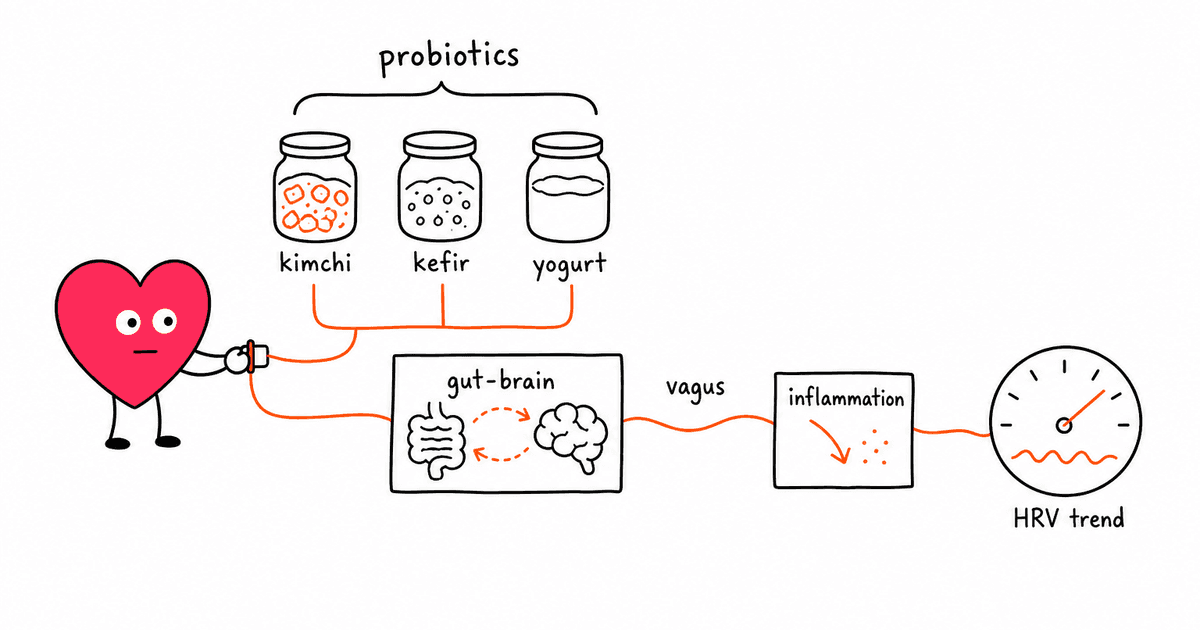
Fermented foods may improve HRV indirectly by supporting gut microbiome diversity, reducing systemic inflammation, and enhancing vagal tone through the gut-brain axis. While direct clinical trials on fermented foods and HRV are limited, research on probiotics, vagus nerve function, and the microbiome-heart connection provides a compelling case for including them in your diet.
The Gut-Brain-Heart Connection
Your gut and brain are in constant communication through the gut-brain axis. The vagus nerve, the longest cranial nerve in your body, serves as the primary highway for this communication. It's also the same nerve responsible for parasympathetic activity that drives higher HRV.
Here's why this matters for HRV:
- Gut microbes produce neurotransmitters. Bacteria in fermented foods produce GABA, serotonin precursors, and short-chain fatty acids that influence vagal signaling.
- The vagus nerve responds to gut signals. A landmark study found that Lactobacillus rhamnosus altered GABA receptor expression in the brain and reduced stress behavior in mice, but only when the vagus nerve was intact. Cutting the vagus nerve eliminated the effect entirely.
- Gut inflammation suppresses HRV. Chronic low-grade inflammation from poor gut health shifts the autonomic nervous system toward sympathetic dominance. Fermented foods help counter this by promoting anti-inflammatory microbial metabolites.
Which Fermented Foods Support HRV
Not all fermented foods are created equal. The most beneficial ones contain live, active cultures and diverse bacterial strains.
Kefir
Kefir contains one of the most diverse microbial communities of any fermented food, including Lactobacillus kefiri and Lactococcus lactis. These strains are known producers of GABA, a neurotransmitter that supports parasympathetic activity. A 2026 study from Preprints.org identified these kefir-specific strains as capable of modulating brain function through vagus nerve stimulation or direct passage across the blood-brain barrier.
Yogurt
Yogurt with live cultures (look for Lactobacillus and Bifidobacterium strains on the label) provides consistent probiotic benefits. A Stanford study found that a high-fermented-food diet increased microbiome diversity and reduced inflammatory markers over 10 weeks, with yogurt being one of the primary foods consumed.
Kimchi and Sauerkraut
These lacto-fermented vegetables provide both probiotics and prebiotics (the fiber that feeds beneficial bacteria). The combination supports sustained microbial diversity. Kimchi specifically contains Lactobacillus plantarum, a strain studied for its anti-inflammatory and cardiovascular benefits.
Kombucha
While less studied than dairy-based fermented foods, kombucha contains a diverse microbial community including acetic acid bacteria and yeasts. Choose unpasteurized varieties to ensure live cultures are present.
Miso and Tempeh
These fermented soy products contain Bacillus subtilis and other beneficial bacteria. Miso consumption has been associated with reduced cardiovascular mortality in large Japanese population studies, though the mechanisms are still being studied.
The Probiotic-HRV Research
Direct research on probiotics and HRV is emerging. A randomized clinical trial published in Journal of Human Hypertension gave hypertensive women a multi-strain probiotic (Lactobacillus paracasei, L. rhamnosus, L. acidophilus, and Bifidobacterium lactis) for eight weeks. The study assessed HRV alongside inflammatory markers and found associations between reduced inflammation and improved cardiac autonomic function.
A 2022 meta-analysis in Frontiers in Nutrition reviewing 13 randomized trials found that probiotic supplementation produced a modest reduction in resting heart rate. While the effect was small, lower resting heart rate generally correlates with higher HRV.
These results suggest probiotics influence autonomic function, but the effects are subtle and likely build over weeks to months of consistent consumption.
How Fermented Foods Reduce Inflammation (and Why That Matters for HRV)
One of the strongest pathways from fermented foods to HRV runs through inflammation. Here's the chain:
- Fermented foods increase microbial diversity in your gut
- Diverse microbiomes produce more short-chain fatty acids (butyrate, propionate, acetate)
- Short-chain fatty acids strengthen the gut barrier and reduce endotoxin leakage
- Less systemic inflammation means less sympathetic activation
- Reduced sympathetic tone allows parasympathetic activity (and HRV) to increase
The Stanford study on fermented foods found that participants eating 6+ servings of fermented foods per day showed significant reductions in 19 inflammatory markers, including interleukin-6 and C-reactive protein. This anti-inflammatory effect provides a plausible mechanism for HRV improvement over time.
How Much Fermented Food Should You Eat
There's no established "dose" for HRV benefits specifically, but the research suggests:
- Start with 1-2 servings per day if you're not currently eating fermented foods
- Build up to 4-6 servings per day over several weeks (this was the level associated with anti-inflammatory benefits in the Stanford study)
- Variety matters more than volume. Eating multiple types of fermented foods (kefir, kimchi, yogurt, sauerkraut) provides a broader range of beneficial strains than large amounts of a single food.
- Consistency is key. Microbial changes from fermented foods are not permanent. Benefits require ongoing consumption.
A "serving" is roughly half a cup of yogurt or kefir, a quarter cup of sauerkraut or kimchi, or one cup of kombucha.
Fermented Foods vs. Probiotic Supplements
Should you eat fermented foods or take a probiotic capsule? Both have a place, but fermented foods offer several advantages:
- Greater microbial diversity. A single serving of kefir may contain 30+ bacterial strains, while most probiotic supplements contain 1-15.
- Prebiotic fiber included. Fermented vegetables provide fiber that feeds bacteria already in your gut.
- Better survival. Bacteria in fermented foods are often more resistant to stomach acid than encapsulated probiotics.
- Additional nutrients. Fermented foods provide vitamins, minerals, and bioactive compounds beyond the bacteria themselves.
That said, probiotic supplements can be useful for targeted interventions or when dietary intake is limited.
Combining Fermented Foods with Other HRV Strategies
Fermented foods work best as part of a broader lifestyle approach to HRV optimization. Consider pairing them with:
- Omega-3 fatty acids for synergistic anti-inflammatory effects
- Magnesium-rich foods to support parasympathetic function
- Adequate hydration to maintain gut barrier integrity
- Breathing exercises to directly stimulate the vagus nerve
- Meditation to reduce stress and support parasympathetic activity
- Regular exercise like walking or zone 2 training
The gut-brain axis responds to multiple inputs simultaneously. A diet rich in fermented foods, combined with movement and stress management, creates the best conditions for autonomic balance. For a broader look at how what you eat affects your autonomic nervous system, see our guide on nutrition and HRV.
Foods That Harm Your Gut (and Your HRV)
While adding fermented foods, consider reducing foods that damage gut health and suppress HRV:
- Ultra-processed foods reduce microbial diversity and increase inflammation
- Excess alcohol disrupts the gut barrier and directly suppresses HRV
- High-sugar diets feed pathogenic bacteria at the expense of beneficial strains (see blood sugar and HRV)
- Artificial sweeteners may alter the gut microbiome in unfavorable ways
Tracking the Effects on Your HRV
Dietary changes affect HRV gradually. If you're adding fermented foods to your routine, here's how to track the impact:
- Establish a baseline by tracking your morning HRV for 2 weeks before changing your diet
- Start your fermented food protocol and continue tracking daily
- Look for trends after 4-8 weeks, not day-to-day changes
- Use a wearable like the Oura Ring 4 or WHOOP 5 for consistent overnight HRV measurement
- Control other variables as much as possible (sleep, exercise, caffeine, alcohol)
Remember that many factors influence HRV simultaneously. Isolating the effect of a single dietary change requires patience and consistency.
The Bottom Line
Fermented foods support HRV through multiple converging pathways: improved gut microbiome diversity, enhanced vagus nerve signaling, and reduced systemic inflammation. While direct clinical evidence linking fermented foods to HRV is still growing, the underlying mechanisms are well-established and the broader health benefits are clear.
Adding a few servings of kefir, kimchi, yogurt, or sauerkraut to your daily diet is a low-risk, high-potential strategy for supporting your autonomic nervous system and overall cardiovascular health.
Frequently Asked Questions
How long does it take for fermented foods to affect HRV?
Most gut microbiome changes from dietary interventions take 2-4 weeks to become measurable. HRV improvements may take 4-8 weeks to show consistent trends, since autonomic changes downstream of gut health are gradual. Consistency matters more than quantity in the early weeks.
Can fermented foods cause HRV to drop temporarily?
If you're not used to fermented foods, introducing them quickly can cause temporary digestive discomfort (bloating, gas) as your microbiome adjusts. This gut stress could temporarily suppress HRV. Start slowly and increase gradually over 1-2 weeks.
Which fermented food is best for HRV?
No single fermented food has been proven superior for HRV. Kefir offers the greatest microbial diversity, while kimchi and sauerkraut provide both probiotics and prebiotic fiber. The best approach is variety: rotate between multiple fermented foods for the broadest range of beneficial strains.
Do pasteurized fermented foods still help HRV?
Pasteurization kills live bacteria, eliminating the probiotic benefit. However, pasteurized fermented foods still contain postbiotics (beneficial metabolites produced during fermentation) that may have some health effects. For maximum HRV-related benefits, choose unpasteurized products with live active cultures.
Need a quick read on your HRV number first?
Enter your HRV value, age range, device, and recovery context for a plain-English interpretation before you decide what to do next.
Interpret Your HRV NumberBuild the 30-day plan