Autism and HRV: What Heart Rate Variability Reveals About Autonomic Regulation
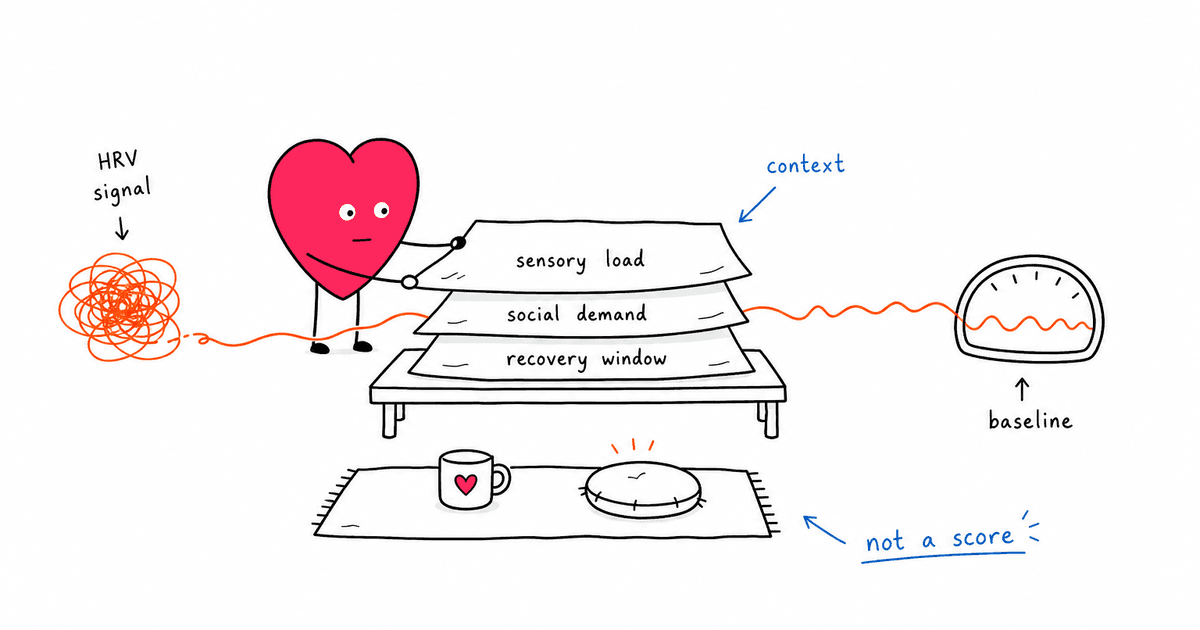
Trying to decode today's HRV number? Use the free interpreter first, then build a practical recovery plan. Interpret your HRV
Autism is usually described through communication style, sensory processing, routines, social interaction, and behavior. That framing misses something important: many autistic people also experience the world through a nervous system that can shift into high arousal quickly and recover slowly.
Heart rate variability (HRV) does not explain autism by itself. It does, however, give researchers and individuals a measurable window into autonomic regulation, stress reactivity, and recovery. That makes HRV especially relevant for autistic people who deal with sensory overload, anxiety, shutdowns, sleep disruption, or difficulty identifying internal body signals.
The key is using HRV carefully. It is not a diagnostic test, a behavior score, or a way to decide whether someone is "regulated enough." It is a physiology signal that can help show when the body is carrying more load than it appears from the outside.
What Is the Link Between Autism and HRV?
Autism is associated with differences in heart rate variability, especially markers of parasympathetic activity and stress reactivity. Research suggests many autistic people show lower vagal tone or a less flexible HRV response during social, cognitive, or sensory demands, though individual patterns vary widely.
A 2020 meta-analysis in Neuroscience & Biobehavioral Reviews reviewed 34 studies comparing HRV in autistic and non-autistic individuals. The researchers found significantly lower baseline parasympathetic HRV in autistic participants, along with lower respiratory sinus arrhythmia (RSA), a breathing-linked marker of vagal activity.
The strongest differences appeared during social stress. RSA reactivity was lower in autistic participants during social stress tasks, with the largest reported effect size in that condition. In plain English: the autonomic nervous system often appears less flexible when autistic people are placed under socially demanding conditions.
That fits lived experience. Many autistic people can function well in predictable, supportive environments but become physiologically overloaded in noisy rooms, ambiguous social settings, rushed transitions, or situations that require masking.
Why Autonomic Regulation Matters in Autism
Your autonomic nervous system controls heart rate, breathing rhythm, blood pressure, digestion, sweating, and the body's stress response. It has two major branches:
- Sympathetic activity: Mobilization, alertness, threat response, effort
- Parasympathetic activity: Recovery, digestion, social engagement, vagal regulation
HRV reflects how flexibly those systems shift. Higher HRV generally suggests more parasympathetic influence and better adaptability. Lower HRV often reflects stress load, fatigue, illness, poor sleep, or reduced autonomic flexibility.
For autistic people, autonomic regulation can matter in several overlapping ways.
Sensory Processing
Bright lights, overlapping conversations, scratchy clothing, strong smells, or unpredictable noise can create real physiological stress. HRV may drop when the sensory environment becomes too demanding, even if the person looks calm externally.
Social Load
Social interaction often requires rapid interpretation of tone, facial expression, timing, body language, and context. For autistic people, that processing load can be high. HRV research showing reduced reactivity during social stress suggests the body may have less autonomic room to adapt under those conditions.
Emotion Regulation
Emotion regulation is not just a mindset. It depends partly on the brain's ability to coordinate arousal through the body. This is why HRV is closely tied to emotional regulation, stress tolerance, and recovery.
Interoception
Many autistic people experience differences in interoception, the ability to notice internal body signals like hunger, thirst, tension, pain, heartbeat, or anxiety cues. HRV can sometimes make invisible physiological load more visible, but it should support self-understanding, not replace subjective experience.
What the Research Shows
The autism-HRV literature is growing, but it is not perfectly consistent. That is expected. Autism is heterogeneous, study methods vary, and HRV is affected by age, breathing, posture, medication, sleep, fitness, anxiety, and measurement quality.
Still, several findings are useful.
Autistic People Often Show Lower Vagal Markers
The 2020 meta-analysis found lower baseline parasympathetic HRV in autistic individuals, including lower RSA. This suggests reduced vagal influence on heart rate in many, but not all, autistic participants.
Vagal tone matters because the vagus nerve helps slow the heart, regulate arousal, support digestion, and coordinate recovery after stress. Lower vagal markers do not mean someone is broken. They mean the body may have less physiological flexibility under demand.
Social Stress May Reveal the Clearest Differences
The same meta-analysis found that HRV reactivity during social stress and social debriefing was significantly lower in autistic participants. RSA reactivity during social stress showed the largest difference.
This is a crucial nuance. Resting HRV may look similar in some autistic and non-autistic people, but task conditions can reveal differences in how the nervous system responds and recovers.
Cognitive Tasks Can Also Show Differences
A 2026 systematic review and meta-analysis in the Review Journal of Autism and Developmental Disorders examined HRV during cognitive tasks in autism and ADHD. Across 20 studies and 2,223 participants, the overall difference was not statistically significant. But subgroup analysis found autistic participants showed significantly lower HRV during cognitive tasks compared with controls.
That does not mean every autistic person has poor cognitive autonomic regulation. It does suggest that demanding attention, executive function, or working memory tasks may create measurable autonomic strain for some autistic people. For comparison, see our guide to ADHD and HRV.
Newer Studies Emphasize Individual Variability
A 2026 Scientific Reports study of autistic adolescents and young adults found resting HRV did not differ significantly from non-autistic peers in that sample. But HRV interacted with daily stress reactivity and internalizing symptoms, suggesting the relationship may depend more on how stress unfolds in daily life than on a single resting measurement.
A 2024 Scientific Reports pilot study also found HRV feasible and useful as a complementary measure in an emotion regulation intervention for autistic youth. HRV added physiological context alongside clinician and parent reports, but it was not treated as a standalone outcome.
This is the right direction: HRV is most useful when it helps personalize support.
The Pattern Is Not One-Size-Fits-All
It would be too simple to say "autism equals low HRV." That is not what the evidence shows.
Some autistic people have low resting HRV. Some have typical resting HRV but stronger drops during stress. Some may show high physiological arousal with little outward expression. Others may have HRV patterns shaped mostly by sleep, anxiety, fitness, medication, co-occurring conditions, or measurement context.
Better framing:
| HRV Pattern | Possible Meaning | What to Check |
|---|---|---|
| Low resting HRV | High baseline stress load or low vagal tone | Sleep, illness, anxiety, medications, fitness |
| Normal resting HRV but big drops after demands | Autonomic cost of masking, sensory load, or cognitive effort | Social events, school/work days, transitions |
| Slow HRV recovery | Nervous system needs longer decompression | Recovery routines, sensory environment, sleep |
| Volatile HRV | Inconsistent load or measurement noise | Routine, device accuracy, timing, tags |
The pattern matters more than one number.
Autism, Anxiety, and HRV
Anxiety is common in autistic people, though it is often underrecognized or misread as avoidance, rigidity, irritability, or noncompliance. HRV can help separate "won't" from "can't right now" by showing when the body is in a high-load state.
Research on anxiety and HRV consistently links lower HRV with reduced emotion regulation capacity and greater stress vulnerability. In autism, that relationship may be amplified by sensory unpredictability, social uncertainty, and the effort of camouflaging or masking.
The practical takeaway is not to chase a higher HRV score. It is to ask better questions:
- Did HRV drop after a noisy social event?
- Does HRV recover faster after quiet time, movement, or a predictable routine?
- Do anxiety symptoms worsen on low-HRV days?
- Does masking all day show up as lower nighttime HRV?
That kind of pattern can be more useful than a generic interpretation from a wearable app.
HRV and Sensory Overload
Sensory overload is not just discomfort. It can be a whole-body stress response. When the nervous system processes too much input at once, sympathetic activity rises and parasympathetic recovery can be suppressed.
For HRV tracking, sensory overload may show up as:
- Lower HRV after crowded or noisy environments
- Higher resting heart rate alongside lower HRV
- Delayed recovery after travel, events, shopping, school, or work
- Worse sleep metrics after a high-sensory day
- Lower HRV during periods of increased stimming, shutdown, or irritability
None of these patterns should be used to judge behavior. They should be used to improve support. If a certain environment repeatedly suppresses HRV, that is information about load, not character.
HRV and Sleep in Autism
Sleep differences are common in autism, including difficulty falling asleep, night waking, altered circadian timing, and lighter sleep. Since sleep is one of the strongest drivers of HRV, poor sleep can easily blur the autism-HRV relationship.
If HRV is consistently low, check sleep first:
- Was bedtime consistent?
- Was the room dark, cool, and quiet enough?
- Did screen exposure run late?
- Was there caffeine, illness, pain, or anxiety?
- Did sensory discomfort interfere with sleep?
For many autistic people, HRV improves less from generic "relaxation" advice and more from reducing friction: better sensory fit, predictable routines, lower evening demands, and fewer abrupt transitions.
Can HRV Diagnose Autism?
No. HRV cannot diagnose autism.
Even though some studies show group-level HRV differences, the overlap between autistic and non-autistic individuals is too large for HRV to function as a diagnostic test. HRV is also influenced by many non-autism factors, including age, fitness, stress, sleep deprivation, medication, illness, caffeine, hydration, and measurement method.
Autism diagnosis requires a developmental history and clinical assessment. HRV can complement that picture by showing autonomic patterns, but it cannot replace it.
How Autistic People Can Use HRV Data
HRV is most useful when it helps someone understand their own body with more kindness and precision. It is least useful when it becomes another metric to perform for.
1. Build a Personal Baseline
Track HRV consistently for at least 2 to 4 weeks before interpreting patterns. Morning measurements or overnight readings are usually more stable than random daytime checks. Compare your HRV to your own baseline, not to population averages.
Our guide to understanding HRV numbers explains why personal trends matter more than universal "good" or "bad" ranges.
2. Tag Context, Not Just Symptoms
The most useful HRV notes are specific:
- Loud environment
- Unexpected schedule change
- Masking-heavy workday
- Social event
- Conflict
- New food, medication, or supplement
- Poor sleep
- Exercise
- Quiet recovery time
Over time, these tags can reveal what reliably drains or restores your nervous system.
3. Watch Recovery Speed
A single HRV drop after a stressful day is normal. The more useful signal is recovery. Does HRV rebound after a night's sleep, or does it stay low for several days?
Slow recovery may mean the support plan needs more decompression time, less sensory load, easier transitions, or fewer back-to-back demands.
4. Avoid Metric Anxiety
Some people become more anxious when they track HRV closely. This is common enough that we have a separate guide to HRV tracking anxiety and orthosomnia.
If checking HRV makes the day worse, reduce the frequency. Weekly trend review may be healthier than daily score-watching.
HRV Biofeedback and Autism
HRV biofeedback uses real-time heart rhythm feedback, usually paired with slow breathing, to train parasympathetic activation. It is not autism treatment. It is a self-regulation tool that may help some autistic people manage anxiety or arousal.
A 2022 home-based pilot study in JMIR Formative Research tested HRV biofeedback in 20 autistic participants ages 13 to 24 over 12 weeks. Pre-post questionnaires showed significant reductions in anxiety in both children and adults, and 65.6% of participant reports indicated the devices helped when used. The authors were clear that larger studies are needed.
For autistic people, HRV biofeedback often needs adaptation:
- Use shorter sessions at first, even 2 to 5 minutes
- Avoid uncomfortable wearables or harsh audio cues
- Use visual feedback only if it feels calming, not demanding
- Do not force slow breathing if it creates air hunger or panic
- Pair practice with a predictable routine
- Consider humming, paced exhale, or gentle movement if seated breathing feels bad
The goal is not perfect coherence. The goal is a repeatable way to shift arousal down when the body is ready.
Lifestyle Supports That May Improve Autonomic Balance
No lifestyle habit changes autism, and that is not the goal. The goal is to reduce avoidable nervous system load and support recovery.
Predictable Transitions
Abrupt transitions can create autonomic stress. Timers, visual schedules, transition warnings, and buffer time can reduce the sympathetic spike that comes from sudden demand shifts.
Sensory-Friendly Recovery
Quiet rooms, dim lighting, comfortable clothing, noise reduction, weighted blankets, or movement breaks may support parasympathetic recovery. The right tool depends on the person. HRV can help identify what actually works.
Regular Movement
Movement supports HRV, but the best format is the one the person can repeat without sensory or social overload. Options like walking, swimming, yoga, or low-pressure strength training may work better than chaotic group fitness settings.
Sleep Consistency
Consistent sleep and wake timing can improve HRV by stabilizing circadian rhythm. For autistic people, the sensory details of sleep may matter as much as the schedule: fabric texture, room temperature, light leakage, noise, and bedtime demands.
Breathing, Humming, and Vocal Practices
Some autistic people dislike formal breathing exercises. Others find them helpful. Singing and humming may be a more tolerable route because extended exhalation and vocal vibration can stimulate vagal pathways without turning the practice into a rigid task.
Professional Support for High Anxiety
If anxiety, panic, self-injury, severe insomnia, or shutdowns are frequent, HRV tracking is not enough. A clinician familiar with autism can help identify supports that match the person's communication style, sensory profile, and needs.
Choosing an HRV Wearable With Sensory Sensitivity in Mind
Wearable choice matters more in autism because sensory comfort can make or break consistency.
- Oura Ring: Useful for overnight HRV with no screen, though some people dislike rings
- Whoop: Screen-free and focused on recovery, but the band texture and subscription model may not fit everyone
- Polar H10: Strong option for short HRV biofeedback or morning readings, but chest straps can be sensory-unfriendly
- Apple Watch Ultra or Garmin: Useful if someone already tolerates watches, but notifications should usually be minimized
For autistic children and teens, tracking should be collaborative, consent-based, and low pressure. A wearable should never become a compliance tool or a way to punish nervous system states.
For device comparisons, see our guide to the best HRV monitors.
When HRV Data Deserves Medical Attention
Most HRV changes are not emergencies. Still, talk with a healthcare professional if low HRV appears alongside:
- Fainting, dizziness, or near-syncope
- Chest pain, palpitations, or unusual shortness of breath
- New medication side effects
- Rapid resting heart rate changes
- Fever, infection, or unexplained fatigue
- Severe sleep disruption
- Sudden changes after starting or stopping medication
This is especially important if there are co-occurring conditions such as dysautonomia, epilepsy, connective tissue disorders, anxiety disorders, or heart rhythm issues.
Key Takeaways
Autism and HRV are connected through autonomic regulation. Research suggests many autistic people show lower parasympathetic HRV markers or less flexible HRV responses during social, cognitive, or stressful situations. But the pattern is not universal, and HRV should never be used as a diagnostic test or behavior score.
The best use of HRV in autism is practical and humane: identifying load, respecting recovery needs, noticing what helps, and reducing avoidable stress. For some people, HRV biofeedback may become a useful self-regulation tool. For others, simply seeing how sensory environments, sleep, social demands, and routines affect recovery can be enough.
HRV is not a measure of worth, effort, or emotional control. It is one signal from the body. Used well, it can help autistic people and their support teams make daily life less physiologically expensive.
Frequently Asked Questions
Is low HRV common in autism?
Lower HRV, especially lower parasympathetic markers like RSA, is common in autism research at the group level. But it is not universal. Some autistic people have typical resting HRV, while others show differences mainly during stress, social demands, cognitive tasks, or recovery periods.
Can HRV predict meltdowns or shutdowns?
HRV may help identify rising physiological load before a meltdown or shutdown for some people, but it should not be treated as a reliable prediction tool. It works best when combined with context, sensory cues, communication signals, sleep data, and the person's own experience.
Does HRV biofeedback help autistic people?
Early research is promising but limited. A 2022 pilot study found reduced anxiety after home-based HRV biofeedback in autistic young people, but larger trials are needed. Biofeedback may help some autistic people regulate arousal, especially when sessions are adapted for sensory comfort.
What HRV metric matters most for autism?
Research often focuses on RSA, high-frequency HRV, RMSSD, and other parasympathetic markers. For everyday tracking, RMSSD or a wearable's overnight HRV trend is usually the most practical. The trend over time matters more than a single reading.
Should autistic children wear HRV trackers?
Sometimes, but only thoughtfully. HRV tracking may help caregivers and clinicians understand stress and recovery patterns, but it should be consent-based, low pressure, and sensory-friendly. It should never be used to judge behavior, enforce compliance, or override what the child communicates.
Need a quick read on your HRV number first?
Enter your HRV value, age range, device, and recovery context for a plain-English interpretation before you decide what to do next.
Interpret Your HRV NumberBuild the 30-day plan