HRV After Surgery: What to Expect During Recovery
Trying to decode today's HRV number? Use the free interpreter first, then build a practical recovery plan. Interpret your HRV
If you track recovery with WHOOP, the Oura Ring, or another HRV monitor, surgery can be a rude surprise. Your HRV often drops hard, your resting heart rate climbs, and your recovery score may look terrible even if everything is going according to plan.
That does not necessarily mean something is wrong. Surgery is one of the biggest controlled stressors your body can go through. Anesthesia, tissue trauma, pain, inflammation, sleep disruption, reduced movement, and medication effects all push your autonomic nervous system away from its normal baseline.
The useful question is not, "Is my HRV low after surgery?" It probably is. The better question is, "What kind of HRV pattern should I expect, and when should I worry?"
Does HRV Drop After Surgery?
Yes. HRV usually drops after surgery because the body shifts into a high-demand recovery state marked by inflammation, sympathetic activation, pain, and disrupted sleep. The size and duration of that drop depend on the procedure, your baseline health, your pain burden, and whether recovery stays uncomplicated.
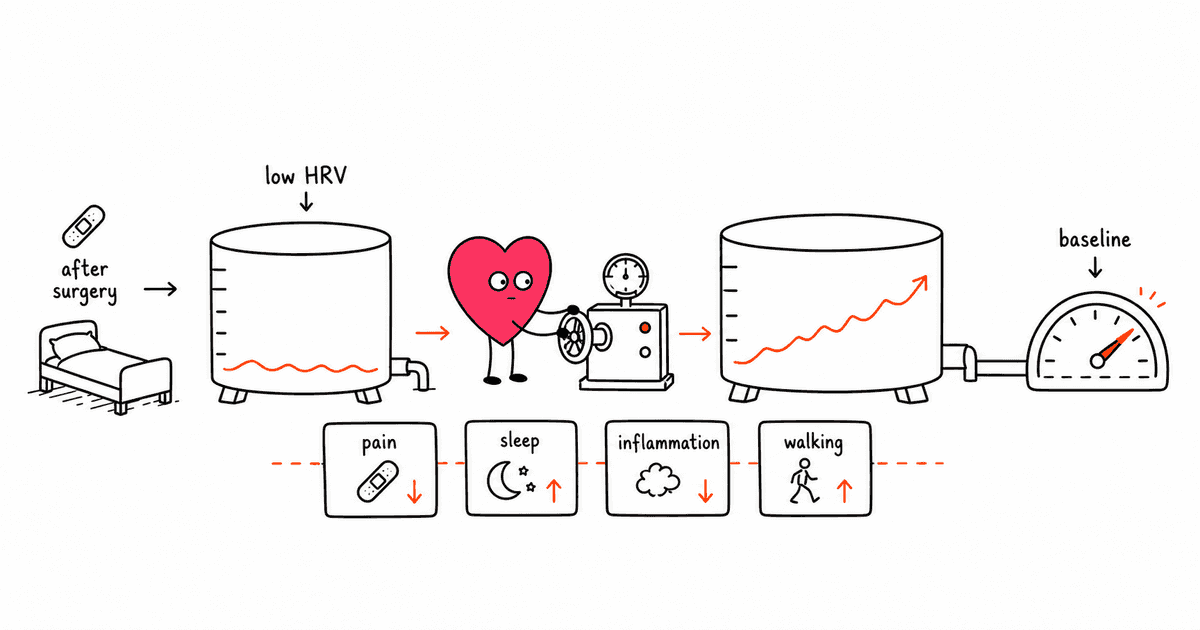
In plain English, surgery pushes your body into repair mode. When that happens, your nervous system often prioritizes vigilance over flexibility, and heart rate variability tends to fall.
This is not unique to one type of operation. It has been observed across cardiac, abdominal, thoracic, and other major surgical settings. The broad pattern is consistent even though the exact numbers vary from study to study.
Why Surgery Pushes HRV Down
Several things hit HRV at once after an operation:
| Factor | What it does to HRV | Why it matters |
|---|---|---|
| Surgical stress | Usually lowers HRV | Tissue injury activates the sympathetic nervous system |
| Anesthesia | Temporarily disrupts autonomic balance | Perioperative drugs alter heart rate regulation and blood pressure control |
| Inflammation | Often suppresses vagal activity | Cytokines and immune signaling shift recovery physiology |
| Pain | Can worsen HRV patterns | Higher pain loads increase autonomic strain |
| Poor sleep | Lowers nighttime HRV | Hospital sleep and home recovery sleep are often fragmented |
| Reduced movement | Slows return to baseline | Immobility affects circulation, conditioning, and overall recovery |
| Complications | Can prolong or deepen HRV suppression | Infection, bleeding, dehydration, or cardiopulmonary issues increase physiological stress |
A 2025 review in The Cardiothoracic Surgeon summarized this well, noting that anesthesia, surgical trauma, and postoperative inflammation disrupt autonomic homeostasis and make HRV a useful window into postoperative recovery.
What the Research Actually Shows
The practical takeaway from the research is simple: postoperative HRV tends to stay lower than baseline for a while, and slower recovery can be a warning sign.
One older but still useful study in Anesthesiology followed patients after coronary artery surgery and found that HRV was still depressed at 28 days, even though some aspects of autonomic recovery began within the first week. That is a good reminder that "I am home" and "my nervous system is fully back to normal" are not the same thing.
A 2022 systematic review in Journal of Clinical Monitoring and Computing looked at 63 studies on preoperative HRV and perioperative outcomes. The evidence was heterogeneous, so the authors were careful not to oversell it, but the review still found a clinically relevant role for HRV in predicting issues like intraoperative hypotension and postoperative atrial fibrillation.
More recently, a 2024 prospective cohort study in Scientific Reports found that postoperative HRV measures had better discriminatory ability for 30-day complications after major urologic surgery than preoperative measures. That does not mean your ring can diagnose a complication. It does mean HRV is picking up real physiology during recovery, not random noise.
There is also evidence that pain matters. A 2024 study in Pain Practice found that perioperative HRV patterns, sleep-related factors, and surgical type helped predict higher early postoperative pain. Another study after abdominal surgery found that worse pain scores were associated with altered HRV patterns the day after surgery.
So the evidence points in one direction: low HRV after surgery is common, persistent suppression can last longer than most people expect, and the trend is more useful than any one isolated reading.
What to Expect on Your Wearable
If you wear a consumer device, expect a pattern something like this:
| Recovery phase | Common HRV pattern | What else you may notice |
|---|---|---|
| First 24-72 hours | HRV often drops sharply | Resting heart rate rises, sleep quality is poor, readiness scores look rough |
| Days 4-10 | HRV may stay suppressed | Pain, swelling, poor appetite, constipation, and reduced activity still affect recovery |
| Weeks 2-4 | Gradual improvement if recovery is uncomplicated | Resting heart rate starts settling, sleep improves, walking gets easier |
| Beyond 4 weeks | May still be below baseline after major surgery | Cardiac, thoracic, abdominal, or complicated recoveries can take longer |
That timeline is general, not universal. A minor arthroscopic procedure is not the same as open abdominal surgery, and laparoscopic procedures often recover faster than larger operations.
This is also why comparing yourself to your normal training baseline too early can be misleading. If your pre-surgery nightly HRV was 65 and it is now 32, that is not automatically alarming. What matters more is whether the trend gradually stabilizes, whether your symptoms are improving, and whether your surgeon expects the recovery course you are experiencing.
HRV Is a Recovery Signal, Not a Surgical Clearance Tool
This is the part people get wrong.
After surgery, HRV can be useful, but it should not be treated like a green light or red light by itself. A low HRV does not automatically mean you are recovering badly. A decent HRV does not mean you are cleared to train, travel, or ignore symptoms.
Use HRV as one signal among several:
- Resting heart rate: A rising resting heart rate plus low HRV is often more informative than HRV alone. See resting heart rate vs. HRV
- Sleep quality: Fragmented sleep can keep HRV low for reasons that are annoying but expected. See HRV and sleep
- Pain level: Poor pain control can drag recovery metrics down. See HRV and chronic pain
- Mobility: If walking is getting easier and fatigue is gradually improving, that context matters
- Wound healing and symptoms: Fever, drainage, swelling, chest symptoms, or shortness of breath matter more than your wearable app summary
The better model is this: HRV helps you monitor recovery load, but your surgical team still defines the actual recovery rules.
What Usually Helps HRV Recover After Surgery
You cannot biohack your way around tissue healing. That part takes the time it takes. But you can make recovery smoother.
1. Follow the boring instructions
The glamorous answer would be nice. The real answer is better.
Take medications as prescribed, follow lifting restrictions, use compression or breathing devices if recommended, and stick to the walking plan your care team gave you. A smoother recovery environment usually produces smoother HRV trends.
2. Prioritize sleep aggressively
Sleep is already one of the strongest drivers of HRV, and it matters even more after surgery. Pain, unfamiliar sleeping positions, nighttime bathroom trips, and medication timing can all wreck it.
A few practical wins:
- Keep the room cool and dark
- Time pain control so you are not chasing pain at bedtime
- Limit alcohol, which can further suppress HRV
- Use pillows or positioning aids that reduce strain on the surgical area
3. Walk early, if your surgeon wants you walking
For many procedures, gentle walking is one of the safest ways to nudge recovery in the right direction. It supports circulation, bowel function, lung expansion, and general autonomic recovery.
That does not mean turning recovery into step-count theater. Short, frequent walks are usually smarter than forcing volume because your app is upset.
4. Stay on top of fluids and basic nutrition
Hydration status affects HRV even when you are healthy, and it can matter even more after surgery, especially if you had fasting, blood loss, nausea, or reduced appetite. Rebuilding also requires adequate calories and protein, which we cover in our guide to nutrition and HRV.
If you are cleared to eat and drink normally, focus on:
- Consistent fluids, with electrolytes when appropriate
- Enough protein to support tissue repair
- Easy-to-digest meals if appetite is poor
- Fiber and hydration if pain medication is slowing digestion
5. Use breathing work only if it fits your recovery plan
Gentle breathing exercises can support vagal activity, but this is not the moment for aggressive breath holds or trying to set a personal best on a relaxation app. If your team gave you an incentive spirometer or breathing drills, do those. Otherwise, light nasal breathing and slow exhales are usually plenty. We cover the basics here: breathing exercises for HRV
What a Normal Recovery Trend Looks Like
The cleanest pattern is usually:
- A sharp HRV drop right after surgery
- Several days to weeks of suppressed readings
- A gradual upward drift as pain, sleep, mobility, and inflammation improve
The messy part is that normal recovery is not linear. You might see:
- A temporary drop after doing a bit too much
- Lower HRV after a bad night of sleep
- A dip when pain medication changes
- Several flat days before the trend improves again
That is normal enough. Bodies are not spreadsheets.
What you want to see over time is a recovery arc, not perfect daily numbers.
When Low HRV After Surgery Deserves More Attention
A low HRV reading by itself is usually not the reason to call your surgeon. Low HRV plus worsening symptoms is different.
Pay more attention if you see a persistent downward trend alongside things like:
- Fever or chills
- New shortness of breath
- Chest pain
- Resting heart rate staying unusually high or climbing further
- Worsening swelling, redness, or drainage at the incision
- Severe fatigue that is getting worse instead of better
- Inability to eat, drink, walk, or sleep without deterioration
A 2024 study in major urologic surgery found that lower postoperative HRV was more strongly associated with later complications than preoperative HRV. Again, your wearable is not a doctor. But if your metrics are worsening and your symptoms are worsening too, that combination is worth respecting.
Should You Use HRV to Decide When to Exercise Again?
Only partly.
After surgery, formal exercise progression should be based first on your surgeon's restrictions, then on symptoms, then on objective trends like HRV. In that order.
Once you are cleared for more activity, HRV becomes more useful. If you are choosing between a longer walk and a shorter walk, or deciding whether today feels like a light mobility day versus a more active recovery day, HRV can add context. But it should not overrule incision precautions, bone healing timelines, or cardiopulmonary restrictions.
If you want a simple rule, use this one:
Do not use a single good HRV score to talk yourself into doing something your surgeon has not cleared.
That rule saves a surprising number of people from very stupid decisions.
Frequently Asked Questions
How long does HRV stay low after surgery?
It depends on the procedure and the recovery course. Minor procedures may settle faster, while major cardiac, thoracic, or abdominal surgeries can keep HRV suppressed for weeks. Research in cardiac surgery has shown incomplete normalization even at 28 days.
Does anesthesia lower HRV?
Usually, yes, at least temporarily. Perioperative literature shows that anesthesia and the surgical stress response both alter autonomic control. That effect then blends with pain, inflammation, poor sleep, and reduced activity during recovery.
Should I worry if my wearable says my recovery is bad?
Not automatically. Consumer wearables do not understand that you just had surgery. They only see a stressed body. If your symptoms are improving and your surgeon is happy, a bad readiness score is often just the device correctly noticing that recovery is hard work.
Can Oura or WHOOP detect a complication after surgery?
Not reliably on their own. They can show that your body is under more strain than usual, but they cannot tell you whether the cause is normal healing, poor sleep, dehydration, pain, or a true complication. Use them as context, not diagnosis.
Is a low HRV after surgery a sign I should not walk?
Usually no, if your surgical team wants you walking. In many recoveries, gentle movement is part of the treatment plan. The key is matching your effort to the instructions you were given, not chasing a wearable score.
The Bottom Line
Low HRV after surgery is common, expected, and often completely normal. Surgery temporarily pushes your nervous system into a more stressed, less flexible state, and wearables pick that up clearly.
What matters most is not the fact that HRV drops. It is whether the broader pattern fits recovery. If pain is easing, sleep is improving, mobility is returning, and your HRV trend is slowly climbing, that is usually reassuring.
If HRV stays crushed and your symptoms are getting worse, pay attention and contact your care team.
Use your wearable as a dashboard, not a judge. After surgery, that mindset is a lot more useful.
Need a quick read on your HRV number first?
Enter your HRV value, age range, device, and recovery context for a plain-English interpretation before you decide what to do next.
Interpret Your HRV NumberBuild the 30-day plan