Heart Palpitations and HRV: Why Skipped Beats Can Confuse Your Data
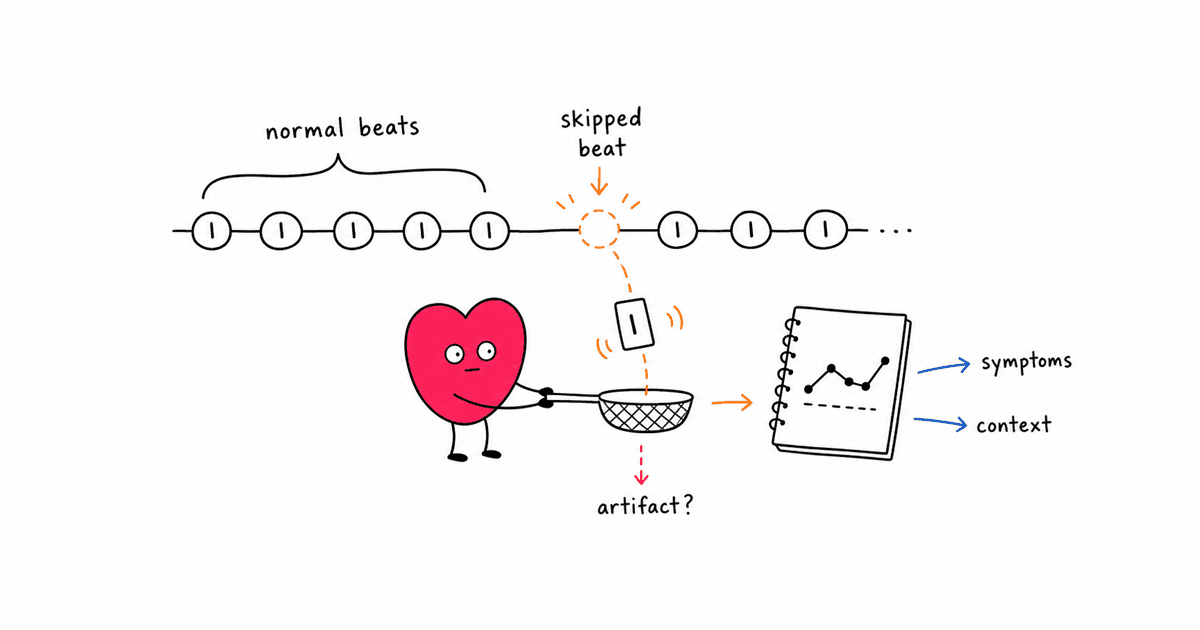
Heart palpitations can make HRV confusing fast.
One night your wearable shows a huge HRV spike. The next morning you remember feeling fluttering, pounding, or a skipped beat in your chest. Was that high HRV a sign of recovery? Was your nervous system suddenly more resilient? Or did your tracker accidentally treat irregular beats as useful variability?
Usually, the answer is the boring but important one: context matters.
Heart palpitations can affect HRV because HRV is calculated from the timing between heartbeats. If you have extra beats, skipped beats, premature atrial contractions, premature ventricular contractions, or signal artifacts, the beat-to-beat intervals can change for reasons that are not the same as normal autonomic recovery.
That does not mean every palpitation is dangerous. It also does not mean HRV is useless. It means you should not interpret a strange HRV reading the same way you would interpret a clean morning baseline.
Do Heart Palpitations Change HRV?
Yes, heart palpitations can change HRV readings, especially when the palpitation reflects an ectopic beat or irregular rhythm. HRV depends on normal beat-to-beat timing. Palpitations can add unusually short or long intervals, which may make HRV look higher, lower, or simply noisier than usual.
The key distinction is this:
- Normal HRV: variation between normal heartbeats, influenced by the autonomic nervous system
- Palpitation-related variability: variation caused by extra beats, skipped beats, rhythm changes, or measurement artifacts
Those two signals can look similar mathematically, but they do not mean the same thing.
A high HRV score after a calm night of sleep may be a good sign. A high HRV score during a night with skipped beats, irregular rhythm alerts, poor sleep, and elevated resting heart rate is a different story.
For the basics of what HRV is supposed to measure, start with our beginner's guide to HRV.
What Heart Palpitations Actually Mean
Palpitations are not a diagnosis. They are a symptom: an increased awareness of your heartbeat.
The American Heart Association describes palpitations as feelings of racing, pounding, fluttering, or skipped heartbeats. They may be felt in the chest, throat, or neck, and they can last seconds, minutes, or longer. The same 2026 AHA explainer notes that palpitations can come from many causes, including stress, anxiety, exercise, excess caffeine, electrolyte issues, medications, or abnormal rhythms such as atrial fibrillation.
Sometimes the feeling is a premature contraction. That means one beat arrives earlier than expected, often followed by a pause that makes the next beat feel stronger.
Common labels include:
- PACs: premature atrial contractions, which start in the upper chambers of the heart
- PVCs: premature ventricular contractions, which start in the lower chambers of the heart
- Ectopic beats: beats that begin outside the usual timing pathway
- Arrhythmias: broader rhythm problems, including AFib and other electrical rhythm disorders
Cleveland Clinic notes that PVCs are common and often not dangerous, but repeated symptoms or underlying heart disease change the risk picture. That is exactly why HRV should be treated as one piece of context, not as a rhythm diagnosis.
Why Skipped Beats Confuse HRV
HRV analysis works best when it is measuring normal-to-normal intervals: the timing between normal heartbeats after artifacts and abnormal beats are handled properly.
Skipped or extra beats break that clean assumption.
A premature beat can create one very short interval followed by one longer compensatory interval. To an HRV algorithm, that may look like dramatic variability. But the variability is coming from rhythm timing, not necessarily from better parasympathetic activity.
A 2018 Frontiers in Physiology study looked at how ectopic beats affect HRV analysis. The researchers found statistically significant differences in HRV metrics even when the ectopic beat ratio was less than 1%. They also emphasized that ectopic beats and false beat detections can distort HRV if they are not corrected before analysis.
That is a big deal for consumer tracking.
If a device captures a clean signal and filters abnormal beats well, the HRV score may still be useful. If the signal includes ectopic beats, motion artifact, loose sensor contact, or irregular rhythm, the HRV score may reflect data quality as much as physiology.
This is one reason chest straps and ECG-based systems can behave differently from wrist optical sensors. We cover that measurement tradeoff in ECG vs PPG for HRV.
Why a High HRV Spike Is Not Always Good News
People learn that higher HRV is usually better, then get confused when their highest score appears on a night that felt terrible.
With palpitations, that can happen.
A sudden HRV spike may be less meaningful if it comes with:
- Fluttering, pounding, or skipped-beat sensations
- An irregular rhythm alert from a wearable
- Elevated resting heart rate
- Poor sleep or frequent awakenings
- Chest discomfort, dizziness, or unusual shortness of breath
- A known arrhythmia history
- A graph that looks jagged, erratic, or unlike your normal trend
This does not mean the score is fake. It means the interpretation changes.
HRV is not a moral scoreboard where high always means healthy and low always means broken. It is a signal. When rhythm becomes irregular, the signal can be contaminated.
Common Triggers Worth Logging
If palpitations happen occasionally, the most useful move is often to track the context around them. You are looking for patterns, not trying to diagnose yourself from a single night of data.
Common triggers to log include:
- Caffeine: dose, timing, and whether it was more than usual. See caffeine and HRV.
- Alcohol: especially evening drinking, which can raise heart rate and disrupt recovery. See alcohol and HRV.
- Poor sleep: short sleep, fragmented sleep, or suspected sleep apnea. See sleep and HRV.
- Dehydration: low fluid intake, heat exposure, travel, or heavy sweating. See hydration and HRV.
- Electrolyte changes: especially sodium, potassium, and magnesium context. See electrolytes and HRV.
- Stress or anxiety: both can increase awareness of heartbeat and shift autonomic tone. See HRV and stress and HRV and anxiety.
- Heavy training: hard workouts, overreaching, or insufficient recovery. See HRV and overtraining.
- Illness: fever, infection, inflammation, or post-viral recovery.
- Medications and stimulants: decongestants, ADHD medications, asthma medications, nicotine, or other stimulants.
- Large late meals: especially if they worsen reflux, sleep quality, or nighttime heart rate.
Do not turn this into obsessive tracking. A simple note is enough: what happened, when it happened, how long it lasted, what your heart rate did, and whether your HRV reading looked unusual.
How to Use HRV If You Get Palpitations
Use HRV more conservatively when palpitations are in the picture.
1. Separate Clean Data From Questionable Data
If you felt skipped beats overnight, had an irregular rhythm alert, or saw a strange HRV spike paired with poor sleep, label that day.
Do not mix questionable rhythm data into your normal baseline without context. A contaminated reading can make your trend look better or worse than reality.
2. Compare Like With Like
Compare normal mornings to normal mornings. Compare post-palpitations mornings to other post-palpitations mornings only if the pattern is recurring.
This is especially important if you have known AFib, frequent PVCs, or another rhythm condition. HRV during irregular rhythm should not be interpreted like HRV during normal sinus rhythm.
3. Watch the Cluster, Not One Number
A single HRV score is weak evidence. A cluster is more useful.
Useful context includes:
- Resting heart rate
- Sleep duration and sleep quality
- Symptoms
- Training load
- Alcohol, caffeine, and hydration
- Illness or fever
- Rhythm alerts or ECG recordings
- Blood pressure, if you measure it
If HRV is low, resting heart rate is high, sleep was poor, and you felt palpitations, the practical answer is usually not "push harder." It is to recover, reduce obvious triggers, and watch whether the pattern repeats.
4. Use ECG Features Correctly
Some watches and portable devices offer ECG recordings. Those are different from HRV scores.
An ECG feature may help capture rhythm information during symptoms, while HRV is usually a recovery and autonomic trend metric. Do not treat HRV as a substitute for ECG evidence.
If your device flags possible AFib or repeated irregular rhythm, use that as a reason to get proper medical evaluation, not as proof from the internet that you have one specific condition.
When Palpitations Deserve Medical Attention
Most occasional palpitations are not emergencies, but some patterns should not be shrugged off.
The American Heart Association advises prompt evaluation when palpitations last minutes to hours or come with new symptoms such as lightheadedness, dizziness, shortness of breath, chest pain, or feeling like you might pass out. Chest discomfort, shortness of breath, nausea, or other heart attack warning signs warrant emergency care.
Talk with a clinician if palpitations are:
- New or clearly different from your baseline
- Increasing in frequency or intensity
- Lasting longer than usual
- Happening with dizziness, fainting, chest pain, or shortness of breath
- Happening during exercise
- Paired with irregular rhythm alerts
- Affecting your sleep, training, work, or quality of life
- Occurring alongside known heart disease risk
This is not about fear. It is about not asking an HRV score to do a clinician's job.
What Data to Bring to a Clinician
If you decide to get palpitations evaluated, wearable data can be useful if you bring it clearly.
Helpful details include:
- Date and time of episodes
- How the palpitation felt: racing, pounding, fluttering, skipped beat, or pause
- Duration: seconds, minutes, hours, or recurring waves
- Heart rate during the episode, if captured
- Any ECG strips or irregular rhythm alerts
- HRV and resting heart rate trends before and after
- Symptoms: dizziness, chest pain, shortness of breath, fatigue, fainting
- Triggers: caffeine, alcohol, dehydration, illness, stress, exercise, medications
- Family history or known heart conditions
A clinician may use history, physical exam, blood work, ECG, or longer rhythm monitoring to figure out what is actually happening. HRV can support the story, but rhythm diagnosis comes from rhythm evidence.
Bottom Line
Heart palpitations can absolutely affect HRV readings.
If the palpitation is caused by an ectopic beat, rhythm change, or measurement artifact, your HRV score may reflect irregular beat timing rather than recovery. That is why a sudden HRV spike during a symptomatic night should be treated carefully.
Use HRV as a trend, label questionable readings, track triggers, and pay attention to the full picture: symptoms, resting heart rate, sleep, rhythm alerts, and how you actually feel.
And if palpitations are new, prolonged, worsening, or paired with chest pain, fainting, dizziness, or shortness of breath, get medical care. No wearable score is worth gambling on that.
Need a quick read on your HRV number first?
Enter your HRV value, age range, device, and recovery context for a plain-English interpretation before you decide what to do next.
Interpret Your HRV NumberBuild the 30-day plan