Gratitude and HRV: How Thankfulness Strengthens Your Heart
Trying to decode today's HRV number? Use the free interpreter first, then build a practical recovery plan. Interpret your HRV
Gratitude might sound like a soft, feel-good concept, but the science behind it is surprisingly hard. Researchers have found that gratitude practices directly influence your autonomic nervous system, the same system that controls your heart rate variability. The connection between what you feel and how your heart responds is more powerful than most people realize.
What Is the Connection Between Gratitude and HRV?
Gratitude activates the parasympathetic nervous system, shifting your body from a stress response toward rest and recovery. This shift increases heart rate variability, which reflects your heart's ability to adapt to changing demands. Higher HRV is associated with better cardiovascular health, emotional resilience, and longevity.
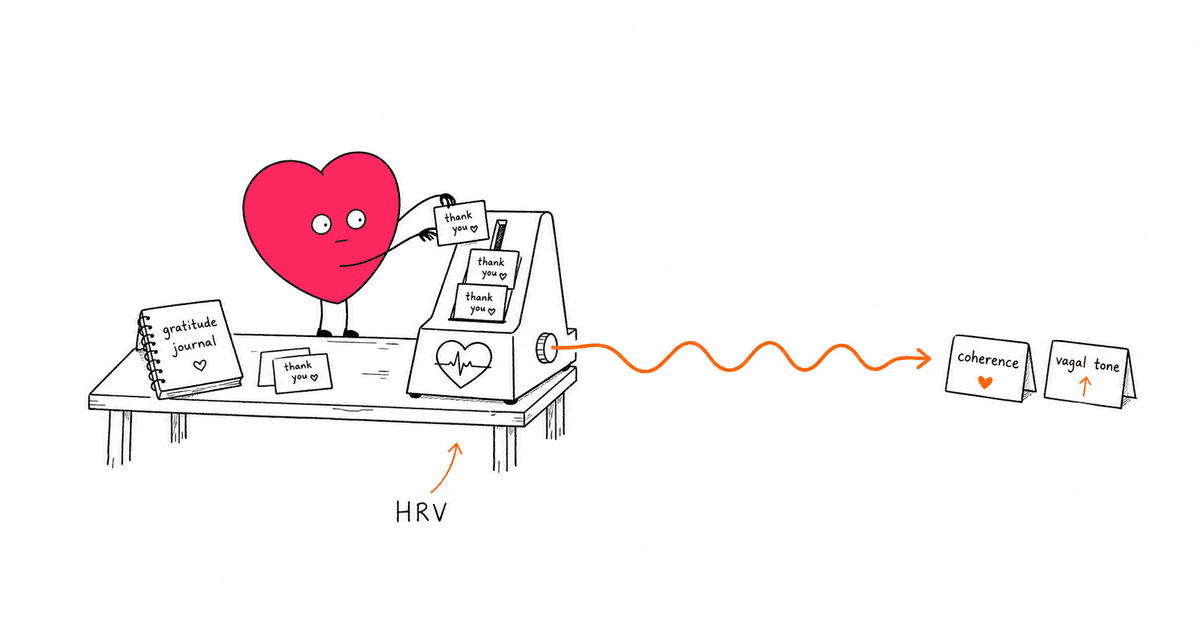
The vagus nerve plays a central role here. Positive emotions like gratitude stimulate vagal tone, which is the primary driver of parasympathetic activity. When vagal tone increases, your heart rate becomes more variable, and your body enters a state that researchers call "coherence," where heart rhythms, breathing, and blood pressure synchronize.
What the Research Shows
A landmark 2016 study published in Psychosomatic Medicine examined 70 patients with Stage B heart failure. Participants who completed an 8-week gratitude journaling intervention showed increased HRV and reduced inflammatory biomarkers compared to the control group. This was notable because heart failure patients typically have very low HRV, and even small improvements carry clinical significance.
Research from the HeartMath Institute has demonstrated that intentionally generating feelings of appreciation produces immediate, measurable shifts in heart rhythm patterns. Participants moved from erratic, low-coherence patterns to smooth, sine-wave-like HRV patterns within minutes of focusing on gratitude.
A 2025 study in the Journal of Positive Psychology found that writing gratitude letters produced a more pronounced HRV response to stress compared to a control condition. Participants who practiced gratitude showed better "allostatic" patterns, meaning their nervous system adapted more effectively to challenges.
How Gratitude Affects Your Nervous System
Your autonomic nervous system has two branches: the sympathetic (fight-or-flight) and parasympathetic (rest-and-digest). Chronic stress keeps you locked in sympathetic dominance, which suppresses HRV and increases cardiovascular risk.
Gratitude works as a parasympathetic activator. When you genuinely focus on something you appreciate, several physiological changes occur:
- Heart rate slows slightly
- Breathing becomes deeper and more rhythmic
- Blood pressure decreases
- Cortisol levels drop
- Vagal tone increases
- HRV rises
These changes are not just momentary. Regular gratitude practice appears to create lasting shifts in autonomic balance, similar to how consistent meditation or breathing exercises rewire the nervous system over time.
Gratitude and Inflammation
One of the most compelling findings is gratitude's effect on inflammation. Chronic inflammation is a major driver of heart disease, and it also suppresses HRV. The 2016 heart failure study found that gratitude journaling reduced inflammatory biomarkers, creating a positive feedback loop: less inflammation leads to higher HRV, which supports better cardiovascular function.
Research from the University of California, San Diego found that people who scored higher on gratitude assessments had lower levels of inflammatory markers like C-reactive protein (CRP) and interleukin-6 (IL-6). Since inflammation directly impacts HRV, reducing it through gratitude may be one of the key mechanisms behind the HRV improvements.
Gratitude Journaling for Better HRV
Gratitude journaling is the most studied gratitude intervention. The practice is simple, but consistency matters more than intensity.
How to Start a Gratitude Journal
- Choose a consistent time, either morning or evening
- Write down 3-5 specific things you are grateful for
- Be detailed rather than generic ("the warm coffee my partner made this morning" beats "my family")
- Focus on the feeling, not just the list
- Aim for at least 5 sessions per week
What Makes It Effective
The key is specificity and emotional engagement. Simply listing items without connecting to the feeling produces weaker effects. Researchers found that participants who spent time truly savoring each item showed greater HRV improvements than those who rushed through the exercise.
Writing by hand may also amplify the effect. The slower pace of handwriting encourages deeper processing, and some research suggests it activates different neural pathways than typing.
The HeartMath Coherence Technique
The HeartMath Institute developed a specific protocol that combines gratitude with breathing to maximize HRV coherence:
- Focus your attention on the area around your heart
- Breathe slowly and deeply (about 5-6 breaths per minute)
- While breathing, recall a genuine feeling of gratitude or appreciation
- Maintain this state for 3-5 minutes
This technique combines the HRV benefits of slow breathing with the parasympathetic activation of positive emotion, essentially a form of HRV biofeedback. Studies show it can shift HRV patterns within 60-90 seconds, making it one of the fastest ways to influence your autonomic state.
Gratitude vs. Other HRV Interventions
How does gratitude stack up against other evidence-based HRV interventions?
| Intervention | Time to See HRV Changes | Effort Level | Research Support |
|---|---|---|---|
| Gratitude journaling | 2-4 weeks | Low | Moderate |
| Meditation | 4-8 weeks | Moderate | Strong |
| Breathing exercises | Immediate | Low | Strong |
| Cold exposure | Immediate | High | Moderate |
| Exercise | 4-12 weeks | Moderate-High | Strong |
Gratitude is not a replacement for physical interventions like exercise or breathing work. Think of it as a complementary practice that addresses the emotional and psychological drivers of autonomic dysfunction. Combining gratitude with other interventions typically produces the best results.
The Social Connection Factor
Gratitude naturally strengthens social connections, which independently boost HRV. Expressing appreciation to others activates oxytocin release, which enhances vagal tone. This creates a virtuous cycle: gratitude improves relationships, stronger relationships provide more opportunities for gratitude, and both pathways support higher HRV.
Research shows that people who regularly express gratitude to others have stronger social bonds, lower perceived stress, and better sleep quality, all factors that independently influence HRV.
Tracking Gratitude's Effect on Your HRV
If you want to see how gratitude affects your personal HRV data, here is a practical approach:
- Establish a 2-week HRV baseline using a wearable like the Oura Ring 4 or Whoop
- Begin a daily gratitude journaling practice
- Track your morning HRV readings for the next 4-6 weeks
- Look for trends in your weekly HRV averages rather than daily fluctuations
Most people notice meaningful changes within 3-4 weeks. The effect may be subtle at first, especially if you are already doing other HRV-supporting practices. Focus on the weekly trend rather than day-to-day variation, since HRV is naturally variable. For help choosing a tracker, see our best HRV monitors of 2026 roundup.
When Gratitude Is Difficult
It is worth acknowledging that gratitude practices can feel forced or even harmful during difficult periods. If you are dealing with grief, trauma, or depression, toxic positivity can backfire. Research suggests that authentic gratitude, even for small things, works better than forcing appreciation for things you do not genuinely feel thankful for.
During tough times, try narrowing your focus. Even noticing something as basic as "my body is still breathing" or "the sun came out today" can activate the parasympathetic response without dismissing real pain.
For those dealing with anxiety or depression, gratitude practices work best as part of a broader approach that includes professional support.
Combining Gratitude With Your Evening Routine
The evening is an ideal time to pair gratitude with other HRV-supporting habits:
- Complete your gratitude journal before bed
- Follow with 5 minutes of slow breathing (5-6 breaths per minute)
- Avoid screens for 30 minutes before sleep
- Keep your bedroom cool and dark for optimal sleep quality
This combination targets multiple HRV pathways simultaneously: emotional regulation through gratitude, direct vagal stimulation through breathing, and recovery optimization through sleep hygiene.
The Bottom Line
Gratitude is one of the simplest, most accessible tools for improving HRV. The research, while still growing, consistently shows that intentional thankfulness activates the parasympathetic nervous system, reduces inflammation, and supports cardiovascular health. You do not need any special equipment, just a few minutes of genuine reflection each day.
The most effective approach combines gratitude with physical practices like breathing exercises, regular movement, and quality sleep. For a complete list of evidence-based strategies, see our guide on how to improve your HRV. Track your HRV with a reliable wearable to see how your body responds, and give the practice at least 4 weeks before evaluating results.
Frequently Asked Questions
How quickly does gratitude affect HRV?
Acute effects can appear within minutes during focused gratitude practices like the HeartMath coherence technique. Lasting baseline changes in resting HRV typically develop over 2-4 weeks of consistent daily practice.
Is gratitude journaling or meditation better for HRV?
Both improve HRV through overlapping but distinct mechanisms. Gratitude journaling is easier to start and requires less training, while meditation has a deeper evidence base. Combining both tends to produce the strongest results.
Can gratitude replace medication for heart conditions?
No. Gratitude practices are complementary to medical treatment, not a substitute. If you have a diagnosed heart condition, continue following your doctor's recommendations. Gratitude journaling can be a helpful addition to your overall care plan.
How many things should I write in my gratitude journal?
Research typically uses 3-5 items per session. Quality matters more than quantity. One deeply felt entry is more beneficial for HRV than a long list written without emotional engagement.
Does forced gratitude still improve HRV?
The evidence suggests that genuine emotional engagement is important. Going through the motions without connecting to the feeling produces weaker autonomic effects. If gratitude feels forced, try starting with neutral observations and building toward appreciation gradually.
Need a quick read on your HRV number first?
Enter your HRV value, age range, device, and recovery context for a plain-English interpretation before you decide what to do next.
Interpret Your HRV NumberBuild the 30-day plan