Best HRV Monitors of 2026: Research-Backed Rankings
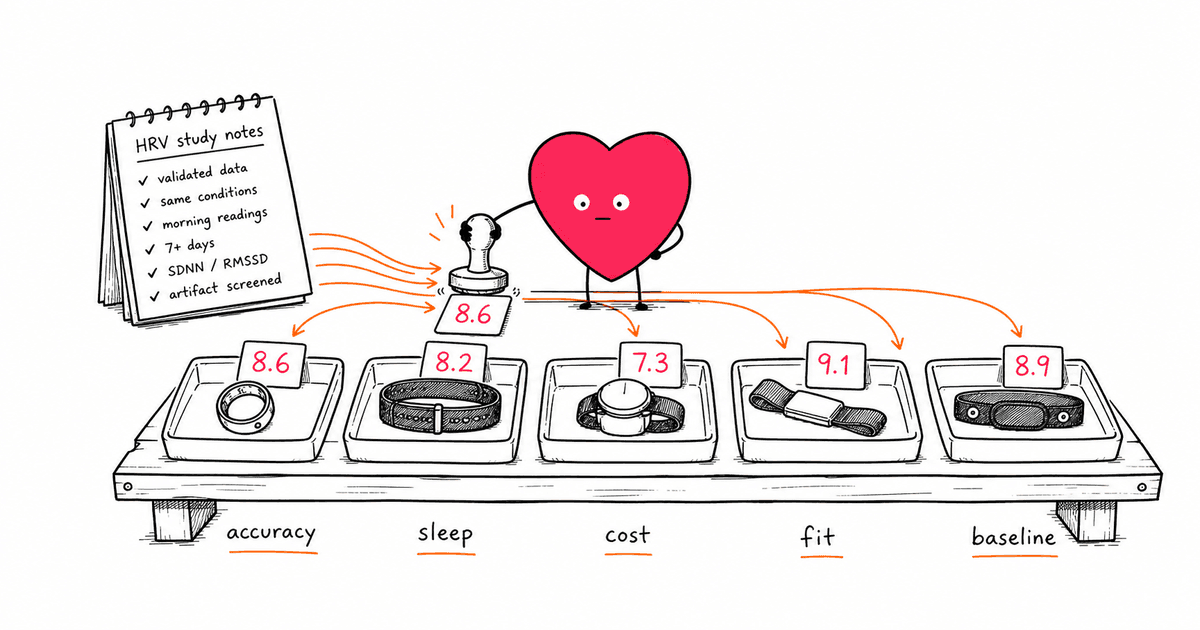
Ready to start tracking your HRV? Check out our top picks: Whoop | Oura Ring 5 | Polar H10
Best HRV Monitors in 2026
| Rank | Device | Best For | Accuracy | Price |
|---|---|---|---|---|
| 1 | Oura Ring 5 | Sleep & recovery | ★★★★★* | $399-499 + $6/mo |
| 2 | Whoop 5 | Athletes & training | ★★★★★ | $30/mo |
| 3 | Samsung Galaxy Ring | Android users | ★★★★ | $399 |
| 4 | Apple Watch Ultra 2 | Apple ecosystem | ★★★½ | $799 |
| 5 | Polar H10 | Medical-grade accuracy | ★★★★★ | $90 |
The Ring 5 rating is provisional. Independent research tested Oura Gen 3 and Ring 4; Ring 5's incremental accuracy evidence currently comes from Oura.
Quick Picks
- Best overall: Oura Ring 5 for sleep-first HRV and passive recovery trends.
- Best for athletes: Whoop 5.0 for recovery, strain, and coaching.
- Best no-subscription accuracy: Polar H10 for controlled morning readings.
- Best smartwatch: Apple Watch if you want HRV inside a broader iPhone ecosystem.
A landmark study published by The Physiological Society in late 2025 helped answer which wearables deliver accurate readings. It tested Oura Gen 3 and Ring 4, not Ring 5. Our Ring 5 accuracy rating therefore combines strong prior-generation independent evidence with Oura's manufacturer-reported generation comparison and remains provisional until independent Ring 5 validation is available. If you're new to HRV tracking, start with our guides on what HRV is and how to improve it. And if you find yourself stressing over your scores, our guide to HRV tracking anxiety and orthosomnia can help you build healthier tracking habits.
The study, conducted at Wright-Patterson Air Force Base with over 500 nights of sleep data, compared consumer wearables against the gold-standard Polar H10 chest strap. Its results form the independent backbone of our 2026 recommendations, while current-model specifications and clearly labeled manufacturer evidence inform generation updates. If your shortlist already includes Apple, Oura, and Whoop, our Whoop vs Oura vs Apple Watch comparison goes deeper on sleep tracking, cost, and long-term usability.
What the Research Tells Us
The study tested Oura Ring (Gen 3 and Gen 4), Whoop 4.0, Garmin Fenix 6, and Polar Grit X Pro against ECG reference measurements. If you want the measurement basics first, our ECG vs PPG for HRV guide explains why chest straps, rings, and watches can produce different HRV numbers. The findings were clear:
- Oura Ring showed the strongest accuracy for both HRV and resting heart rate
- Whoop performed nearly as well, with excellent consistency
- Garmin showed a 10.9ms HRV underestimation (still usable, but less precise)
- Finger and ear sensors outperform wrist sensors for resting measurements
One important caveat: Oura's accuracy decreased slightly at higher HRV levels (above 60ms rMSSD). Athletes with naturally high HRV may see more variance. For a deeper explanation of rMSSD and other HRV metrics, see our guide to understanding your HRV numbers.
Ring 5 was released after that study. Oura reports 12% better overnight HRV accuracy than Ring 4 for the average member, but that claim is not a substitute for independent validation. Our Oura Ring 5 review separates the published specifications from what has and has not yet been independently established.
Our 2026 Rankings
1. Best Overall: Oura Ring 5
The research backs what many suspected: the finger is an ideal location for measuring heart rate during sleep. Blood vessels sit close to the skin, and the ring experiences minimal motion artifacts compared to wrist-worn devices.
Why it wins:
- Earlier Oura generations led the peer-reviewed overnight comparison
- Completely unobtrusive for 24/7 wear
- 6 to 9-day rated battery life
- Smaller and lighter hardware than Ring 4
- Excellent sleep staging and readiness scores
- No screen means no distractions
Considerations:
- Requires $6/month subscription for full features
- Limited real-time HRV during exercise
- Ring 5's incremental accuracy claim is not yet independently validated
- Narrower size range than Ring 4
Price: $399-$499 depending on finish + $6/month
Shop Oura Ring 5 | Read full review
2. Best for Athletes: Whoop 5.0
Whoop's latest hardware maintains the excellent HRV accuracy from the 4.0 while adding improved strain tracking and faster charging. Their "Locker" research hub and advanced recovery algorithms make it the choice for serious athletes.
Why athletes love it:
- Research-validated HRV accuracy
- Strain coach optimizes daily training load
- Journal feature tracks lifestyle factors
- 5+ day battery with portable charger
- Waterproof for swimming
Considerations:
- Subscription model ($199-359/year, no hardware purchase option, see whether WHOOP is worth it for a full cost breakdown)
- No display for quick glances
- Less accurate than Oura at rest, but better during exercise
Price: Free hardware with membership ($16.60-30/month depending on plan)
Shop Whoop 5.0 | Read full review
3. Best Budget Precision: Polar H10
For users who don't need 24/7 monitoring, the Polar H10 chest strap remains the gold standard. It's what researchers use to validate other devices, and for good reason.
Why it's unbeatable for accuracy:
- Medical-grade ECG accuracy
- Used as the reference in validation studies
- One-time purchase, no subscription
- Works with Elite HRV, HRV4Training, and other apps
- 400+ hour battery life
Considerations:
- Not designed for sleep or 24/7 wear
- Requires manual morning readings (see our beginner's guide for how to set up a routine)
- No built-in insights (depends on companion app)
Price: $90
4. Best Smart Ring Alternative: Samsung Galaxy Ring
Samsung's entry into the smart ring market brings solid competition. While not quite matching Oura's HRV accuracy, it offers excellent sleep tracking and no subscription fees.
Why it's worth considering:
- No monthly subscription required
- Accurate sleep and activity tracking
- Seamless Samsung ecosystem integration
- Lightweight titanium design
- 7-day battery life
Considerations:
- HRV accuracy trails Oura in head-to-head tests
- Requires Samsung phone for full features
- Limited third-party app support
- First-generation product (expect improvements)
Price: $399
5. Best Smartwatch: Apple Watch Series 10
For those who want HRV tracking alongside full smartwatch capabilities, the Apple Watch Series 10 delivers solid accuracy with the broadest feature set.
Why it works:
- Good HRV and RHR accuracy in testing
- ECG and blood oxygen monitoring
- Massive app ecosystem
- No subscription required
- Sleep tracking with respiratory rate
Considerations:
- Battery life requires daily charging
- Less HRV-focused than dedicated devices
- Bulkier for sleep wear
Price: $399-$799 depending on model
Shop Apple Watch | Apple Watch HRV guide
6. Best for Runners: Garmin Forerunner 265
If you prioritize GPS accuracy and training metrics over resting HRV precision, Garmin delivers unmatched sports tracking with decent health metrics. If running performance is your main use case, our running and HRV guide shows how to use those recovery signals without overreacting to daily noise.
Why runners choose Garmin:
- Best-in-class GPS and pace metrics
- Training load and recovery advisor
- Multi-sport profiles
- AMOLED display with great battery (13+ days in smartwatch mode)
- No subscription required
Considerations:
- HRV accuracy lags Oura and Whoop by about 10ms
- Body Battery algorithm criticized by researchers
- Wrist sensor less accurate than finger or chest
Price: $449
Shop Garmin Forerunner 265 | Garmin vs Polar comparison
How to Choose
| Priority | Best Choice |
|---|---|
| Best passive overnight HRV | Oura Ring 5 |
| Maximum controlled accuracy | Polar H10 |
| Athletic training focus | Whoop 5.0 |
| Budget with precision | Polar H10 |
| No subscription fees | Samsung Galaxy Ring |
| Full smartwatch features | Apple Watch Series 10 |
| GPS + running metrics | Garmin Forerunner 265 |
The Bottom Line
The 2025 research validated what the HRV community suspected: finger-based sensors (Oura) and well-calibrated wrist bands (Whoop) outperform traditional smartwatches for resting HRV measurement.
For most users focused on recovery and health optimization, the Oura Ring 5 offers the best current combination of passive wearability, battery life, and established Oura measurement performance. That recommendation is not a claim that Ring 5 itself has already won an independent head-to-head study. Athletes who need strain tracking should look at Whoop 5.0. And budget-conscious users can't go wrong with the research-grade Polar H10.
The good news? Even the "less accurate" devices like Garmin are still useful for tracking trends. The key is consistency: pick one device and stick with it to see how your HRV changes over time. Once you're tracking, you can use your data to manage stress and optimize training load. For a detailed head-to-head, see our Whoop vs Oura vs Apple Watch comparison.
Ready to start tracking?
- Oura Ring 5 - Best passive overnight tracking
- Whoop 5.0 - Best for athletes
- Polar H10 - Best budget option
- Samsung Galaxy Ring - No subscription
- Garmin Forerunner 265 - Best for runners
- Apple Watch - Best smartwatch
Need to interpret your HRV before choosing a device?
Use your current reading, age range, device, and recovery context to decide whether you need a new tracker or a better baseline.
Interpret Your HRV FirstBuild the 30-day plan