Dementia and HRV: What Heart Rate Variability Reveals About Brain Aging
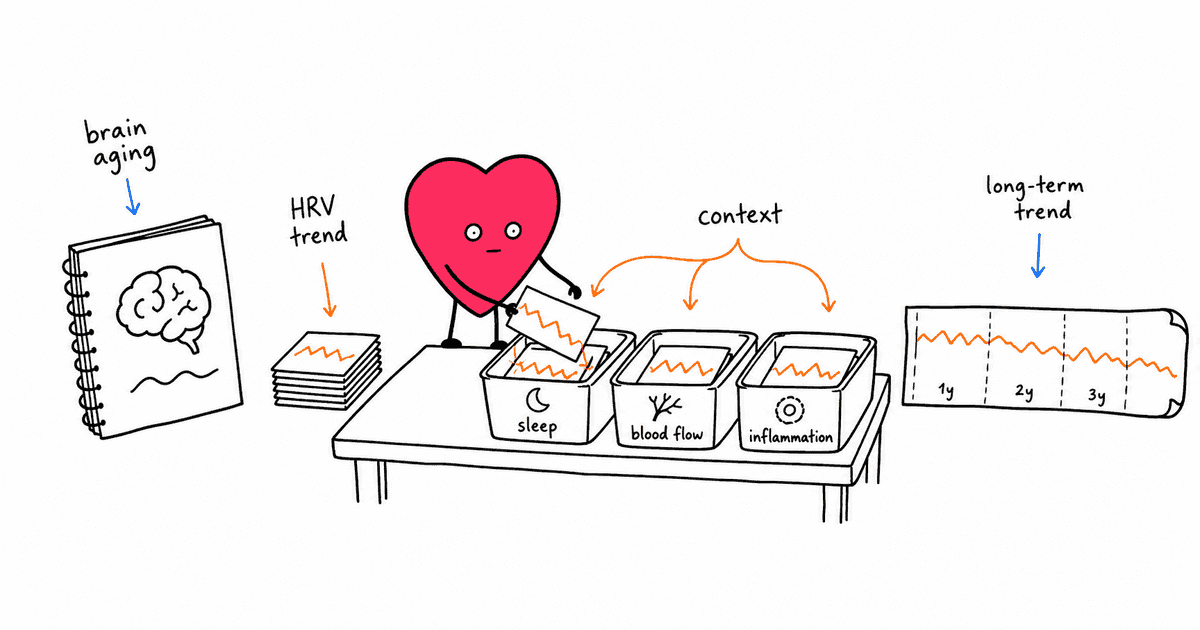
Dementia is usually framed as a memory problem. That is understandable, but incomplete. The brain does not age in isolation. It is connected to sleep, blood pressure, inflammation, vascular health, metabolic health, movement, stress, and the autonomic nervous system.
That is why heart rate variability is worth paying attention to.
HRV does not diagnose dementia. It cannot tell you whether someone has Alzheimer's disease, vascular dementia, Lewy body dementia, or mild cognitive impairment. But HRV can reflect autonomic flexibility, especially vagal regulation, which appears to change in many people with cognitive impairment and neurodegenerative disease.
Used carefully, HRV can be a useful background signal for brain aging, recovery, and overall physiological resilience.
Quick Answer: Is HRV Linked to Dementia?
Yes, lower HRV is often associated with dementia, mild cognitive impairment, and faster cognitive decline, especially when looking at vagally mediated HRV markers such as RMSSD and high-frequency HRV.
The key word is associated. Low HRV does not mean dementia is developing. Many common factors can lower HRV, including poor sleep, illness, alcohol, pain, stress, depression, low fitness, medications, and cardiovascular disease.
The better interpretation is this: if HRV is chronically low or steadily declining over months, it may be one clue that the nervous system, vascular system, or recovery capacity is under strain. For brain health, that context matters.
Why Dementia and HRV Are Connected
Dementia is not one disease. Alzheimer's disease, vascular dementia, Lewy body dementia, frontotemporal dementia, Parkinson's disease dementia, and mixed dementia have different mechanisms. Still, many share a common theme: the systems that regulate the brain and body become less flexible.
Your autonomic nervous system helps regulate:
- Heart rate and blood pressure
- Blood vessel tone
- Sleep-wake rhythm
- Digestion
- Inflammatory responses
- Stress recovery
- Temperature regulation
- Energy mobilization
HRV measures beat-to-beat changes in heart rhythm. In general, higher HRV suggests the heart is receiving flexible autonomic input. Lower HRV often suggests reduced adaptability, higher physiological load, or less parasympathetic activity.
That matters for dementia because brain health is tightly connected to blood flow, oxygen delivery, glucose regulation, sleep quality, and inflammation. A less flexible autonomic system may be both a marker of cognitive vulnerability and a contributor to the biological environment that makes cognitive decline more likely.
For a broader look at the heart-brain connection, see our guide to HRV and cognitive performance. For a seizure-focused example of the same brain-heart theme, read epilepsy and HRV.
What the Research Says
The evidence is not perfect, but it is consistent enough to take seriously.
A 2018 systematic review in Current Alzheimer Research analyzed HRV studies in dementia and mild cognitive impairment. The review found mostly negative effect sizes across HRV indexes, suggesting autonomic dysfunction in dementia and mild cognitive impairment. The authors also noted an important limitation: studies were small and heterogeneous, and results for high-frequency HRV in Alzheimer's disease were inconsistent.
That caveat matters. HRV research can be messy because results depend on measurement method, posture, breathing rate, medication use, disease stage, fitness, cardiovascular health, and whether HRV is recorded during sleep, rest, standing, or cognitive testing.
A later 2022 systematic review and meta-analysis also reported lower HRV in people with dementia or neurocognitive disorders compared with healthy controls, pointing toward reduced parasympathetic activity.
More recently, a 2024 large longitudinal study in the Whitehall II cohort followed 2,702 middle-aged and older adults without prior coronary heart disease or stroke. The study found that lower RMSSD and high-frequency HRV were associated with faster decline in global cognitive function over 10 years. Participants with low RMSSD had 37% higher odds of low cognitive function at follow-up, and low HRV was linked with cognitive decline progressing roughly 3 to 3.5 years faster per decade.
That does not prove low HRV causes dementia. But it supports a practical idea: autonomic regulation may be part of the long runway of brain aging, not just a late-stage consequence.
HRV Metrics That Matter Most for Brain Aging
Consumer wearables simplify HRV into one score, but research usually looks at specific metrics.
RMSSD
RMSSD reflects short-term beat-to-beat variability and is strongly influenced by parasympathetic, vagal activity. It is one of the most useful consumer-facing HRV metrics because it is relatively stable during sleep and less dependent on long recording windows.
If RMSSD is persistently low compared with your own baseline, it may suggest reduced recovery capacity or higher allostatic load. It does not tell you why.
High-frequency HRV
High-frequency HRV is closely tied to respiratory sinus arrhythmia, the natural rise and fall in heart rate with breathing. It is often used in research as a marker of vagal modulation.
This metric is less visible in most consumer apps, but it is common in ECG-based studies.
SDNN
SDNN captures overall variability across a recording period. It can be useful in longer clinical recordings, but it is harder to compare across wearables because it changes with recording length, movement, sleep stage, and context.
If you are still learning the difference between these metrics, our guide to understanding HRV numbers breaks them down in plain English.
What a Low HRV Might Mean in Dementia Risk Context
A low HRV reading by itself is not alarming. A low HRV pattern becomes more meaningful when it appears alongside other risk signals.
1. Poor Sleep and Fragmented Recovery
Sleep is one of the strongest daily drivers of HRV. Fragmented sleep, sleep apnea, short sleep, and irregular sleep timing can all suppress overnight HRV.
That matters because sleep is also involved in memory consolidation, metabolic cleanup, blood pressure regulation, and emotional control. If HRV is low and sleep metrics are also poor, the first question is usually not "What is wrong with my brain?" It is "What is disrupting recovery?"
Start with our guide to HRV and sleep if your overnight trends are unstable.
2. Blood Pressure and Vascular Load
Vascular health is a major dementia risk pathway. High blood pressure, arterial stiffness, diabetes, smoking, inactivity, and air pollution can damage small blood vessels that support the brain.
HRV and blood pressure regulation are linked through the baroreflex, the feedback system that helps the body stabilize blood pressure when you move, stand, sleep, or experience stress.
A person with chronically low HRV and poorly controlled blood pressure should not interpret HRV as a brain-specific signal. It may be reflecting broader cardiovascular strain. Our guide to HRV and blood pressure explains that relationship in more detail.
3. Stress, Depression, and Social Isolation
Psychological stress can lower HRV, and depression and social isolation are recognized dementia risk factors. This does not mean stress causes dementia in a simple direct line. It means long-term autonomic load can sit in the same neighborhood as sleep disruption, inflammation, blood pressure problems, reduced activity, and poorer health behaviors.
In practical terms, HRV can sometimes show when the body is not recovering even if the person is "getting through the day." For the protective side of that equation, see social connection and HRV.
4. Reduced Physical Activity
Physical activity is one of the most reliable ways to support both HRV and brain health. Aerobic fitness improves cardiovascular function, insulin sensitivity, sleep quality, vascular health, and stress resilience.
For many people, the first useful intervention is not exotic. It is regular walking, light zone 2 cardio, strength training, and fewer long sedentary blocks.
If you want the lowest-friction starting point, read walking and HRV.
5. Medication and Illness Effects
Many people tracking HRV are older adults or caregivers of older adults. That means medications and health conditions matter.
Beta blockers, antidepressants, sleep medications, stimulants, anticholinergic medications, pain, infections, dehydration, arrhythmias, and inflammatory disease can all affect HRV. Some dementia medications may also influence heart rate or autonomic symptoms.
This is one reason HRV should never be interpreted without medical context.
Can Improving HRV Reduce Dementia Risk?
No one should claim that raising HRV prevents dementia. That would overstate the evidence.
A more accurate statement is this: many habits that support higher HRV also support better brain and heart health.
The 2024 Lancet Commission on dementia prevention estimated that a substantial share of dementia cases may be preventable or delayed by addressing modifiable risk factors across life, including hearing loss, high blood pressure, smoking, obesity, depression, physical inactivity, diabetes, social isolation, excessive alcohol, traumatic brain injury, air pollution, and other risks.
Several of those same factors influence HRV.
So the goal is not to chase a higher HRV number. The goal is to build a physiology that tends to produce better HRV as a side effect.
That usually means:
- Consistent sleep and wake timing
- Regular aerobic activity
- Strength training two or more days per week, if appropriate
- Blood pressure management
- Better glucose control
- Treating sleep apnea when present
- Limiting heavy alcohol intake
- Not smoking
- Managing depression and chronic stress
- Maintaining social connection
- Protecting hearing and vision
- Eating a nutrient-dense dietary pattern, such as a Mediterranean-style diet
For food patterns that support cardiometabolic health, see Mediterranean diet and HRV.
How to Use HRV If You Are Worried About Brain Health
HRV is most useful when you treat it as a trend, not a verdict.
Track Your Personal Baseline
Compare your HRV to your own 30-day, 60-day, and 90-day history. Do not compare your number to a younger athlete, a friend, or an app's generic readiness range.
Age, sex, fitness, sleep, medications, and device type all shape HRV.
Look for Persistent Changes
A single bad night is normal. A lower HRV trend that lasts for weeks deserves context.
Ask what changed:
- Sleep duration or timing
- Alcohol intake
- Training load
- Illness or inflammation
- Stress level
- Pain
- New medications
- Blood pressure
- Weight change
- Travel or schedule disruption
If the drop has an obvious explanation, fix the input before worrying about the metric.
Pair HRV With Simple Cognitive and Health Signals
HRV becomes more useful when paired with observations such as:
- Sleep consistency
- Resting heart rate
- Blood pressure
- Daily steps
- Exercise tolerance
- Mood
- Memory complaints
- Medication changes
- Dizziness when standing
- New confusion or functional changes
If memory or thinking changes are noticeable to you or others, do not use HRV to self-monitor indefinitely. Talk with a clinician.
Do Not Obsess Over Daily Scores
Anxiety about HRV can backfire. If checking your score makes you more stressed, reduce the frequency. A weekly trend review is often more useful than daily score-watching.
This is especially important for caregivers. HRV can provide context, but it should not become another source of alarm in an already stressful situation.
When to Talk to a Doctor
Get medical guidance if cognitive changes are new, progressive, or affecting daily life. That includes:
- Getting lost in familiar places
- Repeating questions more than usual
- Trouble managing finances, medication, cooking, or appointments
- New confusion, personality changes, or hallucinations
- Sudden weakness, speech trouble, facial drooping, or severe dizziness
- Frequent fainting or falls
- Very low resting heart rate with symptoms
- Irregular heart rhythm alerts from a wearable
Sudden cognitive or neurological symptoms can be urgent. Do not wait for HRV trends to clarify the situation.
The Bottom Line
Dementia and HRV are connected through the autonomic nervous system, vascular health, sleep, stress, inflammation, and metabolic function. Research suggests that people with dementia or mild cognitive impairment often have lower HRV, and newer longitudinal evidence links lower midlife HRV with faster cognitive decline.
But HRV is not a dementia test.
The most useful way to think about it is as a resilience signal. If your HRV is stable, sleep is solid, blood pressure is managed, activity is consistent, and mood is supported, that is a good sign for overall health. If HRV is chronically low or falling, use it as a prompt to look at the basics, not as a reason to panic.
For brain aging, the fundamentals still win: movement, sleep, blood pressure control, metabolic health, social connection, hearing support, and lower chronic stress.
HRV simply gives you one more window into whether your body is handling those demands well.
Need a quick read on your HRV number first?
Enter your HRV value, age range, device, and recovery context for a plain-English interpretation before you decide what to do next.
Interpret Your HRV NumberBuild the 30-day plan