Epilepsy and HRV: What Heart Rate Variability Reveals About Seizure Risk
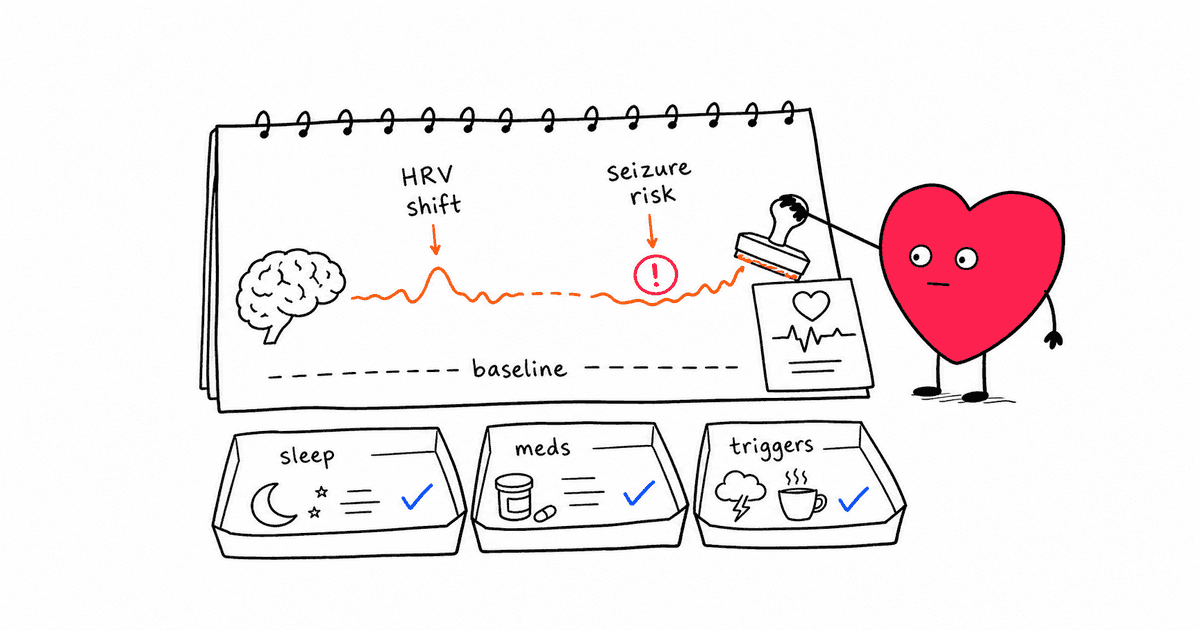
Epilepsy is usually discussed as a brain disorder, which makes sense. Seizures start from abnormal electrical activity in the brain. But epilepsy also affects the body systems that keep heart rate, breathing, blood pressure, and recovery stable.
The CDC reports that about 2.9 million U.S. adults and 456,000 children have active epilepsy. For many of them, the brain-heart connection is not theoretical. It shows up in sleep, stress tolerance, recovery, and sometimes heart rate patterns around seizures.
That is where heart rate variability becomes relevant.
HRV cannot diagnose epilepsy, predict every seizure, or replace neurological care. But it can offer a window into autonomic nervous system strain, especially when seizure activity, sleep loss, medication changes, stress, or illness are pulling the body away from baseline.
Quick Answer: Does Epilepsy Affect HRV?
Yes. Epilepsy is often associated with lower HRV, especially lower vagally mediated markers such as RMSSD and high-frequency HRV. Research suggests that seizures can disrupt autonomic balance before, during, and after an event, but HRV is not reliable enough to use as a stand-alone seizure predictor.
The practical takeaway is careful: HRV can help show how your nervous system is responding over time. It should not be used to decide whether a seizure is about to happen, whether medication is working, or whether it is safe to ignore symptoms.
Why Epilepsy and HRV Are Connected
Your brain and heart are constantly communicating through the autonomic nervous system.
That system has two major branches:
- Sympathetic activity, which raises heart rate, mobilizes energy, and supports emergency responses
- Parasympathetic activity, largely routed through the vagus nerve, which supports recovery, digestion, and flexible beat-to-beat heart regulation
HRV reflects how much beat-to-beat flexibility exists in that system. Higher HRV usually suggests stronger parasympathetic modulation and better adaptive capacity. Lower HRV often suggests greater physiological load, reduced vagal activity, or a system that is less flexible. That vagal connection is also why vagus nerve stimulation and HRV are often discussed together, even though consumer HRV tracking is not the same as clinical VNS.
Epileptic seizures can affect this balance because the brain regions involved in seizures often overlap with areas that influence heart rate and breathing. Temporal lobe and insular activity, for example, can change autonomic output. That does not mean every person with epilepsy will have the same HRV pattern, but it explains why the connection is biologically plausible.
For a broader explanation of autonomic disruption, see our guide to dysautonomia and HRV. The same brain-heart theme shows up in related guides to migraine and HRV, concussions, TBI, and HRV, and Parkinson's disease and HRV.
What Happens to HRV Around a Seizure?
Seizures can change heart rate and HRV in several phases.
Before a seizure
Some studies find measurable changes in HRV during the preictal period, the window before a seizure. The pattern is not universal, but it often involves reduced parasympathetic activity and increased sympathetic activation.
In plain English: the body may shift into a more activated state before some seizures.
That sounds useful, but it is not yet clinically simple. Preictal windows vary by person, seizure type, time of day, medication status, and measurement method. What looks like a seizure-related HRV drop in one person may look like stress, poor sleep, dehydration, or illness in another.
During a seizure
Many seizures are accompanied by increased heart rate, reduced HRV, altered breathing, or a shift toward sympathetic dominance. This is especially relevant for generalized tonic-clonic seizures, but autonomic changes can occur with other seizure types too.
Heart rate changes are one reason researchers are interested in wearable seizure detection. The challenge is specificity. Exercise, panic, fever, caffeine, and poor sleep can also change heart rate and HRV.
After a seizure
After a seizure, HRV may remain suppressed while the body recovers. The postictal period can involve fatigue, confusion, headache, soreness, altered breathing, and lingering autonomic instability.
If you track HRV daily, a seizure may show up as a lower-than-normal recovery score, higher resting heart rate, or unusual overnight pattern. But that signal should be interpreted in context, not treated as a medical verdict.
What the Research Says
The evidence is meaningful, but it is not neat.
A 2012 systematic review and meta-analysis in Epilepsia included 30 references and 39 studies on epilepsy, anti-seizure drugs, and HRV. The authors found that people with epilepsy had lower high-frequency HRV, SDNN, and RMSSD compared with controls. Those findings support the idea of reduced vagal activity and sympathovagal imbalance in epilepsy.
That matters because RMSSD and high-frequency HRV are commonly used as markers of parasympathetic regulation. When those markers are lower, the heart may be receiving less flexible vagal modulation.
A 2024 scoping review, Heart Rate Variability as a Tool for Seizure Prediction, reviewed studies from 1980 through June 2023 and included 72 papers. It found that HRV-based seizure detection and prediction is promising, especially when combined with more advanced features, nonlinear analysis, machine learning, or wearable heart monitoring.
But the same review also highlighted the real limitation: no HRV approach has shown reliable performance across broad epilepsy populations. Studies differ by age, seizure type, device, HRV feature, and definition of the preictal window.
A 2023 systematic review and meta-analysis in European Journal of Neurology looked specifically at HRV and sudden unexpected death in epilepsy, or SUDEP. It found reports of reduced SDNN and RMSSD in many SUDEP cases, with a possible trend toward higher LF/HF ratio, but concluded that more research is needed before HRV can be used as a SUDEP biomarker.
The sober version: HRV is relevant to epilepsy physiology. It is not a crystal ball.
Which HRV Metrics Matter Most?
Different HRV metrics capture different pieces of autonomic regulation.
| Metric | What it reflects | Why it matters in epilepsy |
|---|---|---|
| RMSSD | Short-term vagal activity | Often lower when recovery capacity is reduced |
| High-frequency HRV | Parasympathetic modulation, strongly affected by breathing | Often used in epilepsy research as a vagal marker |
| SDNN | Overall variability across a recording window | May reflect broader autonomic stability |
| LF/HF ratio | A debated sympathetic-parasympathetic balance marker | Sometimes studied in SUDEP research, but easy to overinterpret |
| Resting heart rate | Baseline cardiac load | Often rises with stress, illness, poor sleep, or postictal recovery |
For consumer tracking, RMSSD and resting heart rate are usually the most practical. LF/HF ratio can be interesting in research, but it is too messy for simple day-to-day conclusions.
For more on the difference between HRV and heart rate, see resting heart rate vs HRV.
Can HRV Predict Seizures?
Sometimes HRV changes before seizures. That does not mean HRV can predict seizures reliably for most people.
This distinction matters.
A seizure prediction system needs to detect a meaningful warning window, avoid too many false alarms, work across real life conditions, and perform consistently for the person using it. HRV alone usually struggles with that because the autonomic nervous system responds to almost everything.
HRV can change because of:
- A seizure or postictal recovery
- Poor sleep or sleep deprivation
- Stress, anxiety, or emotional arousal
- Fever, infection, or inflammation
- Alcohol, caffeine, or dehydration
- Menstrual cycle changes
- Exercise load or overtraining
- Medication timing or dosage changes
- Breathing pattern changes
That does not make HRV useless. It means HRV is better viewed as a supportive context signal, not a seizure alarm.
Wearables, Seizure Detection, and Reality
Wearables make this topic more interesting, but also more confusing.
Some medical seizure detection tools use heart rate, movement, electrodermal activity, oxygen saturation, or other signals to identify possible seizures. Consumer HRV devices, however, are usually built for wellness tracking, sleep scoring, or recovery trends. Those are not the same thing.
A consumer wearable may help you notice patterns such as:
- Lower HRV after a seizure
- Higher resting heart rate during poor sleep weeks
- Reduced recovery after medication changes
- More unstable readings during illness or stress
- A gradual change in baseline that is worth discussing with a clinician
But a standard HRV wearable should not be treated as a seizure detection device unless it is specifically designed, validated, and cleared for that use.
Measurement method also matters. ECG is generally more accurate for beat-to-beat HRV than wrist-based optical PPG, especially when movement, poor skin contact, or irregular rhythms are present. For a deeper breakdown, read ECG vs PPG for HRV.
How to Track HRV Safely if You Have Epilepsy
If you have epilepsy and want to track HRV, the goal is not to micromanage every number. The goal is to understand your personal baseline and bring useful patterns to your care team.
1. Track trends, not single readings
One low HRV reading does not mean a seizure is coming. Look for repeated patterns over weeks.
Useful questions include whether HRV is lower after seizure days, whether poor sleep reliably precedes dips, whether medication timing changes affect overnight recovery, and whether resting heart rate rises before symptom-heavy days.
The trend is the signal. The single number is usually noise.
2. Keep a simple seizure and recovery log
A basic log can make HRV more useful.
Track:
- Date and time of seizure activity
- Seizure type, if known
- Sleep duration and sleep quality
- Medication timing and missed doses
- Alcohol, illness, heavy training, or major stress
- HRV and resting heart rate the next morning
- Recovery symptoms, such as headache, fatigue, soreness, or confusion
This does not need to become a second job. A few consistent notes are better than a perfect log you quit after one week.
3. Compare HRV with sleep
Sleep is one of the biggest epilepsy-relevant variables. Sleep deprivation can lower HRV, raise seizure risk for some people, and make recovery harder.
If your HRV drops after several short nights, that may reflect sleep debt rather than epilepsy-specific autonomic change. The same pattern can still be useful if it helps you protect sleep more aggressively.
For broader context, read HRV and sleep.
4. Watch for changes after medication adjustments
Anti-seizure medications can affect fatigue, sleep architecture, heart rate, and autonomic tone in different ways. Starting, stopping, or changing medication can also alter seizure control, which may affect HRV indirectly.
Do not adjust medication based on HRV. Use HRV as one supporting data point to discuss with your neurologist, especially if a clear pattern appears after a treatment change.
5. Treat sudden symptom changes seriously
HRV is not the right tool for urgent decision-making.
Seek medical advice promptly if you notice new seizure patterns, fainting, chest pain, unexplained shortness of breath, severe postictal confusion, injury, medication side effects, or any symptoms your care team has told you to treat as urgent.
If someone is having a prolonged seizure or repeated seizures without recovery between them, follow emergency guidance from their clinician or local emergency services.
What a Low HRV Day Might Mean
A low HRV day in someone with epilepsy could mean many things.
It might reflect seizure recovery. It might reflect poor sleep. It might reflect illness, stress, dehydration, heavy exercise, pain, menstrual cycle shifts, or a medication timing issue. It might also be a measurement artifact.
That is why the best response is usually not panic. The better response is context:
- Did anything obvious happen yesterday?
- Was sleep shorter or more fragmented than usual?
- Is resting heart rate also elevated?
- Are symptoms worse, or is only the number worse?
- Is this part of a multi-day trend?
- Has seizure frequency changed?
If the number is low but you feel normal and there is a clear explanation, watch the trend. If the number is low and symptoms are changing, bring it to your clinician.
Where HRV Fits in Epilepsy Care
HRV is best understood as a nervous system context marker.
It may help people with epilepsy and their clinicians think about autonomic strain, recovery after seizures, sleep disruption, stress load, medication timing patterns, illness, exercise tolerance, and possible changes in baseline stability.
It does not replace EEG, clinical history, medication management, neurological evaluation, or emergency planning. It also should not be used to rule out seizures, diagnose seizure type, or estimate SUDEP risk on its own.
The most useful version of HRV tracking is boring and consistent: same device, same timing, same interpretation rules, reviewed as a trend.
Practical Takeaways
- Epilepsy can affect HRV through autonomic nervous system disruption.
- Research often finds lower RMSSD, SDNN, and high-frequency HRV in people with epilepsy compared with controls.
- HRV can change before, during, and after seizures, but patterns are not reliable enough for stand-alone prediction.
- Wearables may help track recovery trends, but most consumer HRV devices are not seizure detection tools.
- Sleep, medication timing, illness, stress, and alcohol can all confound HRV data.
- HRV is most useful when paired with a seizure log, sleep data, resting heart rate, and clinician guidance.
FAQ
Can low HRV mean a seizure is coming?
Not reliably. Some people show HRV changes before certain seizures, but low HRV can also come from sleep loss, stress, illness, dehydration, alcohol, exercise, or measurement error. Treat HRV as context, not a warning system.
Is HRV lower in people with epilepsy?
Often, yes. Meta-analyses have found lower parasympathetic HRV markers, including RMSSD and high-frequency HRV, in people with epilepsy compared with controls. Individual results vary widely.
Can an HRV wearable detect seizures?
Most consumer HRV wearables are not seizure detection devices. Some medical tools use heart rate and other signals for seizure detection, but a general recovery tracker should not be used as a clinical alarm unless it has been validated and cleared for that purpose.
Should I change my medication if my HRV drops?
No. Do not change anti-seizure medication based on HRV. If HRV changes line up with symptoms, seizure frequency, side effects, or a treatment change, bring the pattern to your neurologist.
What is the best way to use HRV with epilepsy?
Track your baseline consistently, keep a simple seizure and recovery log, compare HRV with sleep and resting heart rate, and discuss repeated patterns with your care team. The value is in long-term pattern recognition, not single-day interpretation.
Need a quick read on your HRV number first?
Enter your HRV value, age range, device, and recovery context for a plain-English interpretation before you decide what to do next.
Interpret Your HRV NumberBuild the 30-day plan