Vaccines and HRV: Why Your Numbers Can Dip After a Shot
Trying to decode today's HRV number? Use the free interpreter first, then build a practical recovery plan. Interpret your HRV
If your wearable shows a lower HRV after a vaccine, it can be unsettling. You felt fine when you got the shot, then your recovery score drops, your resting heart rate rises, or your sleep looks strange the next morning.
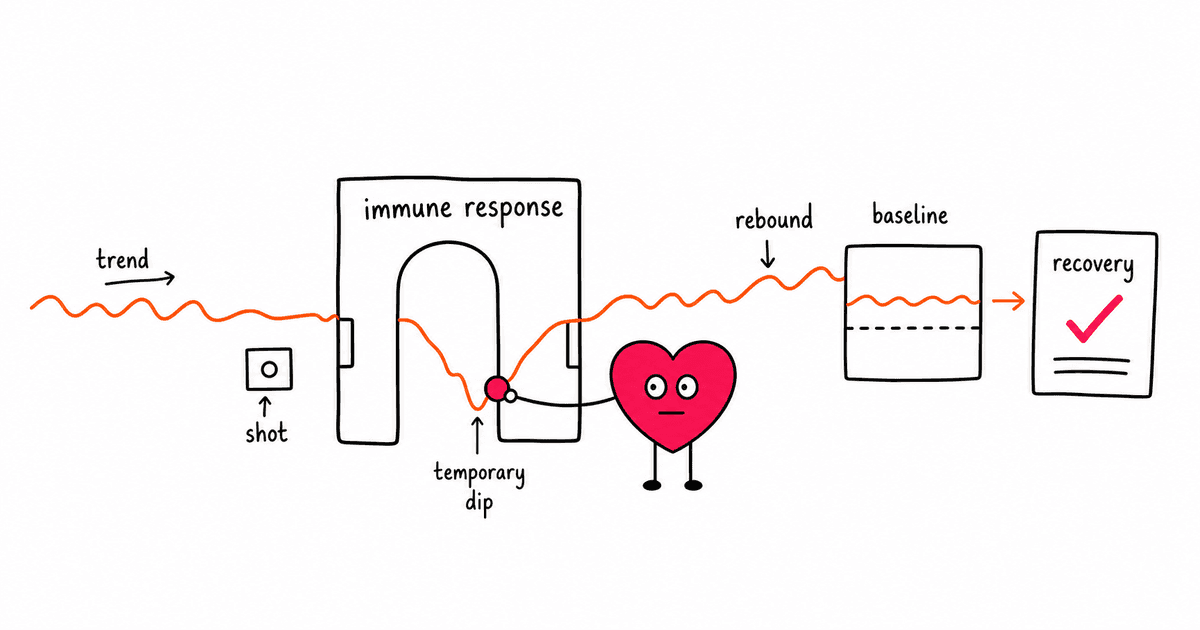
That pattern is real. It is also usually temporary.
HRV can drop after vaccination because your immune system is responding, inflammation rises briefly, sleep may be disrupted, and your autonomic nervous system shifts toward a more stressed state. For most people, this looks like a short dip over the first 24 to 72 hours, sometimes alongside a higher resting heart rate, higher respiratory rate, fatigue, soreness, chills, or fever.
The useful move is not to panic. It is to read the signal correctly.
Can Vaccines Lower HRV?
Yes. Several wearable studies have found short-term changes in heart rate variability after vaccination, especially after COVID-19 vaccines and influenza vaccines.
That does not mean the vaccine damaged your autonomic nervous system. It means your body is doing immune work. Vaccines are designed to train the immune system. That training can create a temporary physiological load, similar to what you might see after poor sleep, a hard workout, travel, or the early stage of an illness.
This is where HRV is helpful but easy to misread. HRV is not a diagnostic test. It is a recovery and autonomic balance signal. A vaccine can create enough short-term immune activation to move that signal.
Why HRV Drops After a Vaccine
Your HRV reflects the balance between parasympathetic activity, especially vagal tone, and sympathetic activation. When your body detects an immune challenge, several things can push HRV down.
1. Immune Activation Raises Physiological Load
Vaccines expose the immune system to an antigen or instructions to recognize one. The immune system responds by activating immune cells and inflammatory signaling pathways. That is the point.
Inflammatory cytokines can affect the nervous system, sleep, energy, temperature regulation, and heart rate. This is one reason HRV often drops when you are fighting an infection, recovering from injury, or dealing with systemic inflammation. If you want the deeper mechanism, the same immune-autonomic pattern shows up in inflammation and HRV and the broader HRV and immune system story.
2. Fever, Chills, and Aches Increase Sympathetic Stress
Common vaccine side effects like fatigue, soreness, headache, chills, and fever are not just sensations. They reflect real physiological work.
The CDC notes that vaccine side effects are usually minor, such as a sore arm or low-grade fever, and typically go away within a few days. During that window, your body may run hotter, sleep lighter, and maintain a higher resting heart rate. HRV often falls when that happens.
3. Sleep Can Be Temporarily Disturbed
Poor sleep is one of the fastest ways to suppress HRV. After vaccination, some people sleep more, some sleep worse, and some see a messy mix of both: lighter sleep the first night, then more catch-up sleep over the next few days.
If your HRV drops after a vaccine, check your sleep before assuming anything dramatic. A rough night can explain much of the change. For context, this overlaps with the broader relationship between HRV and sleep and the acute pattern covered in sleep deprivation and HRV.
4. Your Wearable May Amplify the Story
Wearables estimate HRV under imperfect conditions. A loose strap, unusual sleep position, alcohol, late meals, pain at the injection site, or waking up more often can all change the reading.
That does not make the data useless. It means you should treat one bad night as a clue, not a verdict.
What the Research Shows
The strongest evidence comes from studies that used wearable devices before and after vaccination.
| Study | Population | What changed |
|---|---|---|
| Hajduczok et al., 2021 | 19 internal medicine residents using WHOOP after Pfizer-BioNTech vaccination | HRV decreased on day 1 after dose 1 by an average of 13.44% and after dose 2 by 9.25%. Resting heart rate and respiratory rate did not significantly change in this small cohort. |
| Presby and Capodilupo, 2022 | 69,619 WHOOP users after COVID-19 vaccination | Resting heart rate, respiratory rate, and light sleep rose on the first night and returned to baseline within 4 nights on average. Responses varied by vaccine, dose, age, and sex. |
| Levi et al., 2024 | 2,111 people using Garmin Vivosmart 4 after COVID-19 or influenza vaccination | Wearable data, including heart rate, resting heart rate, and HRV-related measures, helped predict and detect moderate to severe side effects. |
The pattern is consistent: vaccination can produce a measurable but short-lived shift in physiology.
The important nuance is that these studies do not prove your exact HRV dip means a stronger or weaker immune response. HRV may reflect the load your body is experiencing, but it is not a validated measure of antibody response, vaccine effectiveness, or vaccine safety.
How Long Should HRV Stay Low After Vaccination?
For many people, the biggest change appears during the first night or two after the shot. A return toward baseline within a few days is common.
A reasonable interpretation framework:
- 1 to 2 days: A lower HRV can be a normal short-term response, especially with soreness, fatigue, fever, chills, or poor sleep.
- 3 to 4 days: HRV should often be moving back toward your baseline, though this varies by person and vaccine type.
- More than a week: A persistent drop deserves more context. Look for illness, poor sleep, stress, heavy training, alcohol, travel, or another trigger. If the timing is messy, the guides to stress and HRV, alcohol and HRV, and travel and HRV can help separate vaccine effects from common recovery suppressors.
- Severe or unusual symptoms: Do not use HRV to self-diagnose. Contact a clinician if symptoms are concerning, severe, or not improving.
Your personal baseline matters more than any generic number. A drop from 80 to 60 ms means something different than a drop from 32 to 24 ms, even though both are 25% changes.
How to Read Your Wearable After a Vaccine
Use HRV as part of a cluster, not in isolation.
Look at the Full Recovery Picture
After vaccination, review:
- HRV compared with your normal baseline
- Resting heart rate
- Respiratory rate
- Sleep duration and sleep quality
- Skin temperature, if your device tracks it
- Symptoms such as soreness, fatigue, chills, headache, or fever
- Training load in the previous 48 hours
A classic vaccine response might look like lower HRV, slightly higher resting heart rate, lighter sleep, and fatigue the next day. That pattern is more useful than HRV alone.
Do Not Compare Yourself to Someone Else
One person may see a big HRV dip and feel fine. Another may feel wiped out with only a small change in HRV. Age, sex, prior immune exposure, sleep, stress, training status, medication, and device type can all affect the signal.
This is why wearable data is best used longitudinally: you versus your own baseline.
Avoid the Trap of Over-Interpreting a Single Night
A one-night HRV drop after a vaccine is not a crisis. It is a prompt to recover.
The better question is: does the trend normalize as your symptoms improve?
If yes, the data is behaving exactly how you would expect from a temporary immune stressor.
What to Do Before and After a Vaccine If You Track HRV
You do not need a complicated protocol. You just need to make room for recovery.
The Day Before
- Prioritize sleep.
- Avoid stacking hard training, alcohol, and poor sleep together.
- Hydrate normally.
- Note your baseline HRV, resting heart rate, and sleep trend.
If you are training seriously, treat vaccination like a small recovery variable. You would not schedule your hardest workout right before a long-haul flight and expect perfect recovery. A vaccine is similar: usually manageable, but still a physiological input.
The Day Of
- Keep exercise easy unless your clinician has told you otherwise.
- Eat normally and avoid turning the day into a stress test.
- Do not make medication decisions based on HRV. If you have questions about fever reducers, anti-inflammatory medication, or your medical history, ask your clinician.
The Next 24 to 72 Hours
- Use HRV to guide training intensity.
- If HRV is low and symptoms are present, choose rest, mobility, or easy walking.
- If HRV is normal and you feel good, you probably do not need to change much.
- Avoid chasing a recovery score with extreme interventions.
Hard training during a vaccine response is not automatically dangerous for healthy people, but it is often unnecessary. The same recovery logic applies to HRV and overtraining: if your body is already asking for recovery, listen.
HRV After Flu Shot vs COVID Vaccine
Most wearable research has focused on COVID-19 vaccines, but newer data also includes influenza vaccination. The practical interpretation is similar: both can create short-term autonomic and physiological changes because both activate the immune system.
The size of the HRV change can vary. Some people barely notice the flu shot. Others see a meaningful recovery dip. The same is true for COVID-19 vaccination, boosters, shingles vaccination, and other shots.
Do not assume a stronger HRV dip means a better vaccine response. That is tempting, but the evidence is not strong enough. A bigger dip may simply mean more reactogenicity, poorer sleep, more soreness, or a stronger short-term stress response.
When a Low HRV After Vaccination Is Worth Attention
Most post-vaccine HRV dips are not alarming. Still, HRV should never override common sense.
Pay closer attention if you have:
- Chest pain, shortness of breath, fainting, or severe dizziness
- A high or persistent fever
- Symptoms that worsen instead of improving
- Swelling of the face or throat, widespread hives, or signs of an allergic reaction
- A major HRV drop that lasts more than a week without an obvious explanation
- A known heart condition or immune condition and symptoms that concern you
In those cases, do not troubleshoot with your wearable. Contact a medical professional.
The Bottom Line
A lower HRV after a vaccine is usually a short-term recovery signal. Your immune system is doing work, your sleep may be disrupted, inflammation may rise briefly, and your autonomic nervous system may shift toward stress for a day or two.
That does not mean your HRV tracker is wrong. It also does not mean something is necessarily wrong with you.
Use the data the right way: reduce training pressure, prioritize sleep, watch the trend, and let your baseline return. HRV is useful here because it helps you see recovery happening in real time. Just do not confuse a temporary immune response with a diagnosis.
FAQ
Is it normal for HRV to drop after a vaccine?
Yes, it can be normal. Wearable studies have found temporary changes in HRV, resting heart rate, respiratory rate, and sleep after vaccination. The most noticeable changes often happen in the first 24 to 72 hours.
Does a bigger HRV drop mean the vaccine worked better?
Not necessarily. HRV is not a validated measure of vaccine effectiveness or antibody response. A bigger drop may reflect sleep disruption, fever, soreness, stress, or stronger short-term reactogenicity.
Should I skip exercise if my HRV is low after a shot?
If your HRV is low and you feel tired, sore, feverish, or run down, choose rest or easy movement. If you feel normal and your numbers are close to baseline, light to moderate activity is usually reasonable for healthy people. Follow medical advice if you have a condition that changes your exercise guidance.
Can HRV tell me if I am having a vaccine reaction?
HRV can show that your body is under physiological stress, but it cannot diagnose a vaccine reaction. Use symptoms, trend data, and medical guidance. If symptoms are severe, unusual, or persistent, contact a clinician.
How many days after vaccination should I track HRV closely?
The first 3 to 4 days are usually the most useful window. If your HRV, resting heart rate, sleep, and symptoms return to baseline, there is usually no need to keep focusing on the vaccine as the cause.
Need a quick read on your HRV number first?
Enter your HRV value, age range, device, and recovery context for a plain-English interpretation before you decide what to do next.
Interpret Your HRV NumberBuild the 30-day plan