Parkinson's Disease and HRV: What Heart Rate Variability Reveals About Autonomic Changes
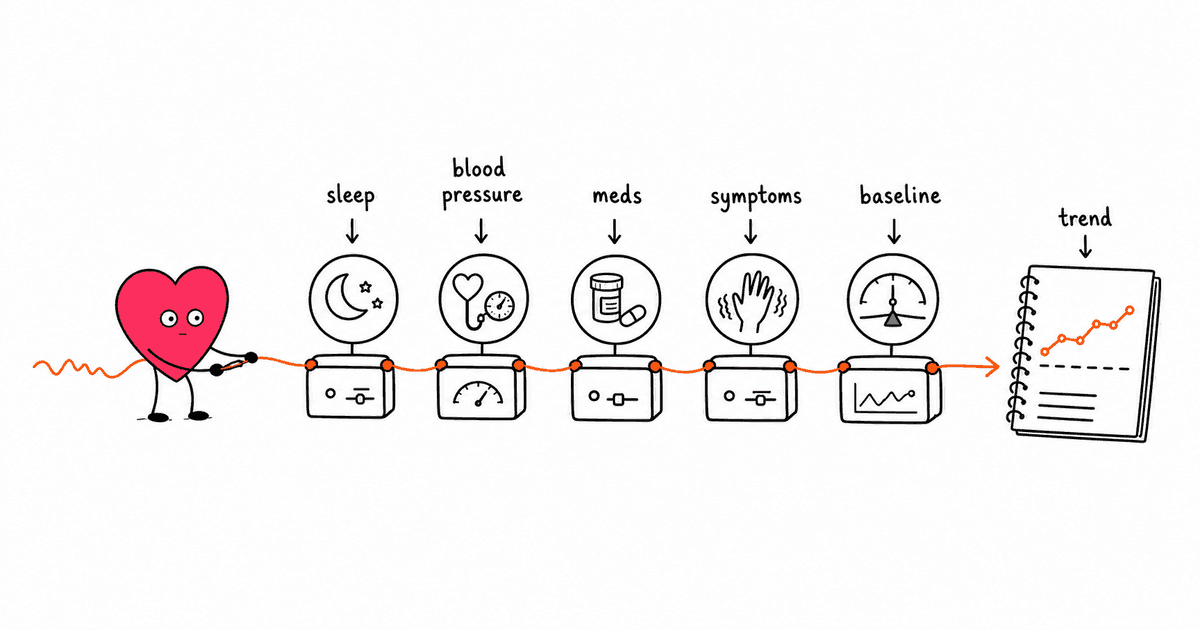
Parkinson's disease is usually described as a movement disorder. Tremor, stiffness, slower movement, and changes in gait get most of the attention. But Parkinson's also affects the autonomic nervous system, the part of the body that regulates heart rate, blood pressure, digestion, temperature control, and sleep-wake rhythm.
That is where heart rate variability becomes interesting.
HRV is not a Parkinson's screening test, and it cannot tell you whether a medication is working. But it can reflect something many people with Parkinson's care about deeply: how flexible, stable, and resilient the nervous system looks from day to day.
Quick Answer: Does Parkinson's Disease Affect HRV?
Yes. Parkinson's disease is often associated with lower HRV, especially lower parasympathetic markers such as RMSSD and high-frequency HRV. This likely reflects autonomic dysfunction, reduced vagal modulation, impaired blood pressure regulation, sleep disruption, medication timing effects, and changes in physical activity.
The important caveat: HRV is a supportive signal, not a diagnostic one. A low HRV does not mean you have Parkinson's, and a normal HRV does not rule it out. For people already diagnosed, HRV may be useful for tracking personal trends, recovery load, orthostatic symptoms, exercise tolerance, and periods when the body appears more stressed than usual.
Why Parkinson's and HRV Are Connected
Parkinson's disease affects dopamine-producing neurons, but the condition is not limited to dopamine or movement. Many people also experience non-motor symptoms, including constipation, sleep problems, blood pressure instability, fatigue, anxiety, urinary symptoms, sweating changes, and dizziness when standing.
Those symptoms point toward autonomic involvement.
Your autonomic nervous system has two major branches:
- Sympathetic activity, which helps mobilize energy, increase heart rate, and respond to stress
- Parasympathetic activity, driven largely by the vagus nerve, which supports recovery, digestion, lower heart rate, and flexible beat-to-beat regulation
HRV reflects how these systems are modulating the heart. Higher HRV generally suggests better adaptive capacity. Lower HRV often suggests the system is less flexible or carrying more physiological load. In Parkinson's, that lower flexibility can come from disease biology, medication timing, reduced movement, poor sleep, orthostatic hypotension, or a mix of all of the above.
For a broader look at autonomic disorders, see our guide to dysautonomia and HRV. For another neurological condition where HRV can reflect autonomic strain without becoming a diagnostic tool, see epilepsy and HRV. For the cognitive and brain-aging side of the same physiology, read dementia and HRV.
What the Research Says
The evidence is not perfect, but the pattern is consistent enough to take seriously.
A 2021 Brain Sciences systematic review and meta-analysis included 47 studies and 2,772 subjects. The authors found that people with Parkinson's disease showed significantly lower short-term RMSSD and lower high-frequency HRV in absolute units compared with healthy controls. Both metrics are commonly used as markers of parasympathetic, vagally mediated cardiac regulation.
Another 2021 meta-analysis in Current Pharmaceutical Design found reduced HRV values in Parkinson's disease and described a pattern of sympathovagal imbalance. The authors also noted important limitations, including heterogeneity between studies and methodological differences.
That second point matters. HRV results can shift depending on:
- Whether the person is measured at rest, during sleep, standing, or after medication
- Whether the study uses ECG or wearable PPG
- Whether breathing rate is controlled
- Which HRV metric is analyzed
- Disease stage, medication status, age, and fitness level
- Whether participants have orthostatic hypotension, sleep disruption, or cardiovascular disease
The clean takeaway is not "Parkinson's equals one specific HRV number." The better takeaway is this: Parkinson's often involves autonomic changes that can show up as lower or less stable HRV.
The Autonomic Changes That Can Lower HRV in Parkinson's
1. Reduced Vagal Modulation
Short-term RMSSD and high-frequency HRV are closely tied to vagal control of heart rhythm. When Parkinson's affects brainstem and autonomic pathways, the heart may receive less flexible parasympathetic input.
In practical terms, that can look like a lower overnight HRV baseline, slower recovery after exertion, or less of the normal nightly rebound that healthy users often see during deep recovery.
If you are still learning the metrics, our guide to understanding HRV numbers breaks down RMSSD, SDNN, LF, HF, and why consumer apps often simplify them.
2. Blood Pressure Regulation Problems
Orthostatic hypotension is one of the clearest cardiovascular autonomic issues in Parkinson's. It means blood pressure drops when you stand, which can cause dizziness, weakness, blurred vision, fatigue, or fainting.
A systematic review and meta-analysis found a pooled orthostatic hypotension prevalence of about 30% in Parkinson's disease, though the authors warned that estimates varied widely between studies. That is a big deal for HRV because standing normally requires a coordinated autonomic response: heart rate, blood vessel tone, and baroreflex activity all need to adjust quickly. For broader context, our guide to HRV and blood pressure explains why vascular regulation and autonomic tone are so tightly linked.
When that reflex is blunted, HRV patterns may become less predictable. Some people may see a sharp drop in HRV when upright. Others may have low baseline variability because the system is already working harder to maintain blood pressure.
3. Sleep Disruption
Parkinson's can disrupt sleep through insomnia, REM sleep behavior disorder, nighttime movement, pain, restless legs, urinary symptoms, and medication timing. Since much of a wearable's HRV signal comes from overnight measurement, poor sleep can make Parkinson's-related HRV changes look worse.
This is one reason HRV should be interpreted alongside sleep timing, awakenings, respiratory rate, and how the person actually feels. A bad HRV night after fragmented sleep is not the same signal as a month-long downward trend with new dizziness or fatigue.
For the sleep side of the equation, see HRV and sleep quality.
4. Medication Timing and On-Off Patterns
Parkinson's medication can affect movement, blood pressure, heart rate, fatigue, and symptom timing. That makes HRV interpretation more complicated.
A small 2011 clinical study in Neurology India found that a single levodopa dose increased several HRV measures in the first hour after dosing, suggesting a short-term improvement in overall heart rate variability and vagal tone in that study group. But this was a small study, and it does not mean everyone should expect the same response.
The practical move is simple: if you are tracking HRV with Parkinson's, log medication timing. Morning HRV, overnight HRV, and spot checks may mean different things depending on whether they happen during an "on" period, an "off" period, or a time when blood pressure symptoms are more likely.
5. Lower Activity and Deconditioning
Reduced movement can lower cardiovascular fitness over time, and lower fitness is associated with lower HRV in many populations. Parkinson's can create a hard loop: symptoms make movement more difficult, reduced activity worsens conditioning, and poorer conditioning can make recovery signals look worse.
That does not mean every low HRV reading should trigger harder exercise. For many people with Parkinson's, the smarter goal is consistent, safe, appropriately scaled movement, ideally guided by a clinician or physical therapist who understands the condition.
What Wearable Users Might Notice
Consumer wearables are not medical autonomic testing tools. Still, they can reveal useful personal patterns when interpreted carefully.
Common patterns may include:
- Lower overnight HRV baseline compared with earlier personal history
- Higher resting heart rate, especially during poor sleep, illness, dehydration, or heavy symptom days
- Slower recovery after activity, visible as a next-day HRV dip or elevated resting heart rate
- Greater day-to-day volatility, especially when sleep, medication timing, or symptoms fluctuate
- HRV drops around illness or inflammation, which can compound Parkinson's symptoms
- Possible artifact from tremor or movement, especially with wrist-based optical sensors
That last point is underrated. Tremor, restlessness, and poor sensor contact can distort optical HRV readings. If a number looks wildly out of character, check whether the device recorded clean sleep, stable heart rate, and enough valid data. For spot checks, an ECG chest strap or validated sensor may be more reliable than a loose wrist wearable. The measurement tradeoff is covered in ECG vs PPG for HRV.
How to Track HRV Safely With Parkinson's
The goal is not to chase a higher score. The goal is to understand patterns.
Use Personal Baselines
Do not compare your HRV to generic charts. Parkinson's, age, medication, fitness, sleep, and cardiovascular health all affect the number. A useful baseline usually requires at least 2 to 4 weeks of consistent tracking under similar conditions.
Better questions include:
- Is my 7-day average rising, falling, or stable?
- Did HRV drop after poor sleep, travel, illness, or a hard activity day?
- Do low HRV days line up with more dizziness, fatigue, freezing, tremor, or brain fog?
- Does my HRV recover after rest, hydration, lighter activity, or better sleep?
- Are changes persistent enough to discuss with my clinician?
Track Symptoms Next to the Number
HRV becomes more useful when paired with context. Consider logging:
- Medication timing and dose changes
- Dizziness or lightheadedness when standing
- Blood pressure readings, if your clinician has recommended them
- Sleep quality and awakenings
- Constipation, pain, illness, or infection symptoms
- Exercise type, duration, and intensity
- Hydration, heat exposure, and skipped meals
- Falls, near-falls, or fainting episodes
This turns HRV from a vague wellness score into a timeline you can actually interpret.
Watch Orthostatic Patterns
If standing causes dizziness, HRV alone is not enough. Blood pressure and heart rate changes matter more. Bring that pattern to a clinician, especially if symptoms are new, worsening, or associated with falls.
Some people use a simple lying-to-standing log at home: rest quietly, record heart rate and blood pressure lying down, then repeat after standing. Only do this if it is safe for you, and stop if you feel faint. HRV can be a supporting data point, but orthostatic symptoms deserve medical attention.
Avoid Overreacting to Single Readings
One low HRV reading can mean poor sleep, dehydration, a heavy meal, heat, emotional stress, illness, device artifact, or a rough symptom night. It is not automatically a Parkinson's progression signal.
A sustained trend is more meaningful than one bad morning. Even then, HRV should be interpreted with symptoms, medication changes, activity, and clinical context.
HRV, Exercise, and Recovery in Parkinson's
Exercise is one of the best-supported lifestyle tools for Parkinson's, but the right dose matters. Aerobic training, strength work, balance training, walking, and physical therapy can support mobility, cardiovascular health, and quality of life. HRV may help show how well the body is tolerating the plan.
A practical approach:
- Use HRV trends to identify recovery load, not to cancel every workout
- Favor consistency over heroic sessions
- Keep easier movement available on low HRV or high symptom days
- Watch for delayed recovery after unusually hard sessions
- Pair HRV with heart rate recovery after exercise
- Discuss exercise changes with a clinician if you have falls, blood pressure drops, heart disease, or advanced symptoms
If HRV drops sharply after a new program and stays low for several days, that does not prove the program is bad. It may mean the dose, intensity, timing, heat exposure, hydration, or sleep support needs adjusting.
When to Talk to a Clinician
HRV is not an emergency detector, but certain patterns deserve professional input.
Talk with a healthcare provider if HRV changes occur alongside:
- New or worsening dizziness when standing
- Fainting, near-fainting, or falls
- Chest pain, shortness of breath, or irregular heartbeat sensations
- A major medication change or new side effects
- Persistent fatigue that is unusual for you
- Rapid resting heart rate changes without a clear reason
- New confusion, severe weakness, or signs of infection
For people with Parkinson's, autonomic symptoms are not just "wellness data." They can affect fall risk, medication tolerance, exercise safety, and daily quality of life.
The Bottom Line
Parkinson's disease can affect HRV because it can disrupt autonomic control of heart rate, blood pressure, sleep, and recovery. Research generally shows lower HRV in Parkinson's groups, especially in vagally mediated metrics like RMSSD and high-frequency HRV, but individual readings vary widely.
The best use of HRV is not diagnosis. It is pattern recognition.
If you have Parkinson's or care for someone who does, HRV can help organize the conversation around recovery, symptoms, sleep, exercise tolerance, medication timing, and orthostatic stress. Treat the number as context, not a verdict.
FAQ
Is low HRV an early sign of Parkinson's disease?
Low HRV can reflect autonomic dysfunction, but it is not specific to Parkinson's. Stress, poor sleep, aging, low fitness, heart disease, medications, alcohol, illness, and many other factors can lower HRV. Parkinson's diagnosis requires clinical evaluation, not wearable data.
Which HRV metric matters most in Parkinson's?
RMSSD is often the most practical metric for consumer tracking because it reflects short-term parasympathetic activity and is widely available in wearable apps. Research also uses high-frequency HRV, SDNN, and frequency-domain measures, but these are more sensitive to measurement conditions.
Can Parkinson's medication change HRV?
Yes, medication timing may affect HRV indirectly through movement, blood pressure, heart rate, sleep, and symptom control. Some small studies suggest levodopa can change HRV measures acutely, but responses vary. Do not change medication based on HRV without medical guidance.
Can HRV help track Parkinson's progression?
Possibly as supporting context, but not as a standalone progression marker. A long-term decline in HRV may reflect autonomic changes, reduced activity, sleep disruption, cardiovascular health, medication effects, or unrelated stressors. It is most useful when paired with symptoms and clinician-guided monitoring.
Are wrist wearables accurate enough for Parkinson's HRV tracking?
They can be useful for trends, especially overnight, but movement, tremor, loose fit, and poor signal quality can create artifacts. If HRV data looks inconsistent or clinically important, confirm patterns with better-controlled measurements or discuss more reliable monitoring options with a clinician.
Need a quick read on your HRV number first?
Enter your HRV value, age range, device, and recovery context for a plain-English interpretation before you decide what to do next.
Interpret Your HRV NumberBuild the 30-day plan